

FC Porto vs PSV Eindhoven at Estadio do Dragao on Tuesday will feature two teams desperate for a win after slow starts to their UEFA Champions League campaigns.
Porto’s 3-2 defeat vs Real Betis on Matchday 2 extended their European losing run, while PSV followed their draw at Shakhtar Donetsk with a 1-0 loss to RB Leipzig. The first meeting between these clubs in 34 years therefore carries more than the usual league-phase weight. Both are still waiting for a Champions League win, and a victory would change the direction of either campaign.
Porto also bring a strong home record against Dutch opposition, whereas PSV’s European record against Portuguese clubs has rarely translated into wins at this level. For Porto, this is the moment to turn urgency into points rather than another respectable performance without a reward.
A win would give their campaign the lift Francesco Farioli has called for; another defeat would leave them chasing the league phase from a difficult position, while a draw would stop the slide without solving it. They arrive with the more assertive intention, and their recent domestic run has offered enough encouragement for them to commit numbers forward.
Their last European outing against Real Betis showed the attacking ambition, but also the cost when the game becomes stretched. The main question is whether the front three can make that initiative count. PSV need a result too, but their circumstances invite more caution. Peter Bosz is under immediate pressure after the domestic defeat by ADO Den Haag, and the attacking group has been reduced by injuries, including the issue that forced Guus Til off before half-time in that match.
A win would settle the campaign and ease the pressure; a draw would at least keep the side moving, while another loss would make their route through the competition considerably harder. PSV’s recent attack has still produced opportunities, but they are coming to Porto with less room for an open contest than their usual possession-based approach might prefer.
Team News: Porto keep their midfield spine; PSV’s attacking slots are less settled
FC Porto are without Joao Costa, who has a meniscus injury, and William Gomes, who is out with an ankle sprain. That removes two options from the squad, but the bigger structural point is that the selected side still has Pablo Rosario sitting in front of the defence and will give the midfield a clear holding reference. Additionally, Chris Smalling, Gabriel Mec, and Dominik Prpic are ineligible to feature on Tuesday, as they are not registered with UEFA.
Diogo Costa should feature between the sticks, with Jan Bednarek and Jakub Kiwior expected to form the central-defensive pairing between Alberto Costa and Francisco Moura. Kiwior’s selection matters because Porto’s shape asks the left-sided centre-back to protect the space behind Gabri Veiga and Pepe.
His recent form has been below the level Porto want, but he remains the natural fit for that side of the back four. Rosario anchors the midfield, with Veiga and Victor Froholdt ahead of him. Veiga has scored once, registered four shots with one on target, and supplied one key pass in his two Champions League appearances.
Pepe should start from the left wing, with Borja Sainz on the other flank and Samu Aghehowa through the middle. This is a side built around a settled 4-3-3, with the midfield and left channel carrying most of the selection argument.
Probable FC Porto Starting Lineup (4-3-3): Diogo Costa; Alberto Costa, Bednarek, Kiwior, Francisco Moura; Froholdt, Rosario, Veiga; Sainz, Samu, Pepe
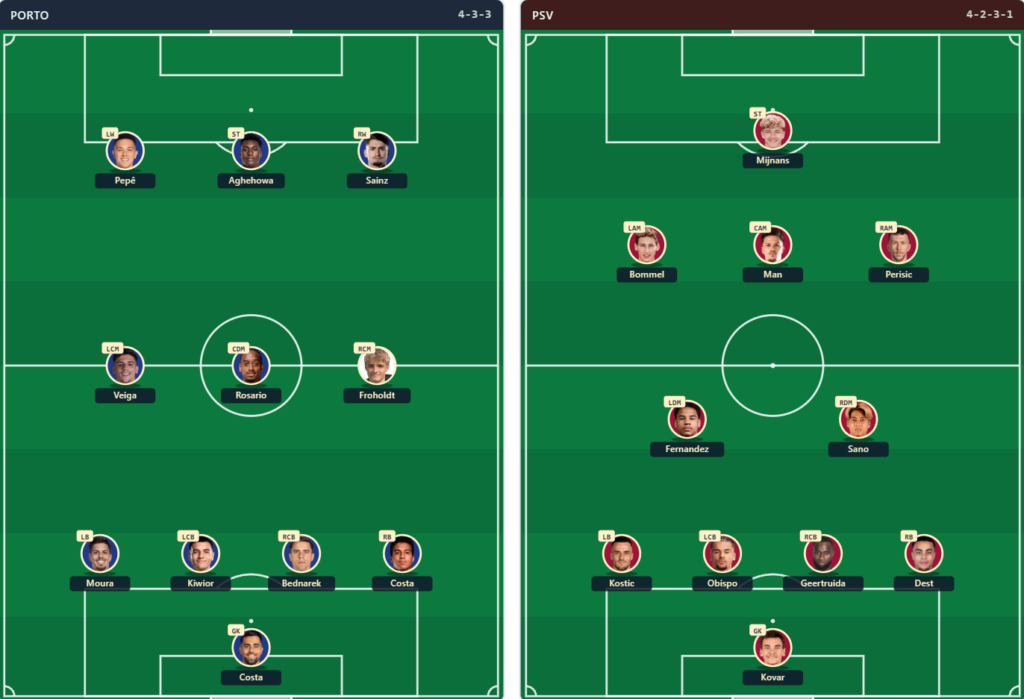


Probable PSV Eindhoven Starting Lineup (4-2-3-1): Kovar; Dest, Geertruida, Obispo, Kostic; Sano, Noah Fernandez; Perisic, Man, van Bommel; Mijnans
PSV Eindhoven have a much longer absent list ahead of the game vs FC Porto. Sam Lammers, Jerdy Schouten, Alassane Plea, Ricardo Pepi, Kiliann Sildillia, Adamo Nagalo, Paul Wanner and Sami Ouaissa are all out, with the reasons ranging from muscle and hamstring problems to surgery, a cruciate ligament tear, a foot injury and unknown injuries.
The key effect is on the attacking midfield options. The usual two-pivot platform remains, but there is less certainty about who can connect it to the striker. Matej Kovar starts behind Sergimo Dest, Lutsharel Geertruida, Armando Obispo and Filip Kostic. Obispo has started twice, supplied an assist and made a key pass, while Geertruida gives the right side of the defence a settled presence.
Kodai Sano should retain the right side of the two-man midfield after starting Champions Legue games so far. Noah Fernandez is likely to join him, though he has yet to make an appearance this season. Dennis Man is the probable choice in the attacking midfield role.
Ruben van Bommel should start from the left flank, while Ivan Perisic is expected on the right wing. Sven Mijnans leads the line, having produced two key passes and scored twice in 91 minutes across his two appearances. That gives PSV a capable frontline, but not one with much spare depth around it.
Tactics: Porto must attack without needing to own the ball
Porto’s 4-3-3 setup is designed to put three attackers on PSV while keeping Pablo Rosario, Gabri Veiga, and Victor Froholdt connected behind them. They are expected to carry the game forward rather than wait for a draw. However, their profile creates a clear tension.
Porto have had 40% of the ball against a league-typical figure of 54.75%, while PSV have had 55.5% against that same norm. Those readings come from two matches, so they describe the current tactical question more than a settled season-long identity. Porto will need to create pressure without relying on long spells of possession; PSV will try to use their two-pivot base to make the centre of the pitch their safer ground.
The attack is also likely to be direct in its intent even if Porto do not control the ball. The recent five-match aggregates give Porto 1.68 xG per match and 1.43 xGA, while PSV sit at 1.85 for and 1.74 against. That points to a game in which both sides can create. However, the home side’s extra midfielder has to do two jobs at once. Support the front three and stop PSV’s possession from becoming sustained pressure around the box.
PSV will take calculated risks rather than open the match from the first minute, keeping the two pivots behind the attacking midfielder so that an attacking move does not leave the defence exposed. The central and wide routes meet in different ways.
Gabri Veiga has to connect Porto’s midfield to Pepe’s left-sided lane, while Kodai Sano protects the right side of PSV’s midfield screen. The Spanish midfielder is the more progressive link in this contest, but Sano’s job is to close the route before Porto can turn that connection into attacks against an unsettled PSV structure. Behind them, the hosts’ three-man midfield offers an extra body, while PSV’s two pivots offer a simpler platform for controlling the next pass.
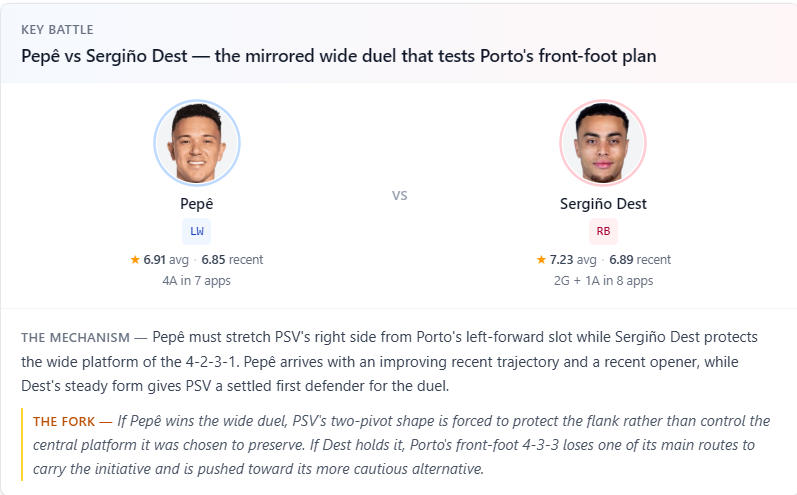
The first duel is Pepe against Sergino Dest. The FC Porto winger should try to pull PSV’s right side away from its central protection, while Dest has to hold the width of the back four without being dragged too far from Geertruida. Pepe arrives after scoring the opener against Benfica and creating chances for teammates; Dest has started twice, scored once and put both of his shots on target, so PSV can expect an active defender rather than a purely passive marker.
If Pepe wins the duel, PSV’s pivots may have to shift wide and surrender some of the central control their formation is meant to provide. If Dest contains him, Porto lose one of their clearest routes to making their attacking posture visible and may have to consider the extra screening midfielder in their alternative shape.
Porto have the clearer route, but not enough for a strong home call
We predict a win for Porto, held with medium confidence rather than conviction. The hosts have the more assertive plan and the more stable attacking structure, while PSV’s depleted attacking group makes it harder for them to turn possession into a consistently dangerous game.
Porto’s season xG difference is 0.644, compared with PSV’s -0.941, which supports the view that Francesco Farioli’s men have been closer to the level their underlying chances suggest. The strongest case against Porto is that PSV can make the match about control rather than duels in the wide areas.
Lean: FC Porto win
Range: 2-1/2-0/1-1
If their two pivots keep Gabri Veiga away from Pepe and allow the visitors to circulate the ball patiently, Porto’s lower-possession route to pressure may not produce enough attacks. PSV’s established 4-2-3-1 also gives them cover behind Sven Mijnans, and their best moments could arrive when Porto’s full-backs are advanced and the first wave of pressure has been bypassed.
That is the scenario in which the home side’s urgency becomes exposure. The most likely range is 2-1 or 2-0 to Porto, with 1-1 the main alternative.
The late shape change Porto can still make
Porto have a clear in-game adjustment if PSV’s two pivots begin to dominate the central corridor: they can move to a 4-2-3-1 and add another screening midfielder. That would reduce the freedom of the established 4-3-3, but it would also protect the defence without requiring the hosts to abandon the match altogether. PSV’s comparable alternative is a move to three centre-backs, yet that would take them further from the shape they have relied on most often. The first hour should therefore reveal whether Porto can keep attacking with three midfielders or need to trade one forward-running connection for extra protection.