
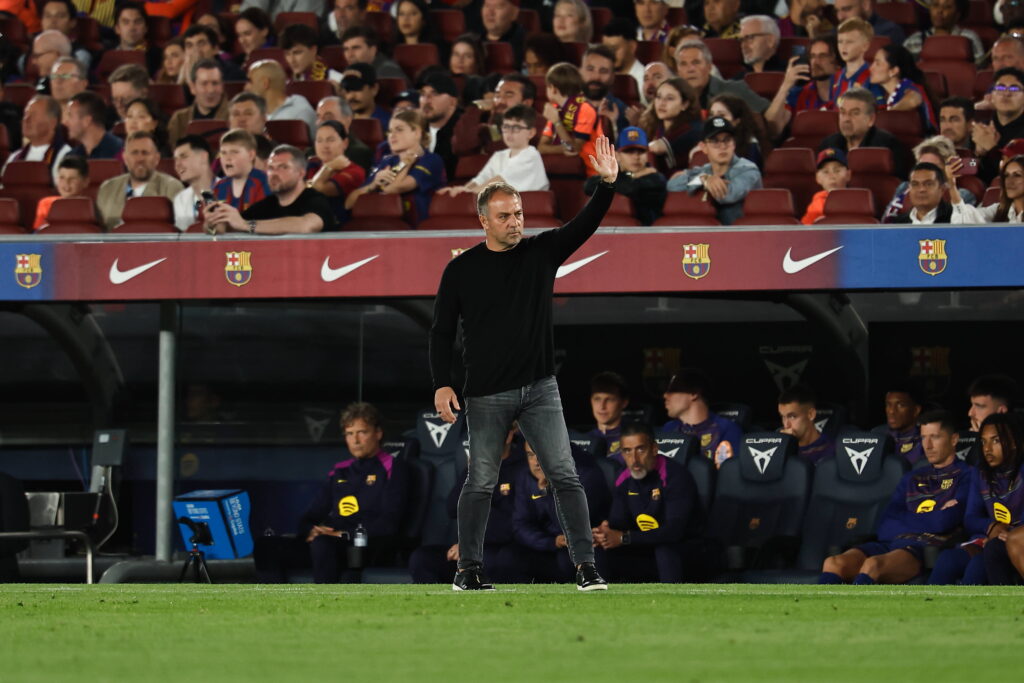
Selling the right players now could fund Barcelona’s bid for UEFA Champions League glory under Hansi Flick.
Hansi Flick has re‑energised Barcelona. Since his arrival, the team’s identity has sharpened, as they are pressing with purpose, producing quicker transitions, and a clearer attacking blueprint. Those changes have not only restored the Catalan giants to the summit of La Liga but have also rekindled belief that the club can again challenge for European glory.
Yet the next phase of Flick’s project will be defined less by slogans and more by hard choices in the transfer market. With Champions League ambitions front and centre and financial restraints still biting, Barcelona must balance short-term strengthening with long-term sustainability. That means pruning the squad intelligently, selling certain players to fund reinforcements that turn domestic dominance into continental success.
Flick’s influence is obvious. The team shows better structure, improved match management and an ability to extract consistency from younger players. Those gains mean Barcelona look close to having the spine required to dominate Spain. But Europe is a different test.
The UEFA Champions League demands not just a starting XI of high calibre but also a deeper, more versatile bench and specialist players who can change big matches. Barcelona have already moved to bolster attacking options with the signing of Anthony Gordon, a statement of intent, but more reinforcements are needed in defence, midfield and in the all-important striker position.
The problem is fiscal. Despite recent investment, Barcelona’s wage bill and outstanding obligations constrain wholesale spending. The sensible route is to generate funds internally by selling assets that, while useful, are either surplus to Flick’s emerging blueprint or can be exchanged for greater value.
Below are three players who, if sold this summer, could provide the club with the resources to bring in world-class upgrades and sharpen the squad for a genuine European push.
Ferran Torres
Ferran Torres remains a talented forward who can play across the front line, but he has not delivered the level of consistency Barcelona need from a primary goal-threat. In Hansi Flick’s system, the most effective forwards combine movement, finishing ruthlessness and the ability to perform under steady pressure.
That profile is still a missing piece for Barcelona in the form of a marquee striker following the departure of Robert Lewandowski. Torres has flashes of brilliance but too often drifts from matches or struggles to convert clear chances. That inconsistency is costly when the margin of error in the Champions League is wafer-thin.
Torres would attract healthy interest on the market and command a substantial fee. Selling him would raise funds that could be reinvested in a proven centre-forward, the kind of specialised finisher who converts half-chances and fixes matches single-handedly. Barcelona would lose a versatile attacker who fits into several tactical permutations.
But the upgrade the Catalan giants must prioritise is a consistent, high-volume goalscorer. If the club can replace Torres with a clinical attacker while keeping other creative pieces intact, the overall attacking output should rise rather than fall. Interestingly, he has no shortage of suitors, with recent reports linking the Spaniard with Manchester United, and other Premier League clubs like Arsenal and Chelsea.
Marc Casado
Barcelona’s midfield is increasingly crowded. Pedri, Gavi, and Frenkie de Jong, if retained, and other creative midfielders already occupy the central spaces. Young players are emerging, and tactical flexibility requires some trimming to avoid stagnation and loan cycles that do no one any good.
Marc Casado, a talented youngster with promise, faces genuine competition for minutes, and development pathways could be blocked if he remains. The Spanish midfielder would attract suitors willing to offer game time and a transfer fee that, while not astronomical, contributes to a broader sales strategy.
For Barcelona, cashing in a promising talent is often painful but prudent. Funds can be pooled for immediate needs, a defensive reinforcement or a specialist midfielder, and the player’s career continues in an environment where he can play regularly. Given the Catalan club’s academy depth, the club can replace Casado’s role internally or through a targeted short-term signing.
The moral case against selling a youth product is strong, yet the reality is that squad balance and immediate quality must sometimes trump idealistic retention. If Barcelona retain the Spaniard but cannot guarantee minutes, his development stalls and his market value may fall. Selling at the right time maximises value for the club and provides the player with a clearer career path.
Raphinha
Raphinha is perhaps the most contentious name on this list. When fit and focused, he offers pace, creativity and directness, traits Hansi Flick values. But he is also one of the club’s higher earners and, crucially, one of its most transferable assets in terms of market value.
For the Blaugrana to make a seismic signing, a top-tier striker, a world-class centre-back, they might need to relinquish a player of Raphinha’s standing. Selling Raphinha would raise significant capital in one operation, simplifying Barcelona’s pursuit of multiple targets. In a constrained market, converting a high-wage, high-value asset into funds for a smaller number of high-impact purchases is efficient.
The Brazilian international could be replaced tactically. Gordon could take his place on the left, while Lamine Yamal continues to do the damage on the right. They can bring in a young, cost-effective option to provide competition to Gordon. Meanwhile, he has several suitors pursuing him, including Manchester United.
Letting Raphinha go would cost Barcelona a creative spark and a proven match-winner. The gamble is that the funds reinvested would produce players who improve the squad’s balance and increase the probability of Champions League success. If Barcelona can recruit a clinical striker and a solid defensive upgrade with the money raised, the collective step forward would justify the sale.
How these sales fit a broader plan
A coherent selling strategy is not simply about trimming salary lists. It must match Hansi Flick’s tactical blueprint, a compact pressing unit, interchangeable offensive pieces and defensive resilience. Barcelona should channel proceeds into a specialist number nine, a proven finisher who guarantees 20+ goals a season in big games. European success often hinges on single moments of clinical finishing, and investing here yields outsized returns.
Barcelona should also seek defensive reinforcement, either a ball-playing centre-back with physicality for European ties or a disciplined defensive midfielder who can shield the backline and recycle possession under pressure. The club must add rotational depth with smart, cheaper additions that maintain quality across all competition fronts. Those players should fit Flick’s pressing demands and can step in without disrupting rhythm.