

Manchester City vs Fulham at the Etihad on Saturday will be a battle of an ailing giant desperate to return to winning ways and a resurgent mid-table club eager to continue a recent unbeaten run.
Manchester City’s defeat at Nottingham Forest, where Jair Cunha and Liam Delap struck within 18 minutes, exposed the defensive imbalance that has followed their recent collapse in the Premier League. Fulham, on the other hand, arrive after draws with Aston Villa and Newcastle United, unbeaten having been across their last four Premier League matches.
So, this is less a meeting between a dominant home side and a passive visitor than a test of whether City can turn control into security. Both teams need the result for different reasons. The hosts are trying to restore their top-four recovery, while Fulham are looking to move away from the relegation band.
For Manchester City, a home win would steady a side that has slipped to third after three consecutive Premier League defeats and keep the top-four target comfortably live. A draw would still leave that objective available, but another defeat would deepen the pressure on Enzo Maresca and make the defensive problems harder to dismiss.
Their latest league result was the loss at Forest, part of a run that has made every attacking commitment carry more risk than it did during the opening sequence of victories. Meanwhile, Fulham can approach the match with more room to manage the outcome. Victory would give their unbeaten run real value against a top-four opponent, while a draw would still represent a useful away point and preserve the progress made under Alvaro Arbeloa.
The Cottagers have steadied after a difficult start, and the response to going behind against Newcastle reinforced that impression. The main uncertainty in their plan is not ambition but how much possession they can turn into forward support if City force them deeper.
Team News: The projected teams and the absences behind them
Manchester City’s available group is shaped by two separate issues. Antoine Semenyo is out with a knee injury, while Marc Guéhi is a doubt with a hip injury, though he could line up at the heart of the defence; Abdukodir Khusanov is also doubtful because of a knock. Guehi’s situation is the one that affects the starting structure most directly, since any late change would alter the centre-back pairing rather than simply reduce the bench.
Manchester City should line up in a 4-2-3-1 formation vs Fulham, with Gianluigi Donnarumma taking his place in goal behind Josko Gvardiol, Guehi and Ruben Dias, with Matheus Nunes at right-back.
Gvardiol brings more attacking involvement from the left, with four assists and eight key passes, and his selection allows City to retain an aggressive full-back outlet without changing the basic shape. Nunes is the more conservative choice on the other side. His job is to preserve cover first, then help City build around the attacking players.
As for the midfield unit, Ayyoub Bouaddi and Elliot Anderson should form the double pivot behind Rayan Cherki, Iliman Ndiaye and Jeremy Doku, with Erling Haaland leading the line for Manchester City vs Fulham. The Norwegian striker remains a prime candidate for FPL captaincy despite two recent blanks.
Cherki is the clearest creative reference, having scored five times and supplied 20 key passes in nine appearances, while Anderson has 11 key passes and three big chances created. Haaland’s role remains simpler and more decisive; he gives the formation a fixed striker, and his nine goals from 10 appearances explain why City are reluctant to reduce the support around him. Doku and Ndiaye should provide the width and connections that stop the attack becoming a series of isolated deliveries.
Probable Manchester City Starting Lineup (4-2-3-1): Donnarumma; Nunes, Dias, Guehi, Gvardiol; Anderson, Bouaddi; Ndiaye, Cherki, Doku, Haaland
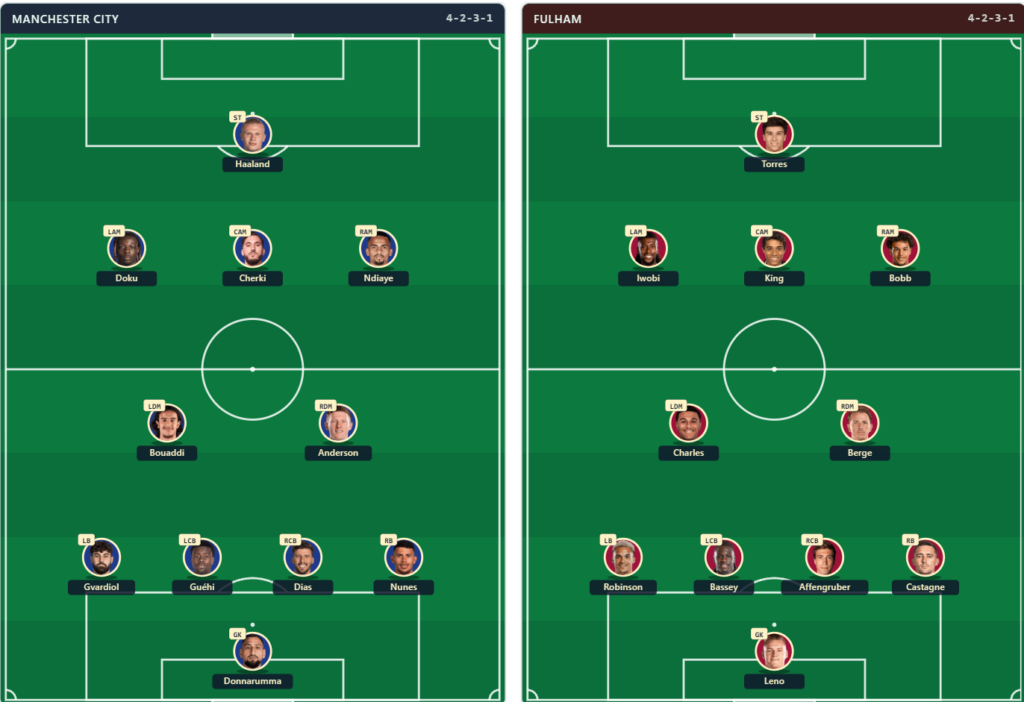

Probable Fulham Starting Lineup (4-2-3-1): Leno; Castagne, Affengruber, Bassey, Robinson; Berge, Charles; Bobb, King, Iwobi; Garcia
Fulham have Tom Cairney unavailable with a knee injury. The absence removes an experienced midfield option, but the expected 4-2-3-1 shape remains intact, with Sander Berge and Shea Charles behind Alex Iwobi, Oscar Bobb and Josh King. Charles is expected to pair up with Berge, though his recent form has been uneven.
Antonee Robinson and Timothy Castagne are likely to reprise the full-back role, while Calvin Bassey and David Affengruber form the more secure centre-back pairing in front of Bernd Leno.
Leno has started every match and has played all 900 available minutes. Bassey has done the same, giving Fulham continuity at the heart of the defence. Berge has eight starts, nine key passes and one assist, so his importance is less about final-third production than the platform he provides for the three advanced players.
On the left, Iwobi is Fulham’s main creator; he has 24 key passes and seven big chances created in 10 appearances. Bobb adds 17 key passes from the opposite side, while King should connect them to Gonzalo Garcia, who will spearhead the Fulham attack vs Manchester City.
Tactics: Two matching shapes, but different risks
Both teams are expected to use a 4-2-3-1 formation, yet they will not ask it to behave in the same way. Manchester City’s version is designed to keep two midfielders behind the attacking trio, give Erling Haaland a fixed reference, and let Elliot Anderson support the centre. They are likely to carry the game forward while keeping enough cover to avoid turning every lost ball into an open-field attack.
Fulham’s version, on the other hand, puts Sander Berge and Shea Charles behind Alex Iwobi, Oscar Bobb, and Josh King, balancing a route toward the City box with the option of protecting a draw. Meanwhile, City’s habits point to a possession-heavy home performance. They average 65.5% of the ball against a league typical figure of 48.5%, while Fulham average 58% against the same mark.
That is a meaningful difference in how much of the match each side usually controls, even though Fulham are not a side that simply surrender the ball. City also take on opponents directly more often, averaging 15 shots against Fulham’s 12.5, with the league typical figure at 12.5.
The visitors’ longer route remains important, however. Fulham average 47.5 long balls against City’s 43, with the league typical figure at 49.75. That gives Alvaro Arbeloa’s team a way to bypass the central pressure and compete for the second ball around King. The tactical tension is clear.
Manchester City must attack first because of the home setting and recent results, but their front-foot approach only works if the double pivot keeps the centre protected. Fulham can seek moments to win while still settling into a draw-protecting structure. Their crossing habits are close to the league norm rather than unusually wide, so their best route may be the combination of longer passes, second balls and Iwobi’s ability to receive between City’s lines.
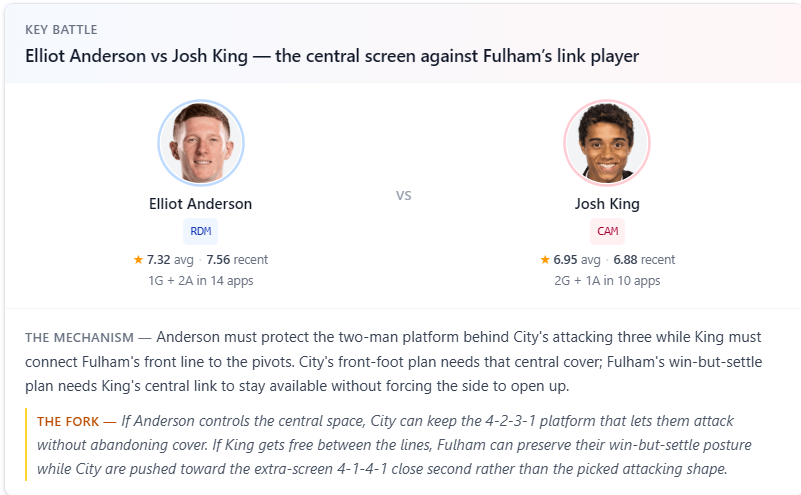

The main contest is Elliot Anderson against Josh King. Anderson has to protect the space behind Manchester City’s attacking unit; King has to make himself available between the Fulham midfielders and the forward line.
Anderson is the midfielder who can preserve City’s two-man platform, while King is the link player who can stop Fulham’s striker from becoming isolated. If the England international controls that central space, the hosts can keep attacking without abandoning their cover. If King gets free, Fulham can retain their shape, connect their attacks and make City’s structure uncomfortable enough to demand an extra midfielder.
That second outcome would put pressure on City’s chosen balance. The hosts could switch toward a 4-1-4-1, adding a central screen but reducing the support around Haaland. The first outcome keeps the attacking structure intact and makes Fulham defend longer phases. This is why the duel matters beyond the individual players.
Anderson’s success allows the hosts to sustain pressure, while King’s success makes Fulham’s restraint an attacking weapon rather than simple retreat. There is a related contest on City’s right against Alex Iwobi.
Matheus Nunes must preserve the cover that lets the home side attack from that side, while Iwobi is Fulham’s most productive creative outlet and has looked sharp this season. If Nunes holds the channel, City can continue using their full-back structure without changing the shape. If Iwobi wins that space, Fulham can build possession on their left and force the home side’s attacking players to consider the defensive cost of pushing forward.
Prediction: City should edge a tense home win
We predict a Manchester City victory, but only with medium confidence. Their attacking process remains the stronger one, and their recent five-match work has produced 1.97 xG per game against 0.80 xGA. Fulham’s corresponding figures are 1.47 for and 0.94 against.
Those figures support City’s greater attacking ceiling, but they do not justify assuming that the hosts will keep a clean sheet after the defensive instability seen in the recent run. City also bring a stronger ability to make opponents’ passing fall away from their own normal standard.
Their disruption figure is 2.10007 per match compared with 0.0613688 for the league typical figure, a sizeable sign that their possession game can become an uncomfortable defensive problem for Fulham. If Elliot Anderson protects the middle and City recover the ball quickly after attacks break down, the home side should create enough pressure for Erling Haaland and Rayan Cherki to decide the contest.
Lean: Manchester City win
Range: 2-1/2-0/1-1
The strongest case against the home win is Fulham’s ability to avoid being forced into an open match. Josh King can connect the midfield to the striker, Iwobi and Bobb can carry the ball into the spaces around Manchester City’s midfield, and the visitors have the option of going longer when the home side’s full-backs move forward.
If that route produces enough second balls, Fulham can keep City from establishing sustained attacks and turn the hosts’ defensive uncertainty into chances of their own. The match therefore settles in the 2-1, 2-0 or 1-1 range rather than pointing cleanly toward a runaway result.
The switch that could change City’s balance
The selection that could still alter the match is Manchester City’s midfield structure. If Josh King repeatedly finds the space behind Elliot Anderson and the attacking unit, Enzo Maresca has the option of moving to a 4-1-4-1, using an extra central screen at the cost of some support for Erling Haaland. That change would make the team safer through the middle, but it would also reduce the attacking platform City need to turn their possession into a home win.