
Ipswich Town vs Nottingham Forest at Portman Road on Friday will be battle between an impressive promoted side and a rebuild project off to a slow start.
Nottingham Forest’s 1-0 defeat to Arsenal at the City Ground last time out ended with Noni Madueke’s deflected effort in the 80th minute, yet the visitors had still created late openings. Chris Wood saw a shot blocked and Murillo fired over, which summed up the Tricky Trees’ problem. The chances are arriving, but the finishing is not.
At Portman Road, that meets an Ipswich side who took Manchester City to 3-2 at the Etihad, with Daizen Maeda equalising and Zian Flemming converting a late penalty. This is a meaningful meeting between the home side’s upward push and Forest’s need to stop a slide, but neither side is forced into a win-or-bust approach.
For Ipswich, victory would strengthen their pursuit of the European places, while defeat would underline how narrow the margin remains after the loss to Manchester City. Their last four matches have produced seven goals for and seven against, a run that fits the broader picture of a side showing more steel without yet becoming consistently secure.
The Tractor Boys arrive with confidence from taking City deep into the contest and with a recent habit of finding late goals; eight have arrived in the 88th minute or later this season. The cost of chasing too hard is clear, though. Forest’s direct game can expose the space behind Ipswich’s attacking midfielders if their control slips.
Oliver Glasner’s men need points to arrest a run of three straight league defeats and to move away from 19th, where they have five points from seven matches. Another loss would deepen the pressure around the Austrian’s project, even if the club’s longer-term targets remain mathematically reachable; a draw would at least stop the immediate bleeding.
Their latest defeat at home to Arsenal followed the same frustrating pattern of creating enough to threaten without getting the reward, and their four-match return is three goals scored against six conceded. The absence of Igor Jesus with a calf injury and Nicolo Savona with a knee injury reduces the depth available around the established structure, but Forest’s main requirement is sharper execution rather than a wholesale change of plan.
Team News: The expected teams and the missing options
Gary O’Neil has a full strength squad, with Sasa Lukic likely to be available after recovering from a groin complaint. Ipswich Town will line up in a 4-2-3-1 formation vs Nottingham Forest, with Christian Walton featuring between the sticks. The backline will feture Leif Davis, Dara O’Shea, Issa Diop, and Abdoul Ouattara, with O’Shea being the natural organiser in the centre.
Diop has also started every match in the current window and carries the squad’s best defensive rating among those regulars at 6.91. So, that pairing gives Gary O’Neil a settled reference even though Davis has not been at his best recently. However, Ouattara has been impressive lately and has found his way on to our FPL differential tips.
As for the midfield unit Sasa Lukic should line up alongside Exequiel Palacios in the double pivot. Daizen Maeda and Jack Clarke will be on either side of Julio Enciso ahead of the central midfield duo. Enciso is the player around whom Ipswich’s central attacking work is likely to run. Finally, Emersonn should lead the line, with Zian Flemming a backup option on the bench.
Probable Ipswich Town Starting Lineup (4-2-3-1): Walton; Ouattara, Diop, O’Shea, Davis; Lukic, Palacios; Maeda, Enciso, Clarke; Emersonn
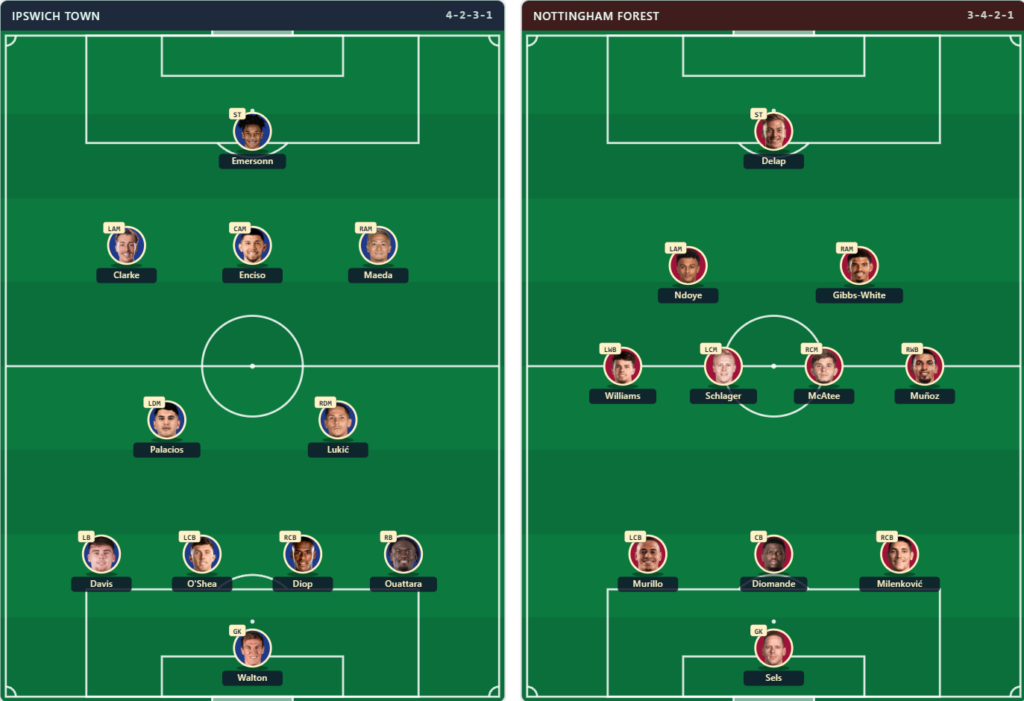

Probable Nottingham Forest Starting Lineup (3-4-2-1): Sels; Milenkovic, Diomande, Murillo; Munoz, McAtee, Schlager, Williams; Gibbs-White, Ndoye; Delap
Nottingham Forest will be without Igor Jesus and Nicolo Savona. That leaves Oliver Glasner with less cover in the squad, but the predicted side still preserves the 3-4-2-1 shape that has been used throughout the recent run.
Matz Sels starts behind Nikola Milenkovic, Murillo, and Ousmane Diomande. Neco Williams and Daniel Munoz provide the wing-back width, with Xaver Schlager and James McAtee pairing up in the middle of the park.
Morgan Gibbs-White should operate from the right attacking pocket after producing two assists and 17 key passes in six starts, having recovered from a knock and training all week. Dan Ndoye is expected to join him behind Liam Delap, whose six appearances include five starts, one goal and 2.22 expected goals. That front three gives Forest a physical central outlet with runners arriving around him.
Tactics: Why Forest’s long game meets Ipswich’s cover
Ipswich Town’s 4-2-3-1 setup is designed to keep Julio Enciso between the lines while the double pivot protects the centre and Dara O’Shea organises the back four. It is not a radical departure. The formation has been used in three of their last four matches. The Tractor Boys tend to play with less of the ball than the league norm, holding 45% against a typical 49.5%, and they shoot 11 times per match compared with the league’s average of 13.
That points to a side that must make its attacks count rather than relying on sustained volume. On the other hand, Nottingham Forest’s 3-4-2-1 system keeps Murillo on the left of a back three while placing Morgan Gibbs-White and James McAtee in the pockets behind Liam Delap. Their long-ball figure is 57 per match against the league’s norm of 49.5, compared with Ipswich Town’s 48.
So, the visitors are more willing to bypass midfield and ask their front line to compete for the first ball. Forest also create more from dead-ball situations. Their figure is 0.353 xG per match against the league-typical figure of 0.229, while Ipswich sit at 0.124 against the same benchmark. That gives the away side two routes to threaten without having to dominate possession.
Both teams are likely to pursue the win while keeping a draw acceptable. Ipswich can carry the game forward without throwing away their cover, and Forest can attack in their usual structure without turning the match into an uncontrolled exchange.
The central question is whether the home side’s midfield can deal with Forest’s first ball and second phase. Their recent aggregate is 1.42 xG and 1.77 xGA, while the visitors’ figures are 1.79 xG and 1.20 xGA, a difference that gives Oliver Glasner’s men the stronger underlying platform despite their poor results.
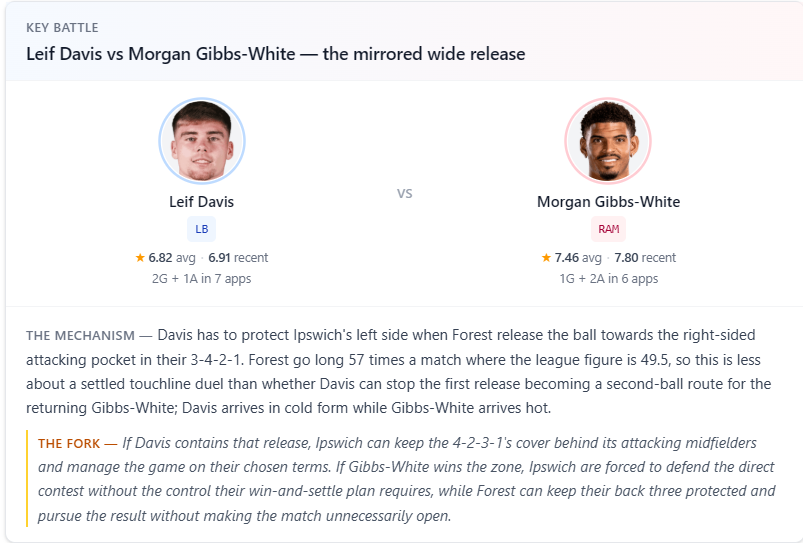

The main duel is on Ipswich’s left, where Leif Davis must deal with Morgan Gibbs-White arriving from Nottingham Forest’s right attacking pocket. The Ipswich left-back has the defensive responsibility of stopping the first release from becoming a second-ball attack, while Gibbs-White is the more confident current presence and has the freedom to connect the loose ball to Delap or move inside.
If Davis contains that route, Ipswich can keep their 4-2-3-1 compact and manage the contest on their preferred terms. If Gibbs-White wins it, the home side’s double pivot is pulled toward the wide release and the visitors can keep their three centre-backs protected behind the attack.
The central battle adds another layer. Emersonn has to remain connected to Julio Enciso rather than allowing Forest’s back three to isolate the striker, while Ousmane Diomande’s job is to prevent Emersonn from becoming a reliable platform for Ipswich’s attacking midfielder.
If Emersonn holds the reference point, the hosts can sustain attacks without changing shape. If Diomande controls that contest, Forest preserve their defensive base and Ipswich may need the extra centre-back option they have kept available for a more direct game.
Prediction: A low-confidence draw call
We predict a draw, but only with low confidence. Ipswich Town have home momentum and a more encouraging results-conversion profile, yet Nottingham Forest’s direct release is a genuine way to unsettle them. The visitors’ season xGD is -5.986, while Ipswich Town’s is 1.937.
So, Forest have the clearest case for improvement if their finishing catches up with the chances they have been creating. That makes the draw safer than a strong home or away position, not a settled conclusion.
Lean: Draw
Range: 1-1/0-0/2-2
The strongest case against the draw is a Nottingham Forest performance that wins the first ball, turns Morgan Gibbs-White towards goal and forces Ipswich to retreat instead of building through Enciso.
That would leave Gary O’Neil’s men defending more than they want and allow Forest to use their set-piece threat as well as their open-play deliveries. Ipswich can answer through dead balls and late pressure, but their lower shot volume means they may struggle to recover if they fall behind. The most defensible scoreline band is 1-1, with 0-0 and 2-2 also plausible.
The switch Ipswich can still make
Ipswich Town have a clear in-game adjustment if Nottingham Forest’s direct release begins to overwhelm the double pivot. They can move to a 3-4-2-1 setup and add a centre-back without abandoning their attacking pockets entirely.
That change would give them another defender behind the first contest and reduce the space Forest can attack after the initial ball. The away side’s current structure is already their settled answer, so the hosts possess the more obvious lever if the match refuses to stay controlled.