

Tottenham Hotspur vs Aston Villa will feature two high-profile English clubs desperate to get their first Premier League win of the 2026/27 season when they clash in North London on Saturday afternoon.
Two winless sides arrive with different kinds of pressure when Tottenham Hotspur host Aston Villa on Saturday. Spurs’ 3-1 defeat to Liverpool in the Carabao Cup third round at Anfield on Tuesday sharpened the question around this meeting. Can their control finally produce a Premier League goal?
Tottenham created more chances and had 17 shots to Liverpool’s 12, but the result extended a frustrating start. Aston Villa responded to their own difficult Premier League run with a 3-1 EFL Cup victory over Coventry City the following night, giving Unai Emery’s side a more positive immediate backdrop. This is an important fixture for both clubs, but neither result is decisive this early in the season.
For Tottenham, a win would ease the pressure around a new project and move them onto five points, while a draw would bring only a modest step forward. Another defeat would deepen the concern that possession is not becoming clear chances, particularly amid mounting criticism of Roberto De Zerbi and his style.
They carry cautious optimism after the Anfield loss, particularly because the side created enough to suggest the attack is not entirely disconnected. Their immediate problem is turning that promise into a result, and the selection of a central creator and striker will influence how much responsibility falls on the players around them.
Aston Villa need points too, but their situation allows them to protect the game more carefully. They have only one Premier League point and remain near the bottom of the table, yet a draw would still represent movement rather than collapse, while a win would lift them to four points.
The victory in the Carabao Cup has restored some confidence, and the established structure under Unai Emery offers a steadier platform than Tottenham’s rebuild. The Villans arrive with a greater reason to value control than to chase an open contest, especially after a Premier League start in which their attacking output has been inconsistent.
Team News: The predicted elevens reflect two familiar 4-2-3-1s
Tottenham should keep the 4-2-3-1 setup that has been used throughout their recent run. Antonin Kinsky starts in goal, with Jan Paul van Hecke and Micky van de Ven expected to form the central defensive pairing. Andrew Robertson and Archie Gray should complete a settled-looking back four, with Robertson offering the more convincing recent attacking contribution from that group after creating two big chances.
The double pivot is where the predicted side carries more uncertainty. Rodrigo Bentancur starts on the right of it, while Lucas Bergvall is expected to take the other position. Bentancur has played 287 minutes across four appearances, but his selection is about preserving the shape as much as adding forward production.
Mateus Fernandes should operate ahead of them; he has five key passes and has created two big chances in only two starts, making his current attacking form the strongest reason for the call. If Bergvall does not get the nod in the double pivot, Fernandes may drop deep to bring James Maddison into the team to reprise the no. 10 role.
Omar Marmoush is expected to essay the left attacking role and Savio should continue on the right, with both providing width around the central creator. Marmoush has started three times and recorded four key passes, while Savio has two starts and five key passes.
Dominic Solanke should spearhead the Tottenham attack, though his selection is less established than the structure behind him. He has made only one start and played 106 minutes. That makes his ability to occupy the centre and convert the possession around him particularly important.
Probable Tottenham Hotspur Lineup (4-2-3-1): Kinsky; Gray, van Hecke, van de Ven, Robertson; Bentancur, Bergvall; Savio, Fernandes, Marmoush; Solanke
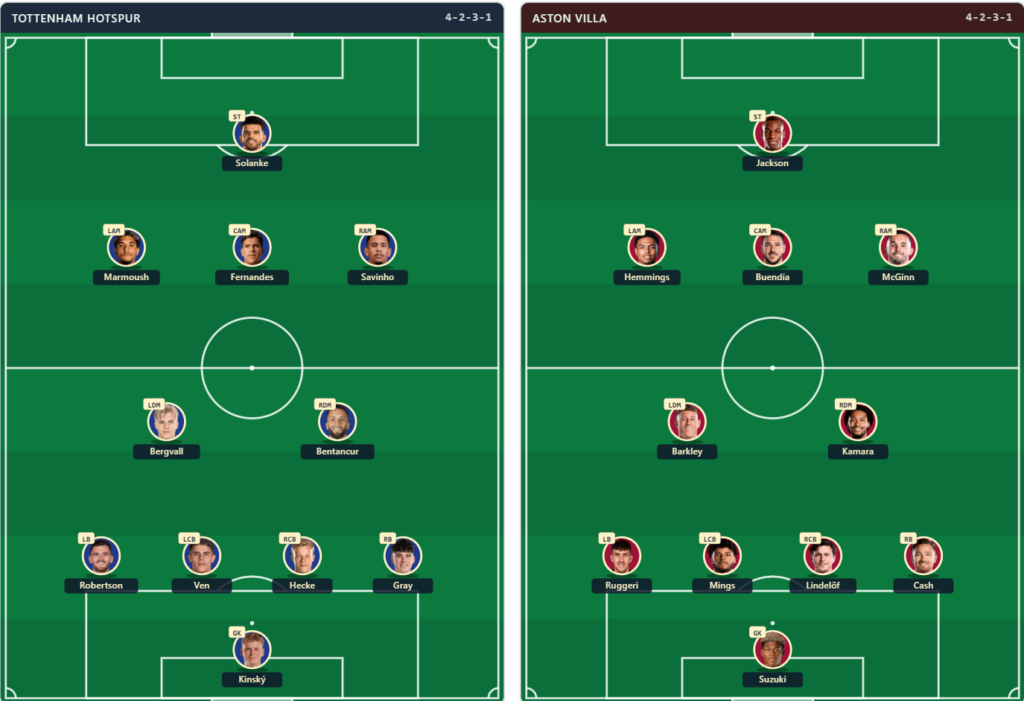

Probable Aston Villa Lineup (4-2-3-1): Suzuki; Cash, Lindelof, Mings, Ruggeri; Kamara, Barkley; McGinn, Buendia, Hemmings; Abraham
Aston Villa’s 4-2-3-1 system should be equally recognisable. Zion Suzuki starts behind a back four of Matteo Ruggeri, Tyrone Mings, Victor Lindelof, and Matty Cash. Ruggeri fills the left-back position after limited involvement so far, filling in for the injured Ian Maatsen (ankle). Meanwhile, Mings brings experience in the absence of Pau Torres (hamstring).
Cash is the more secure selection on that line, having started three times and produced two key passes. The absences of Leon Goretzka, Amadou Onana, Taylor Harwood-Bellis, and Brian Madjo apart from the aforementioned duo reduce Unai Emery’s options.
As for the midfield unit, Ross Barkley and Boubacar Kamara should form the double pivot. The former has started all four of his appearances and supplied six key passes, the highest total in Villa’s squad, while Kamara has played every available minute across four starts.
Emiliano Buendia remains the central creator despite a difficult attacking return, and John McGinn should take the right-sided attacking slot after four starts and one assist. Alternatively, the skipper could occupy a central position, with Ibrahim Mbaye starting on the right. George Hemmings is likely to continue on the left wing, with Nicolas Jackson leading the line despite Tammy Abraham’s brace in the EFL Cup tie earlier this week.
Tactics: Tottenham want the ball, but the central screen decides whether it matters
Tottenham’s 4-2-3-1 setup is designed to put three advanced players around the striker while keeping two midfielders behind the attacking line. At home, they should carry the game forward without abandoning the cover that makes their possession sustainable.
Meanwhile, Aston Villa’s version has the same basic structure but a different purpose. The double pivot gives them a platform from which to pursue the win without making a draw unnecessarily fragile. That contrast means Spurs should have more initiative, while the away side will be more comfortable allowing the match to remain controlled. The measured profiles underline that difference.
Tottenham have averaged 59% possession per match against a league-typical 46.0% figure, while Aston Villa have averaged 46% ball-retention. Spurs are therefore the side likelier to establish territorial control, but that control has to become pressure rather than circulation. The visitors have shown they can accept very different possession conditions, so their priority will be keeping the double pivot connected to the centre-backs when Tottenham settle in.
Both teams also tend to stay shorter than the Premier League’s usual long-ball level, though Villa are the more direct of the two. Tottenham have played 34 long balls per match and Villa 41, against a league typical 50.5. Neither side is built around constantly bypassing midfield.
That makes Rodrigo Bentancur, Boubacar Kamara, and the two attacking midfielders central to the game’s shape, because Tottenham will want to advance through possession while Villa will look for moments to release Jackson without abandoning their platform. The contest is likely to become more physical than the possession split suggests.
Tottenham have averaged 103.5 combined ground and aerial contests per match, compared with Villa’s 92.5 and a league-typical 94.0. Spurs’ greater involvement in those battles fits their attempt to keep Villa pinned, but it also creates opportunities for Emery’s side if Kamara and Barkley can win the first challenge and move the game away from Tottenham’s preferred territory.
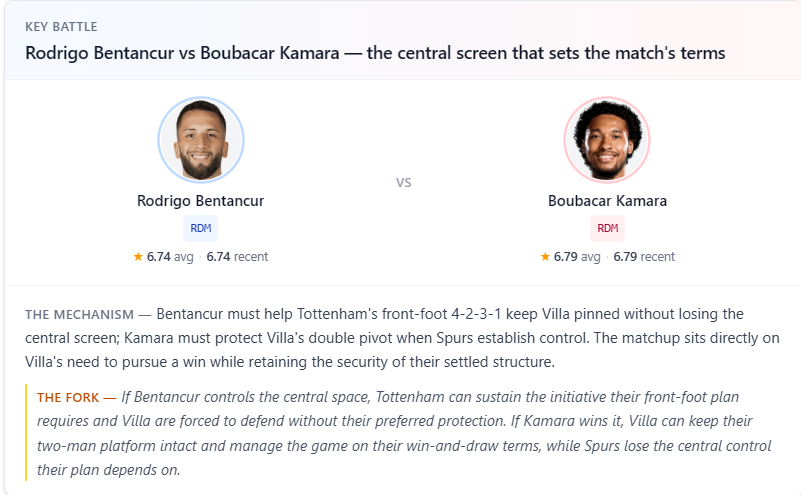

The leading duel is Bentancur against Kamara. The former has to help Spurs sustain attacks while remaining the screen in front of their defence; Kamara has to protect Aston Villa’s two-man platform when Tottenham establish control. If Bentancur controls the central space, Tottenham can maintain the initiative and force Villa to defend without the protection their shape is meant to provide.
If Kamara wins that exchange, the away side can keep the game within manageable limits and make Tottenham solve their finishing problem against a settled block. The consequence runs beyond the two midfielders. The player who loses the duel leaves his own back four exposed to the pressure that follows.
Omar Marmoush against Matty Cash is the secondary route into the same question. The former gives Tottenham a left-sided outlet and can stretch the compactness Villa want to preserve, while Cash’s task is to contain that threat without opening a route around Kamara. If Marmoush gets free, Tottenham can attack wide and still keep their central structure involved. If the Villa right-back holds him, the visitors can remain compact and force Roberto De Zerbi’s men to create through the congested middle.
Prediction: The draw is the safest call in a game short on finishing certainty
We are leaning towards a draw, albeit only with low confidence. Tottenham are more likely to control the ball and take the initiative, yet Aston Villa’s structure is suited to slowing that pressure without needing to attack recklessly. The central battle should therefore matter more than the overall possession picture. Spurs may have enough of the ball to look dominant without finding the decisive pass or finish.
The strongest case against the draw is a Tottenham home win created by sustained pressure. Villa have conceded 1.83 expected goals per match in their recent aggregate, and if the visitors fail to keep their double pivot close to the back four, Mateus Fernandes and the wide attackers could repeatedly expose the spaces around the centre.
Lean: Draw
Range: 0-0/1-1/1-0
Tottenham’s average of 0.94 expected goals per match so far in the top flight this season and their failure to score in the Premier League make that outcome difficult to trust. However, one clear breakthrough could force Villa out of their preferred game state.
The broader attacking record points to two sides that have created more expectation than they have converted. Tottenham’s season expected-goals difference is -3.763, while Villa’s is -2.137. That does not identify a reliable winner; it points to a match in which both teams may produce promising phases without consistently finishing them. The scoreline range is 0-0, 1-1 or 1-0, with the first two outcomes the more natural fit for the tactical picture.
The centre-forward call could still change the balance
The late decision for the centre-forward remains capable of changing the game’s texture. Tottenham’s shape is built to carry the ball into the final third, but it needs a striker who can turn that territory into a target for crosses, cut-backs and passes through the middle.
If the chosen forward cannot hold the line, Villa’s double pivot can stay focused on the creators behind him; if he does, Spurs may force the visitors to defend deeper than Emery intended. That selection call is the clearest remaining variable in a contest otherwise likely to stay within narrow margins.