
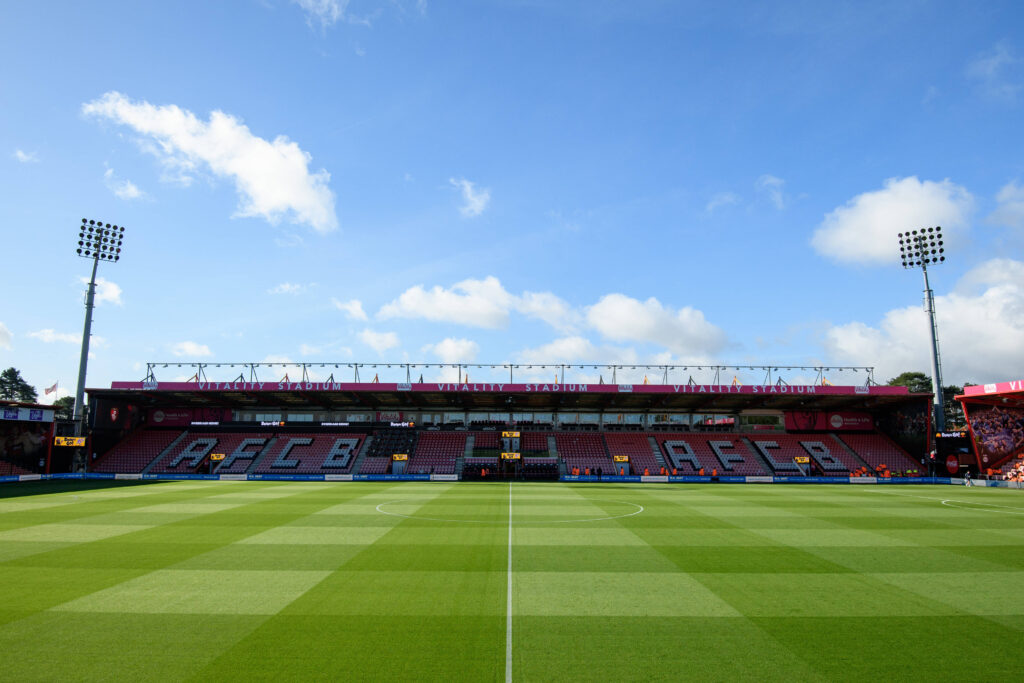
Bournemouth vs Nottingham Forest at the Vitality Stadium on Saturday will be a battle between one of the world’s most in-form teams and a resurgent side aiming to build on a big win before the international break.
Nottingham Forest’s dramatic 3-1 win over Manchester City at the City Ground changed the mood around this fixture going into the international, though it did not remove the pressure. Bournemouth arrive after Evanilson scored in a 2-1 victory over Ipswich Town.
Forest must now show that their upset against City was the start of a recovery rather than one outstanding evening. The match is worth more than three points in isolation. Bournemouth are protecting a European push, while the visitors need to turn renewed belief into distance from the lower-table danger.
For Bournemouth, victory would keep their European target moving and extend a run that has already transformed the season. A defeat would not destroy that objective, but it would interrupt the momentum that has made them one of the Premier League’s most convincing recent sides.
Their last league outing against Ipswich showed both sides of the team. Evanilson supplied the decisive attacking moment, while the result preserved the defensive togetherness Marco Rose has credited for the turnaround. The main issue before the teams are confirmed is Ryan Christie’s ankle problem, because his absence affects how much protection Bournemouth can put behind their attacking midfield.
On the other hand, Nottingham Forest need the win for a more immediate reason. Three points would make the result against Manchester City meaningful and keep their lower-table recovery alive; a defeat would leave them exposed again after a long sequence of poor league results.
Liam Delap scored twice and Jair Cunha added another in that win, giving Oliver Glasner evidence that his side can punish a stronger opponent when its running and defensive intensity are right. The concern is whether that performance can travel. Xaver Schlager’s injury and several availability doubts around the travelling group could make Forest’s structure less settled than it was in their best recent display.
Team News: Absences leave both midfields under scrutiny
Bournemouth are expected to use a 4-2-3-1 formation vs Nottingham Forest, the shape that has become their regular route to control. Ryan Christie is doubtful with an ankle injury, while Alex Toth is out with a hamstring injury and is not expected back until February. That removes two midfield options.
So, Lewis Cook should start the double pivot alongside Tyler Adams. The pairing gives Bournemouth a functional base, but it places more responsibility on them to protect Justin Kluivert and the wide attackers when the side moves forward.
Djordje Petrovic is an automatic pick between the sticks behind a settled defensive line of Adam Smith, James Hill, Antonio Silva, and Adrien Truffert. Truffert’s current level is an important part of the selection because he gives the left side a dependable outlet without changing the back four.
Rayan is expected to continue on the right, Marcus Tavernier should start on the left, while Kluivert will play centrally behind Evanilson. Tavernier has five goals and 17 key passes, while Evanilson brings five goals, four assists and 11 key passes from his central role. That form has earned him a place in our FPL Captaincy Pick Tips for Gameweek 11.
Probable Bournemouth Starting Lineup (4-2-3-1): Petrovic; Smith, Hill, Silva, Truffert; Adams, Cook; Rayan, Kluivert, Tavernier; Evanilson
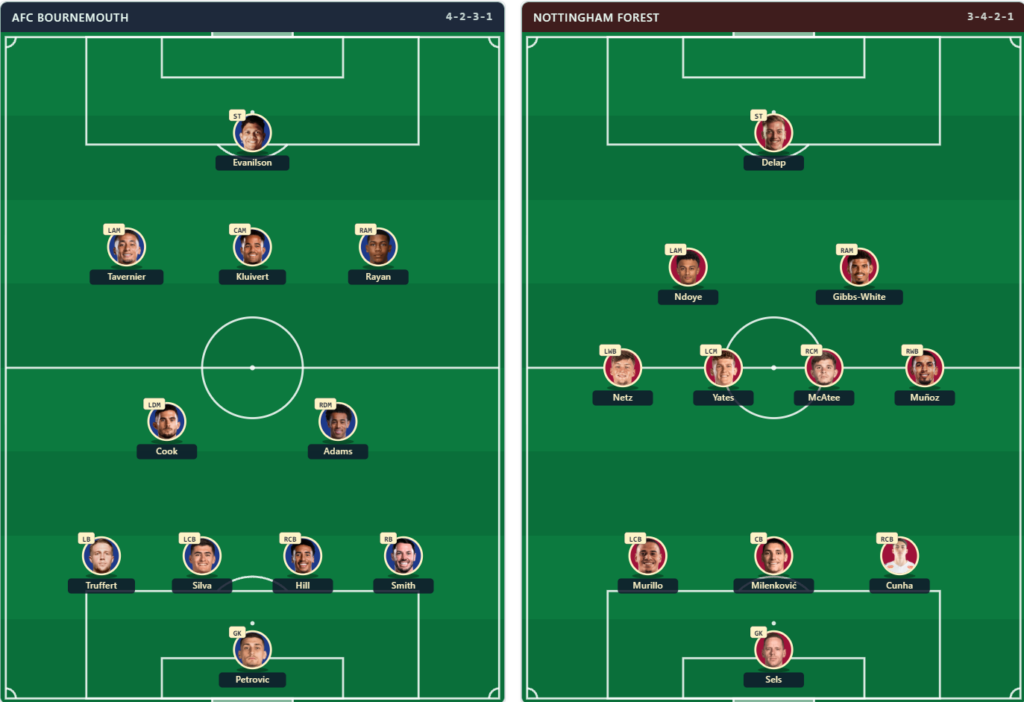

Probable Nottingham Forest Starting Lineup (3-4-2-1): Sels; Cunha, Milenkovic, Murillo; Munoz, McAtee, Yates, Netz; Gibbs-White, Ndoye; Delap
Nottingham Forest are likely to retain their usual 3-4-2-1 setup. Xaver Schlager is doubtful after feeling his hamstring on international duty, while Nicolas Dominguez (thigh) and Callum Hudson-Odoi (groin) are out. Neco Williams, Ibrahim Sangare, and Ousmane Diomande also carry doubts connected to the international period and their travel.
Daniel Munoz is expected to occupy the right wing-back position, although his arrival situation has created uncertainty, and Dan Ndoye is a further doubt after illness and injury concerns despite completing a full week of training. Those questions matter because Forest’s shape depends on the wing-backs and central midfield staying connected.
Matz Sels should play behind a back three of Nikola Milenkovic, Murillo, and Jair Cunha. Murillo has started every match and has contributed one assist and nine key passes, while Cunha has started eight times and scored once. Ryan Yates is expected to join James McAtee in central midfield if Schlager misses out, with Luca Netz on the left.
Morgan Gibbs-White should operate behind Delap with Dan Ndoye, if available, completing the attacking pair. Gibbs-White has 24 key passes and three assists, the clearest creative output in this Forest side, while Delap has three goals and eight key passes. That frontline will need to make the most of limited possession.
Tactics: Evanilson’s movement against Forest’s spare defender
Bournemouth’s 4-2-3-1 setup is designed to keep two midfielders behind Justin Kluivert while Evanilson remains the central reference point. The Cherries can carry the game forward at home without committing every player beyond the ball, which suits a match where Nottingham Forest’s counter-threat demands some protection.
The away side’s 3-4-2-1 system offers three central defenders behind Morgan Gibbs-White, James McAtee, and Liam Delap, allowing them to pursue the win while still taking a draw if the game does not open up. The two profiles point to a direct contest rather than a slow battle for territorial possession.
Bournemouth have 45% average possession against a league typical 48.5%, while Forest have 49% against the same reference. Marco Rose’s men therefore do not need to dominate the ball to make their plan work, and Forest are unlikely to be satisfied simply by defending deep. Both sides also use the long pass heavily.
The Cherries play 62 long balls per match and Forest 60, compared with a league typical 49.75. That should produce repeated contests around the two centre-forwards and the second ball behind them. The main tactical question is whether Bournemouth’s double pivot can control the loose phase after those direct passes.
Nottingham Forest’s route over midfield can bypass Lewis Cook and Tyler Adams, releasing Gibbs-White into the spaces around Kluivert or allowing Liam Delap to contest the next pass against the centre-backs. Bournemouth’s recent defensive improvement gives them a platform to press for territory, but that pressure only works if the second ball stays near their midfield rather than becoming an immediate Forest attack.
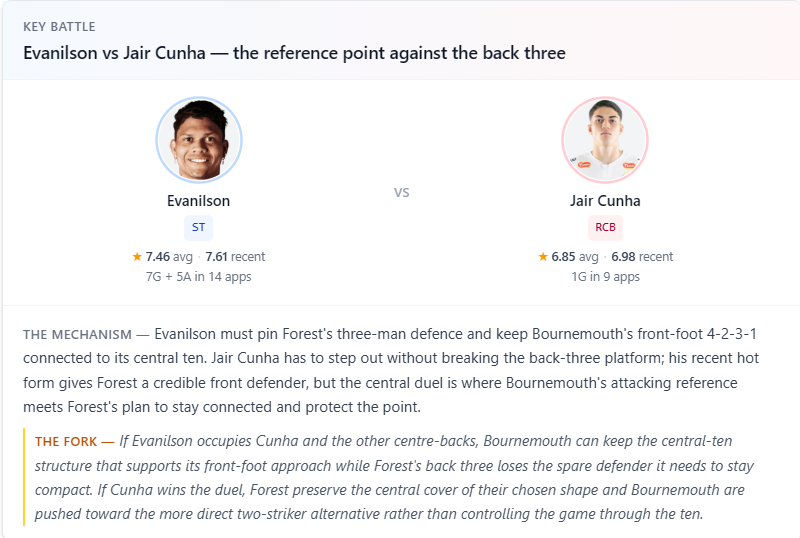

The defining duel is Evanilson against Jair Cunha. The in-form Brazilian striker’s job is to occupy the back three and keep Justin Kluivert connected to the attack; Cunha must step out when necessary without breaking the three-man defensive platform behind him. Both arrive with attacking or defensive momentum from recent matches, but their roles are opposed: one wants to pin the line and create room, the other wants to preserve the spare cover that makes Forest’s shape safe.
If Evanilson wins that battle, Bournemouth can keep Kluivert in the central lane and attack Forest without immediately changing shape. If Cunha handles the reference point, the Tricky Trees retain their extra central defender and Bournemouth may have to move toward the alternative two-striker arrangement to occupy the back three earlier.
That is the fork in the game. The duel does not only decide who gets a chance; it decides whether Bournemouth can keep the structure they prefer. The wider contest between Adrien Truffert and Daniel Munoz carries a different mechanism.
Truffert can give Bournemouth a reliable left-sided route forward and force Forest’s right wing-back to defend for long spells. Munoz, if his travel situation does not affect him, can instead preserve Forest’s width and help the visitors release Gibbs-White and McAtee inside. Bournemouth’s four-man structure must cover more ground when that outlet works, while the visitors’ compact plan becomes deeper and narrower when Truffert controls the lane.
Prediction: Bournemouth have the steadier platform
We are leaning towards a Bournemouth win, albeit only with medium confidence. Their recent attacking platform is stronger. The Cherries have averaged 1.91 xG across their recent run, while Forest have averaged 1.23 xGA. Marco Rose’s men have also kept three clean sheets in that period; Forest have kept none.
That combination gives the home side the more dependable base, especially if their first pressure forces Forest’s back three to defend facing its own goal. The strongest case against Bournemouth is the visitors’ direct release game.
If Liam Delap wins enough first contacts and Morgan Gibbs-White finds the spaces around the home double pivot, the visitors can turn Bournemouth’s willingness to press into open attacks. Their win over City showed that this side can produce a high-level performance when its intensity and running are coordinated, and the away shape gives them enough central cover to stay in the contest.
Lean: Bournemouth win
Range: 2-1/2-0/1-1
Bournemouth cannot assume that a strong recent run will prevent Forest from creating danger. The Tricky Trees’ larger problem is conversion. They have scored nine goals against 15.92 xG, while Bournemouth’s 16 goals sit close to their 15.96 xG.
That gap suggests Forest have created more than their results show, but it also means the visitors have not yet made chance-taking a stable part of their league performance. The likely scoreline range is 2-1, 2-0 or 1-1, with the home win the preferred outcome.
The switch Bournemouth can still make
If Nottingham Forest’s back three continues to absorb Evanilson comfortably, Bournemouth have a clear in-game adjustment: move to 4-4-2 and add a second striker to occupy the central defenders earlier.
That would sacrifice Justin Kluivert’s natural central-ten position, but it would give the hosts another body against the structure that currently protects the away side’s point. The option matters because Bournemouth are not locked into one attacking picture, whereas Forest’s plan depends more heavily on keeping its three defenders and wing-backs connected.