Bournemouth vs Liverpool at the Vitality Stadium on Sunday will feature a renuion shaped by European fatigue and unfinished starts.
Bournemouth’s 2-1 win at Real Sociedad on Thursday gave Marco Rose a strong opening to the club’s European campaign, but it also sharpened the question facing his side here. Can that intensity be sustained in the Premier League against Andoni Iraola’s Liverpool?
Speaking of Iraola, the Spanish tactician returns to the club he left in the summer, bringing a system Bournemouth know well and a Liverpool side arriving after a 3-1 win over Tottenham in the EFL Cup third round. The match is worth progress in different forms. Bournemouth need to turn an unbeaten but winless Premier League run into something tangible, while Liverpool can keep their European target within reach.
For Bournemouth, a home victory would validate Rose’s early work and ease the pressure created by a Premier League campaign that has produced draws despite dominance. A loss would leave them still searching for a result after leading in each of their league matches so far, while another draw would extend the feeling that promising spells are not being converted.
Their win in San Sebastian earlier this week showed that the side can punish opponents early, but the league return asks for concentration after a demanding trip. On the other hand, Liverpool arrive with a more comfortable platform. Their unbeaten start has included too many draws for a side aiming higher, but the cup win over Tottenham restored momentum before Bournemouth’s European trip and gave them a freshness advantage.
Three points would strengthen their pursuit of the European places; a draw would still keep that chase alive, while defeat would make their early dropped points more costly. Iraola’s knowledge of Bournemouth adds a personal edge, yet Liverpool’s broader challenge is managing a congested period without allowing the former club’s intensity to pull them into a game they cannot control.
Team News: The predicted elevens and the roles that matter
Bournemouth will be without Eli Junior Kroupi because of a foot injury, an absence that removes another attacking option from the squad and places more responsibility on the chosen front four. Veljko Milosavljevic (knee), Julian Araujo (hamstring), and Amine Adli (calf) are the other absentees.
Bournemouth’s usual 4-2-3-1 shape should retain the spine that has carried the side through the opening weeks. Djordje Petrovic remains in goal, with Adam Smith, James Hill, and Antonio Silva expected to form the defensive base alongside Adrien Truffert.
Hill has played every available minute and has supplied five key passes, while Silva’s four starts make him the natural left-sided partner. Smith’s three key passes from right-back also give Bournemouth a route forward without requiring the midfield to force every pass.
Scott should sit at the base of the midfield, with Lewis Cook his probable partner in the double pivot. The former has started all four matches, scored once and produced eight key passes, so his importance is not limited to defensive cover. Cook has started twice and played 166 minutes, making his selection the less settled part of the centre.
Justin Kluivert should operate ahead of them as the central attacking reference. The Dutchman has six shots on target from ten attempts, three key passes, and a squad-leading 1.33 xG. Marcus Tavernier is expected to attack from the left after scoring three times and creating eight key passes, while Rayan should preserve the right-sided width. Evanilson leads the line, offering three assists and three big chances created even though he is yet to register a shot on target.
Probable Bournemouth Lineup (4-2-3-1): Petrovic; Smith, Hill, Silva, Truffert; Cook, Scott; Rayan, Kluivert, Tavernier; Evanilson
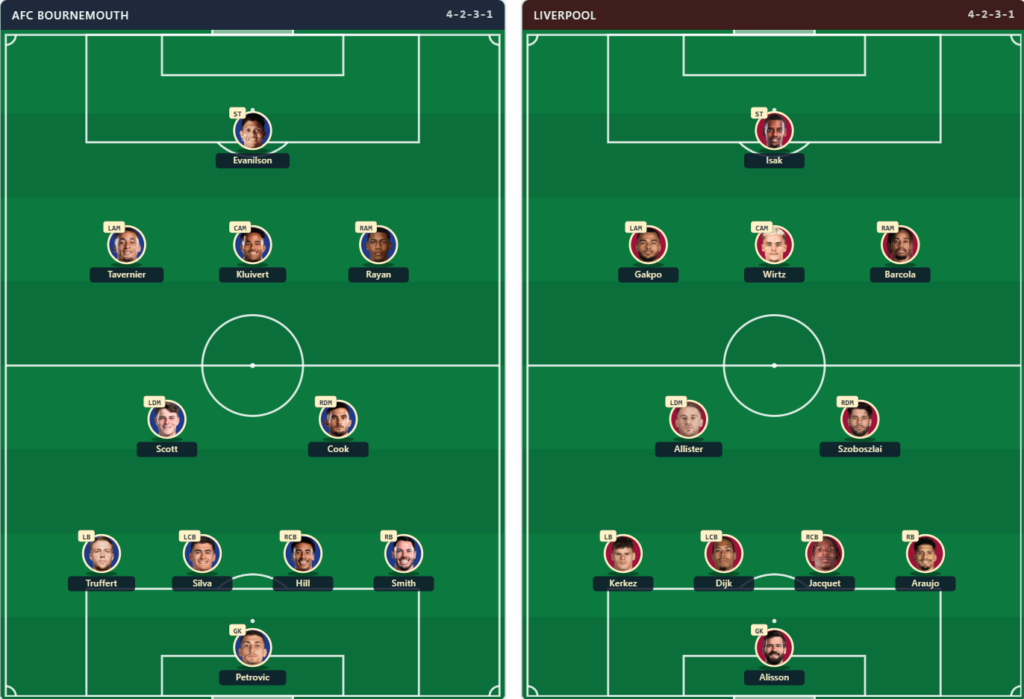
Probable Liverpool Lineup (4-2-3-1): Alisson; Araujo, Jacquet, van Dijk, Kerkez; Szoboszlai, Mac Allister; Barcola, Wirtz, Gakpo; Isak
Liverpool should mirror Bournemouth’s shape in a 4-2-3-1 setup of their own. Alisson Becker will behind Ronald Araujo, Jeremy Jacquet, Virgil van Dijk, and Milos Kerkez, with van Dijk providing the senior cover behind an aggressive defensive line.
Jacquet has started four times and carries a 7.33 rating, while van Dijk has completed every minute and is unbeaten in his defensive workload across the current run. Araujo is expected to handle the right side, where his defensive security will be tested by Tavernier.
Alexis Mac Allister should join Dominik Szoboszlai in the double pivot. The latter has started every Premier League match, leads the squad with eleven key passes, and has scored once; he is also Liverpool’s penalty taker. Florian Wirtz will play ahead of them, with Cody Gakpo on the left, Bradley Barcola on the right, and Alexander Isak through the middle.
Gakpo has one goal, three assists, and eight key passes, while Isak has scored three times and produced six shots on target from twelve attempts. The absences of Federico Chiesa, Hugo Ekitike, Conor Bradley, and Giovanni Leoni reduce Liverpool’s alternate options, but the predicted starting structure remains intact.
Tactics: Two similar shapes, but very different routes through the game
Both managers should begin with a controlled 4-2-3-1 formation. Bournemouth’s version is designed to keep Alex Scott and his partner close enough to protect the centre while leaving Justin Kluivert, Marcus Tavernier, and Rayan connected to Evanilson. They want to win at home, but not by turning the match into an uncontrolled chase.
Liverpool’s version places Dominik Szoboszlai and Alexis Mac Allister behind Florian Wirtz, with Alexander Isak as the central reference, giving them a stable platform for sustained possession and pressure. Their profiles point to a clear difference.
Bournemouth play 59.5 long balls per match against a league typical 50, while Liverpool are at 50. The hosts are therefore more likely to bypass midfield and compete for the next ball, whereas Liverpool should prefer to connect their pivots to Wirtz before attacking the final third.
In the four-match run at the start of the 2026/27 Premier League season so far, the Reds have had 58.5% of the ball and Bournemouth 50%, both against a league-typical 46.0% figure. That gives Liverpool the stronger platform for deciding where the match is played. However, it also gives Bournemouth a clear target: disrupt the first pass and turn possession into a second-ball contest.
The risk is similar in principle but not in execution. Bournemouth’s controlled push is most effective when Tavernier and Rayan can threaten without pulling both midfielders away from Scott. Liverpool can carry the game forward while keeping enough players behind the ball to avoid being opened by the direct route. The system that handles the opponent’s preferred rhythm will have the advantage.
That is why Scott against Szoboszlai is the central duel. The Englishman will be tasked to protect Bournemouth’s two-man base while interfering with the Liverpool vice-captain, who starts the pressure and helps connect the pivot to Wirtz.
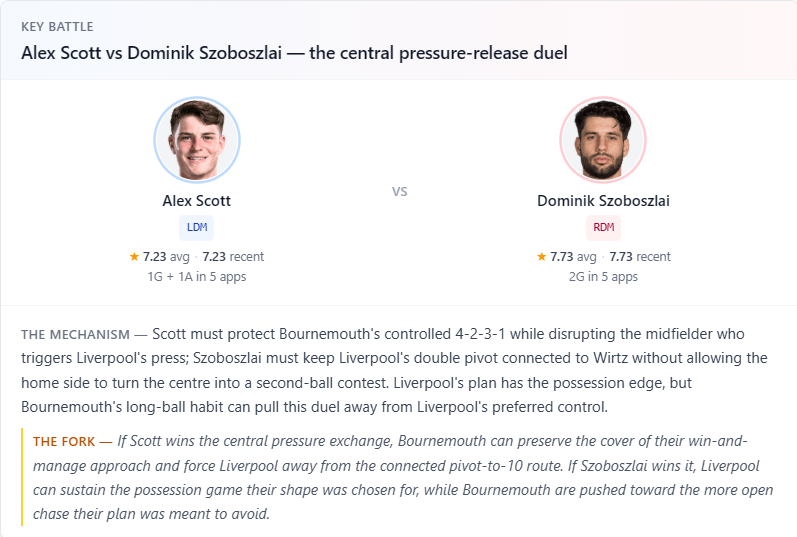
Szoboszlai, who also carries Liverpool’s set-piece responsibility, must keep that link alive without allowing Scott to turn the centre into a series of loose-ball contests. If the in-demand Bournemouth mainstay wins the exchange, the Cherries can remain compact and force Liverpool away from their cleanest route into Wirtz. If Szoboszlai wins it, the visitors can keep the ball moving and push Bournemouth toward the open chase Rose wants to avoid.
There is a second mechanism on Bournemouth’s left. Tavernier’s attacking form gives the home side an outlet against Ronald Araujo. However, the Liverpool full-back’s job is not simply to defend that lane; he must also preserve the width and security that allow Liverpool to keep their shape high up the pitch.
If Tavernier gets free, Liverpool may have to spend more of their possession protecting that side. If Araujo contains him, Bournemouth lose the outlet that lets them attack without committing too many bodies.
Prediction: Liverpool have the clearer control, but not a risk-free edge
We are leaning towards a Liverpool win, held with medium confidence rather than as a strong straight-result call. Their central control offers the best route to separating the sides. Liverpool can keep Dominik Szoboszlai connected to Florian Wirtz, while Bournemouth need to make the match more direct and contested. That is a difficult task against a side that has already shown it can manage possession without chasing every phase.
The recent attacking figures support a narrow away advantage. Liverpool have averaged 1.64 xG for and 1.22 against across the last five matches, compared with Bournemouth’s 1.50 for and 1.12 against. The home side’s defensive figure is slightly better, so this is not a case of Liverpool simply overwhelming them; the away side’s edge is the greater attacking ceiling and the likelihood of having more of the ball in useful areas.
Liverpool have also kept two clean sheets so far, while Bournemouth have kept none. That makes a narrow home breakthrough more plausible than a comfortable defensive performance. The strongest case against the visitors is Bournemouth’s ability to escape vertically and feed Marcus Tavernier or Evanilson before the visitors can reset.
Lean: Liverpool win
Range: 1-2/1-1/2-2
Their direct play can bypass the central duel, and their attacking set pieces give them another way to make Liverpool defend a close game. If Scott disrupts Szoboszlai and Bournemouth win the first contact after going long, the match can become much less comfortable for the visitors.
That is the route to a draw or a home win, particularly if Tavernier can force Araujo into a deeper role. The most likely scoreline range is 1-2, with 1-1 and 2-2 also live. Liverpool should have enough control to shade the game, but Bournemouth’s direct threat makes a narrow margin more likely than a decisive result.
Marco Rose’s formation choice can alter the final phase
The selection call that may still change the match is whether Bournemouth stay with the protective 4-2-3-1 or move toward the 4-4-2 when they need a goal. The first option keeps Alex Scott and Lewis Cook connected to the defence and protects the routes into Florian Wirtz.
Meanwhile, the second option would give Evanilson more immediate support but leave more space for Liverpool to control. Marco Rose’s timing there matters more than a wholesale tactical surprise, because the starting plan is already clear.