
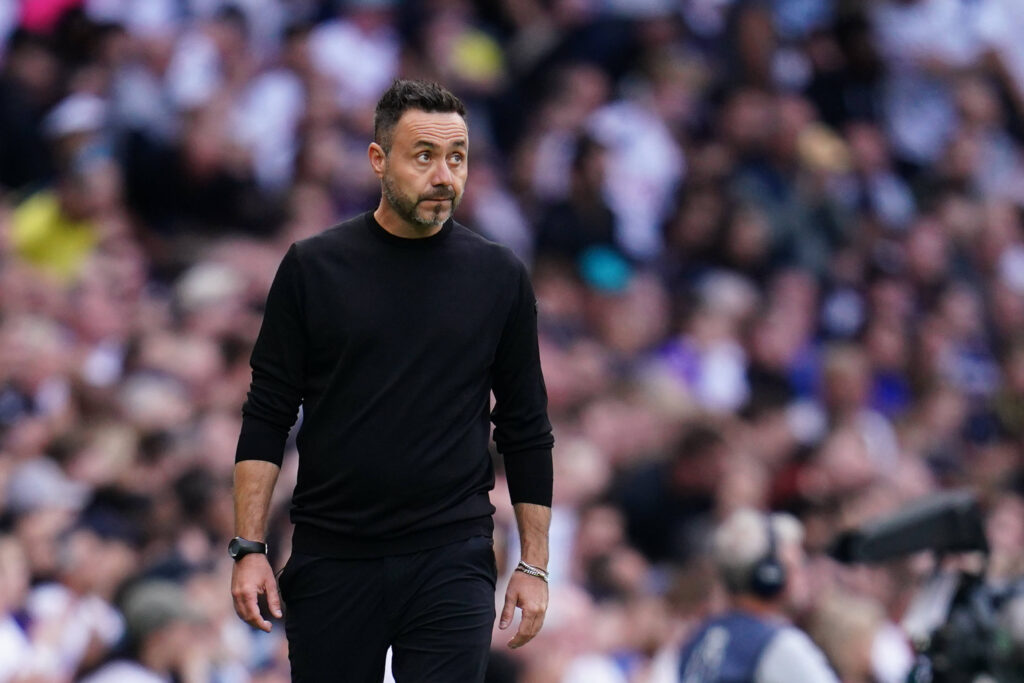
Tottenham’s lavish summer rebuild has produced little more than confusion, frustration and a goalless Premier League start.
Tottenham Hotspur’s summer transfer window was supposed to mark the beginning of a new era. Instead, after spending more than £300 million and completely reshaping their squad, the North London club look every bit as confused as they did before Roberto De Zerbi arrived.
The Italian manager took charge towards the end of last season with one straightforward task: keep Tottenham in the Premier League. He achieved that, with Spurs finishing only two points above the relegation zone. That narrow escape should have served as a warning that the squad required careful rebuilding, not a sudden overhaul built around expensive names.
Yet Tottenham chose the latter route. They brought in 10 new players, including loan arrivals Omar Marmoush and Mykhailo Mudryk, while committing a fortune to a collection of signings expected to transform the team. Sandro Tonali was the headline addition, with Mateus Fernandes and Savinho also arriving to raise the technical level. On paper, it looked ambitious. On the pitch, it has been anything but convincing.
A disastrous start
Tottenham have won only one of their first six matches in all competitions. That victory came in the EFL Cup, a competition they were knocked out of after losing 3-1 to Liverpool in the third round on Tuesday night.
Their Premier League record is even more alarming. Spurs remain winless after four matches and have yet to score a single goal. That statistic alone makes the club’s huge investment difficult to defend. When a team spends hundreds of millions on new attacking options, supporters are entitled to expect at least some improvement in the final third.
Instead, Tottenham look short of ideas. Their possession is often sterile, their attacking movements lack coordination, and their new players appear to be operating as individuals rather than as part of a clear system. There is no settled front line, no obvious creative pattern and no reliable source of goals.
This is not simply a case of poor finishing. The larger problem is that Spurs are struggling to create the conditions for their forwards to succeed.
Too much change, too quickly
A squad overhaul can work when the recruitment is closely aligned with the manager’s methods. However, signing a large number of players in one window creates its own problems. New arrivals need time to understand their teammates and learn the demands of the system.
Tottenham have placed that burden on De Zerbi immediately. The former Brighton & Hove Albion manager has inherited a team with a new midfield, new attacking options and a changing defensive structure. The result is a side that appears to be searching for its identity during competitive matches.
There is also a bigger question over how Tottenham approached the recruitment itself. Giving De Zerbi a major say in transfers can be useful when the manager and sporting structure are working from a clear long-term plan. At Spurs, however, the summer business has at times looked more like a collection of decisions based on what the manager wants at a particular moment rather than a systematic attempt to build a balanced squad.
The pursuit of Savio is one example of that rigidity. Tottenham spent more than a year chasing the winger, while their midfield recruitment also appeared influenced by the wider market rather than a clearly defined team-building strategy.
Tonali, Mateus Fernandes, and the other midfield additions may all possess quality, but signing talented midfielders simply because they are available or fashionable does not automatically create a functional midfield. Recruitment should provide a manager with the right pieces. It should not leave him trying to assemble an entirely new team while results are already being demanded.
The club’s summer business was praised in some quarters as a decisive attempt to address years of weakness. However, spending heavily is not the same as building intelligently. Tottenham have added talent, but they have not yet created balance.
The old problems remain
The most frustrating aspect for Tottenham supporters is that the spending has not solved the issues that were visible last season. Spurs still lack control in key moments, still struggle to turn possession into clear chances and still look vulnerable when opponents increase the pressure.
The defensive problems have also not disappeared. A team that is uncertain in attack often becomes exposed at the other end, because misplaced passes and poor positioning invite opponents to counter-attack. Against Liverpool, Tottenham showed flashes of energy but could not maintain the organisation needed to compete with a stronger side.
There is also a psychological concern. A goalless Premier League start increases pressure with every passing week. Players begin to force passes, take rushed shots and make decisions based on fear rather than instinct. For a squad still learning to play together, that pressure can make the process even slower.
Tottenham’s summer spending has therefore become part of the problem. Every poor performance is now judged against the size of the investment. The more the club spent, the less patience the fans are likely to show.
There is another concern that could become even more important next summer. If Tottenham fail to break into the top half of the Premier League, another major spending spree may be required to push them towards the upper reaches of the table.
But after committing more than £300 million this summer, their financial room for another overhaul could be considerably smaller. Spurs could find themselves needing to spend heavily again while being less able to do so, leaving the club worse for wear if this rebuild fails to deliver.
De Zerbi remains hopeful
De Zerbi, however, has refused to suggest that the project is failing. After the defeat to Liverpool, he admitted that the situation was painful and frustrating, but insisted that Tottenham will win many matches and score plenty of goals once the team finally clicked. He also argued that the players had shown the right mentality and continued fighting until the end.
That optimism may sound excessive after four league matches without a goal, but the manager is right about one point: Tottenham cannot be judged solely on the first weeks of a major rebuild. New players need time, and tactical ideas rarely become automatic overnight.
Not everyone is convinced by De Zerbi’s credentials, though. Former France international Christophe Dugarry was scathing in his assessment of the Tottenham manager.
“I never really understood what De Zerbi’s level actually is. They tell me he did well at Brighton and Sassuolo, but for me he’s not a guarantee for big teams. He signed at Spurs for 5 years, genuine robbery without even needing to wear a mask. It’s incredible.”
The problem is that time is a luxury Spurs may not possess. Having escaped relegation by the narrowest of margins last season, they cannot afford another prolonged slump. De Zerbi needs results quickly, not simply encouraging passages of play.
Tottenham’s spending has given them more quality, but quality without structure is merely an expensive collection of possibilities. Until De Zerbi finds a settled formation, a dependable attacking plan and a defensive shape capable of surviving pressure, Spurs will continue to look like a club that spent first and thought later.
The manager believes the click is coming. Tottenham supporters will hope he is right. For now, though, the club’s haphazard summer spending is not lifting them towards a brighter future. It is exposing just how much work remains to be done.