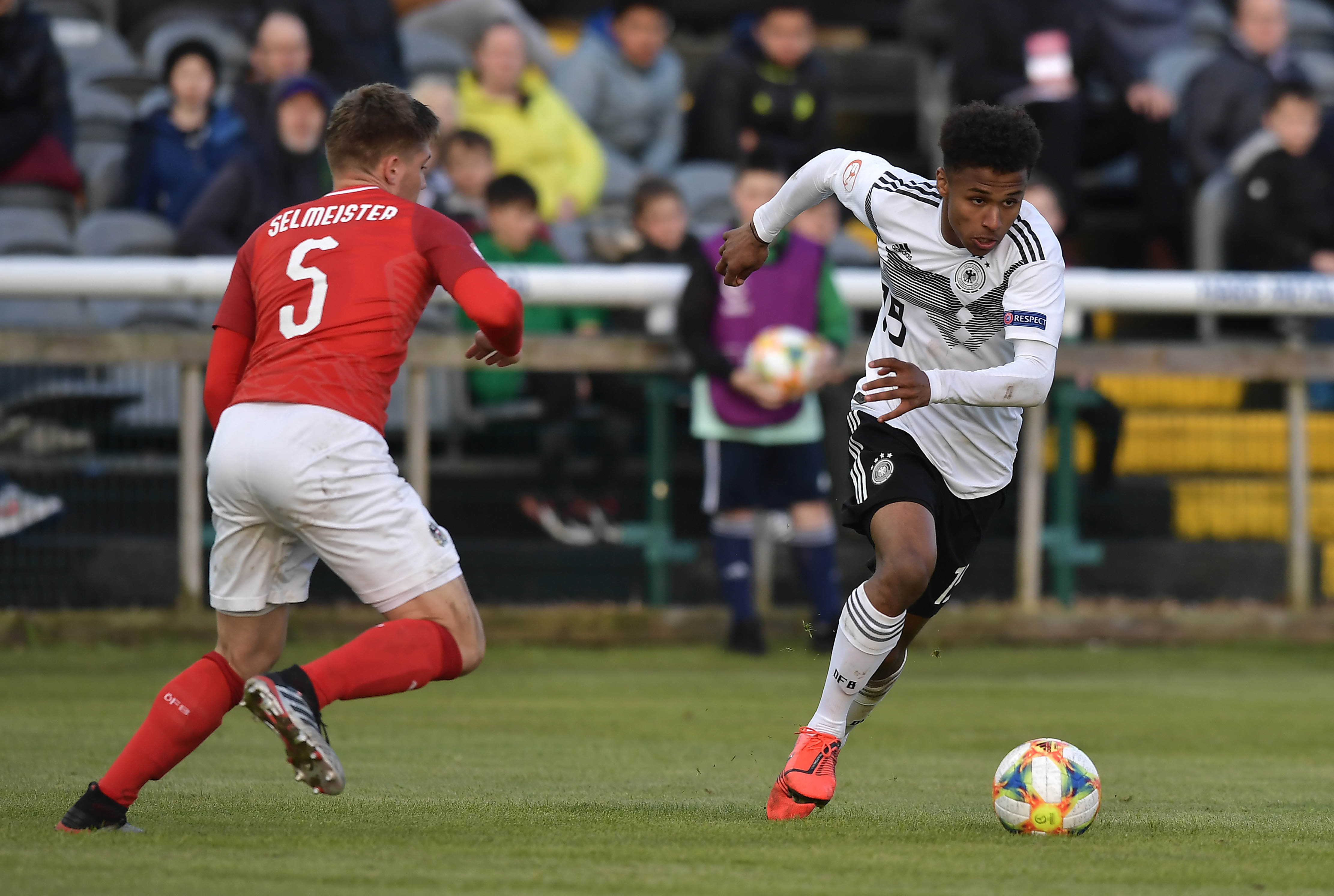
Karim Adeyemi has not arrived merely to add depth out wide; he looks like the turbocharged piece that could let Hansi Flick reshape Barcelona’s entire forward line.
Karim Adeyemi’s imminent move to Barcelona is not just another forward signing; it is a deliberate step in Hansi Flick’s attempt to rewire the club’s attack for pace, versatility and long‑term balance.
Barcelona and Borussia Dortmund are finalising an agreement worth an initial €22 million plus a further €7 million in performance‑related add‑ons, with the Bundesliga giants also due a percentage of any future profit.
Adeyemi has been clear that he wanted Barcelona, and he is expected to sign a five‑year contract once he arrives in Catalonia. That commitment is important for a club trying to build a new forward line after Robert Lewandowski’s departure and Marcus Rashford’s return to Manchester United following a productive loan spell.
This is the second major wide forward addition of the summer after Anthony Gordon’s €70 million switch from Newcastle United, underlining that Barcelona’s current rebuild is centred on the flanks as much as on the No. 9 role. With Ferran Torres closing in on a move to PSG, Adeyemi arrives as a fresh, flexible option rather than a direct replacement, and his fee sits in a bracket that leaves room for a future marquee striker signing.
What Adeyemi brings to the table
Adeyemi’s biggest selling point is his versatility and pure speed. The 24-year-old can operate across the front three, but he tends to be most comfortable starting on the right and driving inside onto his stronger foot, a profile that immediately makes him useful as both support and cover for Lamine Yamal.
His acceleration over short distances forces defensive lines to drop deeper, creating more room between the lines for technically gifted midfielders and wingers to exploit. Across four seasons at Dortmund, he has made 146 appearances and scored 36 goals, adding 10 in 39 games in all competitions in the most recent campaign.
Those are not elite striker numbers, but they paint the picture of a wide forward who chips in consistently while also stretching play and pressing from the front. Adeyemi’s willingness to attack space behind the defence contrasts nicely with Gordon’s more ball‑to‑feet inclination and Yamal’s creative, playmaking instincts from the wing.
Crucially, he is experienced enough to play as a central forward when needed. For Flick, who has worked with him previously in the German national team set‑up, that opens the door to in‑game tactical shifts without substitutions, a winger can be pushed inside to lead the line, or can start centrally before rotating into wide zones as moves develop.
How Flick can line up with Adeyemi
Barcelona, under Flick, already have the framework for multiple systems, and Adeyemi fits neatly into several of them. In a 4‑3‑3, a first‑choice front line could feasibly feature Gordon on the left, Yamal on the right and a new No. 9 through the centre, with Adeyemi rotating in for either wide role or acting as a high‑energy option up top in certain matches.
His presence also allows Barcelona to field a more transitional front three of Gordon, Adeyemi and Yamal when they want to play on the counter against higher‑line opponents. A 4‑2‑3‑1 unlocks further combinations. the Dortmund attacker can start nominally on the right, with license to come inside while Yamal drifts between the lines as a central creator, and Gordon holds width on the opposite flank.
The German winger’s pressing work and recovery runs make him useful in a wide role in this shape, especially if Flick wants to protect an attacking full‑back behind him. There is also scope for Adeyemi to lead the line with Gordon and Yamal either side in matches where Barcelona expect to defend deeper and break quickly.
His arrival also effectively shuts the door on a Rashford return, despite the Englishman’s positive loan spell, because Adeyemi covers similar spaces and offers a comparable transition threat at a lower long‑term cost and with a longer contract. For a club juggling strict finances and squad needs, adding a lightning‑quick, multi‑role forward is more sustainable than committing to another big wage for a player who would still want to be a guaranteed starter.
Adeyemi, Gordon, Yamal, and the wide puzzle
On paper, a wide pool of Anthony Gordon, Adeyemi, Lamine Yamal, and Roony Bardghji gives Flick four very different but complementary options. Yamal is the creative hub, able to act almost as a playmaker from the right.
Gordon is direct and aggressive, constantly demanding the ball to drive at full‑backs. Adeyemi offers depth and dynamism, happy to operate off the ball and hit space, while Bardghji is a technical, scoring winger whose future is still being discussed.
Reports have linked Bardghji with a move away. However, keeping him while cashing in on Raphinha could make more sense if Barcelona are serious about funding a world‑class replacement for Lewandowski. Raphinha remains valuable, yet he is one of the few saleable assets who could bring in a sizeable fee, and Adeyemi’s arrival lowers the risk of moving him on because the club would still have enough quality out wide.
Adeyemi, Yamal, Gordon and Bardghji form a group that can be balanced across both flanks, across age profiles and across styles. However, there is a counter‑argument in favour of keeping Raphinha, at least for another season. Retaining him would give Flick five high‑level wide options, making rotation smoother across competitions and allowing him to switch mid‑game between a more possession‑focused unit and a more direct, transitional one.
The question then is whether Barcelona can still afford a top striker in the current window if they do not cash in on the Brazilian, given the costs involved in pursuing someone of Julian Alvarez’s calibre.
The knock‑on effect in the striker market
Sources have already indicated that Barcelona’s chase for a No. 9, with Alvarez among the leading options, is separate from the deals for Gordon and Adeyemi. However, in reality the budget is finite, and every signing affects what is possible next.
Roberto Lewandowski’s departure has created both a gap in the lineup and some room on the wage bill, yet replacing his goals will not be cheap. If Raphinha is sold, the fee and salary saved could push Barcelona closer to the kind of centre‑forward who immediately lifts them back into the Champions League elite.
In that sense, Adeyemi is as much a financial tool as a footballing one. By securing a versatile attacker on a relatively modest base fee, Barcelona give themselves cover on the wings while keeping the door open to invest heavily through the middle.
A future front line of Gordon, a new striker and Yamal, backed up by Adeyemi and Bardghji, would represent a full attacking revamp: younger, faster and built to give Flick tactical flexibility across Europe and La Liga.
The German might not be the headline act of Barcelona’s summer. However, he looks like the kind of signing that quietly makes the bigger moves possible, stretching defences on the pitch and stretching the budget just enough off it.