
Leeds United vs Coventry City at Elland Road on Saturday will feature two teams seeking momentum after impressive wins in Gameweek 11.
Leeds United’s first win at Chelsea this century, a 4-1 comeback at Stamford Bridge, has changed the mood around this fixture. Noah Okafor scored twice, Dominic Calvert-Lewin converted a penalty, and Daniel Farke’s side used structured pressure to disrupt the Blues after falling behind.
Coventry City, on the other hand, arrive with a 3-2 victory over Crystal Palace of their own. However, the central question at Elland Road is whether Leeds can turn their attacking momentum into sustained pressure against a side that prefers a more physical, patient contest.
The result matters to Leeds because a win keeps their European ambitions alive, while a defeat would waste the advantage created by that Chelsea performance. They bring elevated morale into this mixture, and the manager’s decisions have been strengthened by the result at Stamford Bridge.
Their latest five-match figures also point to a controlled run: six goals scored, four conceded, and two clean sheets. The only selection issue that changes the picture is the absence of Mateo Joseph with a knee injury, which removes one forward option rather than altering the established attacking structure.
Coventry need points that keep their distance from the relegation danger meaningful rather than allowing the pressure to build again. Their recent win interrupted a difficult stretch, and Frank Lampard’s men have won four of their last seven Premier League matches while moving between expansive and patient approaches.
The Sky Blues have scored eight and conceded ten across their latest five, so the revived results have not removed the defensive concern. Leeds can therefore expect a visiting side willing to compete for the win, but not one that needs to turn the game into a constant attacking exchange.
Team News: The settled shapes and the selection calls
Leeds United should retain the 3-4-2-1 setup that has been used throughout their recent five-match run. James Trafford remains in goal behind a back three of James Justin, Nico Elvedi, and Tarik Muharemovic. The wing-back positions should go to Gabriel Gudmundsson and Jayden Bogle.
Gudmundsson gives the left side its width and has started nine times, while Bogle is expected to continue despite a less convincing recent spell; he has two goals and 11 key passes from his 11 appearances. Ethan Ampadu should keep the right-sided midfield role, with his 11 key passes showing why Leeds continue to use him even when his own form has dipped. Ao Tanaka, fresh off signing a new contract, is expected to start on the other side.
Noah Okafor should support Calvert-Lewin from the left, with Harry Wilson likely to occupy the opposite attacking midfield position. Okafor has four goals and six key passes in ten appearances, and his two-goal display at Chelsea makes him the most obvious recent threat around the striker.
Wilson has supplied two assists and nine key passes despite making only three starts. Calvert-Lewin, another player to have signed a new deal, leads the line and takes Leeds United’s penalties; he has four goals, two assists and thirteen shots on target from twenty-five attempts.
Probable Leeds United Starting Lineup (3-4-2-1): Trafford; Justin, Elvedi, Muharemovic; Bogle, Ampadu, Tanaka, Gudmundsson; Wilson, Okafor; Calvert-Lewin
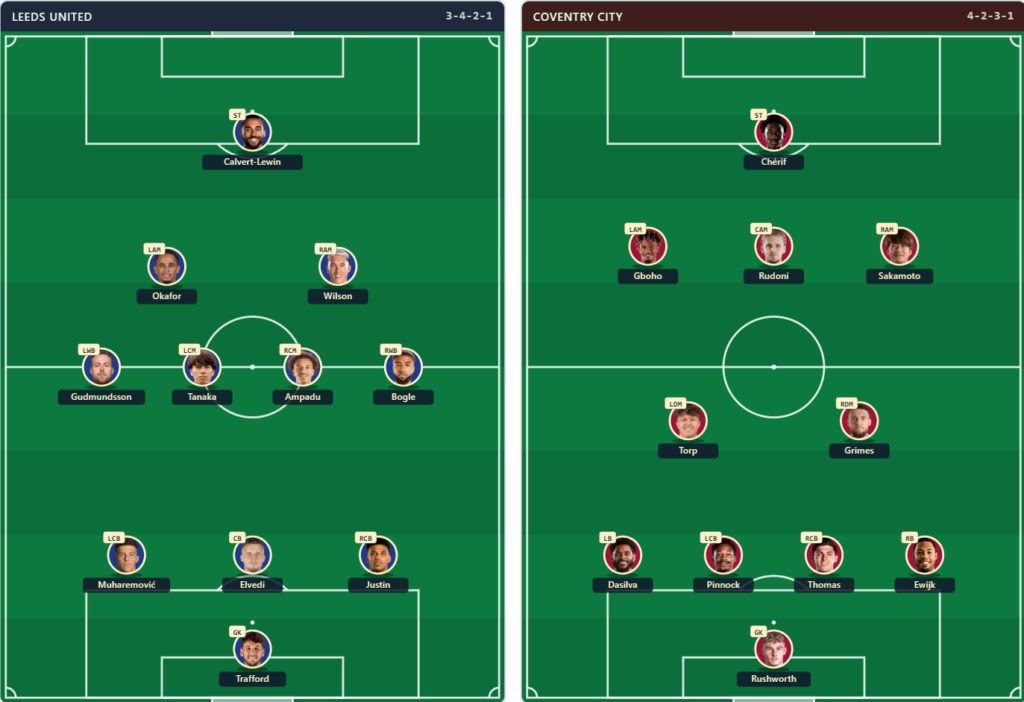
Probable Coventry City Starting Lineup (4-2-3-1): Rushworth; van Ewijk, Thomas, Pinnock, Dasilva; Grimes, Torp; Sakamoto, Rudoni, Gboho; Cherif
Coventry City’s 4-2-3-1 shape has also been the consistent recent choice, but the absences affect how the visitors fill it. Haji Wright is out with a hamstring injury and Aurele Amenda is unavailable because of a calf injury. Taiwo Awoniyi is also ruled out with a significant ankle injury, so Sidiki Cherif is expected to lead the line. Other absentees are Josh Eccles (ankle) and Luke Woolfenden (knee).
Carl Rushworth should continue in goal behind a back four of Milan van Ewijk, Bobby Thomas, Ethan Pinnock, and Jay Dasilva. As for the midfield unit, Matt Grimes and Victor Torp are expected to form the double pivot. Grimes has eight starts and Torp three, but the latter”s seven key passes from limited involvement give him the more progressive profile of the pair.
Tatsuhiro Sakamoto should start on the right after two goals in seven appearances, with Yann Gboho on the left. Jack Rudoni remains the attacking hub; he has three goals, two assists and twenty key passes, the most in the Coventry City squad. His movement behind Cherif is the visitors’ best way to turn a direct first pass into a meaningful attack. Cherif’s job will be to occupy the home side’s centre-backs sufficiently for Rudoni to arrive from behind.
Tactics: Leeds United’s deliveries vs Coventry City’s cover
Leeds United’s 3-4-2-1 setup is designed to keep two attackers close to Dominic Calvert-Lewin while the wing-backs stretch Coventry City’s back four. They are not simply asking for possession; their profile shows 47% of the ball per match against Coventry’s 36%, both below the league’s 48.5% typical figure.
That suggests Leeds should have more of the ball, but not necessarily an uncontested grip on it. Their shape is intended to carry the match forward without losing the three-man defensive base. The attacking emphasis is wider and more direct than their possession figure alone suggests.
Leeds produce 21 crosses per match against Coventry’s 13, with the league typical at 16, while their 57 long balls compare with Coventry’s 62 and the league norm of 50. The hosts therefore have the stronger delivery route, but Frank Lampard’s men are even more willing to bypass midfield.
For the home side, the question is whether that direct Coventry game can be disrupted before the visitors turn first contacts into second-ball attacks. The Sky Blues’ 4-2-3-1 system keeps two midfielders behind Jack Rudoni and gives Tatsuhiro Sakamoto and Yann Gboho responsibility for supporting the lone striker without opening the centre.
The visitors can pursue the win while still accepting a draw, which means they are unlikely to chase Leeds recklessly from the start. The clash is clearest on Leeds United’s left. Gabriel Gudmundsson must provide the width that makes the home shape dangerous, while Sakamoto has to help Milan van Ewijk prevent that side from becoming a repeated crossing platform.
If Coventry’s wide players drop too far, Leeds can pin them back; if they stay high, the space beside the full-backs becomes available. The primary contest is Dominic Calvert-Lewin against Bobby Thomas.
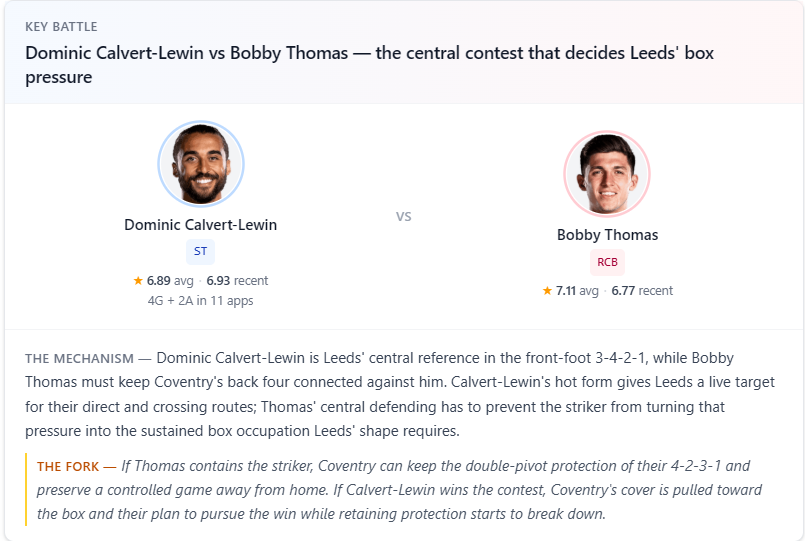
Calvert-Lewin is the central reference for Leeds United’s forward play, while Thomas has to keep the visiting back four connected rather than allowing the striker to receive, turn and bring Noah Okafor or Harry Wilson into the box. Both arrive with strong individual form, so this is less about an obvious weak link than about which side imposes its preferred distance.
If Thomas contains Calvert-Lewin, Coventry can retain the protection of their double pivot and keep the match controlled away from their goal. If the Leeds United striker wins the contest, Coventry’s cover is drawn towards the box and the balance of their 4-2-3-1 begins to fail. Behind that duel sits the larger system problem.
The home side’s three centre-backs can support the striker’s pressure, but they must also be ready for Coventry’s long route towards Cherif and the runners around him. If Leeds win the first contact, they can keep the visitors pinned in their own half.
If Coventry escape that pressure, the match becomes more open and Leeds’ wing-backs are forced to turn and defend rather than sustain the delivery game. The result may depend on whether the central battle produces repeated attacks or merely isolated moments.
Prediction: Why the home side has the clearer route
We are leaning towards a Leeds United win. Their settled structure gives them the more convincing way to control the match, and the contrast in recent attacking production supports that lean. The hosts average 1.54 xG per match across the latest five, compared with Coventry’s 1.10.
The visitors have also kept no clean sheets in that period, which matters against a home side with Dominic Calvert-Lewin and Noah Okafor both carrying recent goal threat. The strongest case against Leeds is Coventry escaping the initial pressure.
Their direct route can force a more contested second-ball game, and Jack Rudoni’s position behind Sidiki Cherif gives them a route into the spaces Leeds leave when their wing-backs advance.
Lean: Leeds United win
Range: 2-1/1-0/1-1
If Bobby Thomas keeps Calvert-Lewin from turning and Tatsuhiro Sakamoto helps close Gabriel Gudmundsson’s side, Coventry can preserve enough defensive cover to make the draw live. That is why the home call is not being treated as certain.
The likely scoreline range is 2-1, 1-0 or 1-1. Leeds United should create the greater sustained pressure, but Coventry’s ability to make the match physical and direct gives them a realistic path to an equaliser.
Rudoni’s freedom can change the finish
The late tactical lever belongs to Coventry City’s central attacking line. If Leeds United’s pressure begins to force Sidiki Cherif into isolated duels, Jack Rudoni may need to move closer to the striker and attack the second ball earlier rather than waiting behind him.
That would give Coventry a more immediate presence against the back three, but it would also reduce the protection in front of Bobby Thomas and Ethan Pinnock. The choice of when to make that adjustment could decide whether the visitors remain in a controlled contest or spend the closing stages defending their box.