Chelsea vs Leeds United at Stamford Bridge on Saturday will be a battle of two top-half teams seeking consistency after inconsistent recent form.
Chelsea’s defeat at Sunderland exposed the problem this fixture is meant to answer. They had most of the ball at the Stadium of Light but could not break down a compact defence, while a first-half penalty from Enzo Le Fee settled a disappointing 1-0 loss. Leeds United, in contrast, beat Tottenham 1-0 at Elland Road, with Noah Okafor scoring in the 79th minute.
Saturday’s meeting therefore turns on whether Chelsea can turn initiative into chances against a Leeds side that has just found a little momentum. The Blues can move from fifth to fourth with a win, while Leeds can rise from ninth to fifth. However, neither side is playing a decisive early-season game.
For Chelsea, the points matter as a test of consistency rather than as an immediate demand. They have won three and lost two in their recent five-game run, and another uneven performance would keep the concern around their ability to sustain a challenge near the European places.
Their recent five-match return is nine goals scored and four conceded, which gives the home side the better short-term results profile, even though the Sunderland match showed how quickly territorial control can become sterile. The message from the club has been about staying together, and the home team need that collective response here.
Leeds United, on the other hand, come to this with a different kind of pressure. Their target remains live across several results. So, a draw would not undo their progress, while a win would move them into fifth and reinforce a run that had started to turn after two consecutive league victories.
The 1-0 win over Tottenham was especially useful because it arrived at Elland Road through a late decisive moment rather than through complete control of the game. Leeds have scored three and conceded five across their recent five-match run. So, their improved mood still sits alongside a modest attacking return. Their settled structure should make them harder to unsettle, but their away approach is unlikely to demand the same level of risk as Chelsea’s.
Team News: The predicted sides and the choices behind them
Chelsea are expected to use a 4-2-3-1 formation. Reece James (knee), Maxence Lacroix (thigh), Joao Pedro (hamstring), and Jorrel Hato (back) are unavailable. Jamie Gittens has resumed training after recovering from an ankle injury, but Saturday’s game has come too soon for the exit-linked winger. However, there is some good news, as Josh Acheampong has recovered from a minor issue to be available to take on Leeds United.
The effect is clearest in two areas. Pedro Neto should lead the line in place of Joao Pedro, while Pep Chavarria supplies the left-sided width that makes the back-four version of the shape workable. The alternative three-centre-back system is less attractive without Hato, so Chelsea should retain the double-pivot structure.
Mike Penders should retain his spot in goal behind Wesley Fofana and Levi Colwill, with Josh Acheampong expected at right-back and Chavarria on the left. As for the midfield unit, Romeo Lavia and Moises Caicedo should form the holding pair. The midfield pairing needs to protect the full-backs and not merely circulate possession when Chelsea push forward.
Cole Palmer should occupy the right attacking-midfield lane, with Morgan Rogers on the left and Estevao centrally. Palmer has three goals, three assists, and 22 key passes from ten appearances, and his penalty duty gives Chelsea another route when the game becomes tight. Rogers has five goals and 17 key passes from ten starts, making him the clearest current source of attacking momentum. Neto has three goals and one assist from nine starts and should provide the reference point at striker.
Probable Chelsea Starting Lineup (4-2-3-1): Penders; Acheampong, Fofana, Colwill, Chavarria; Caicedo, Lavia; Palmer, Estevao, Rogers; Neto
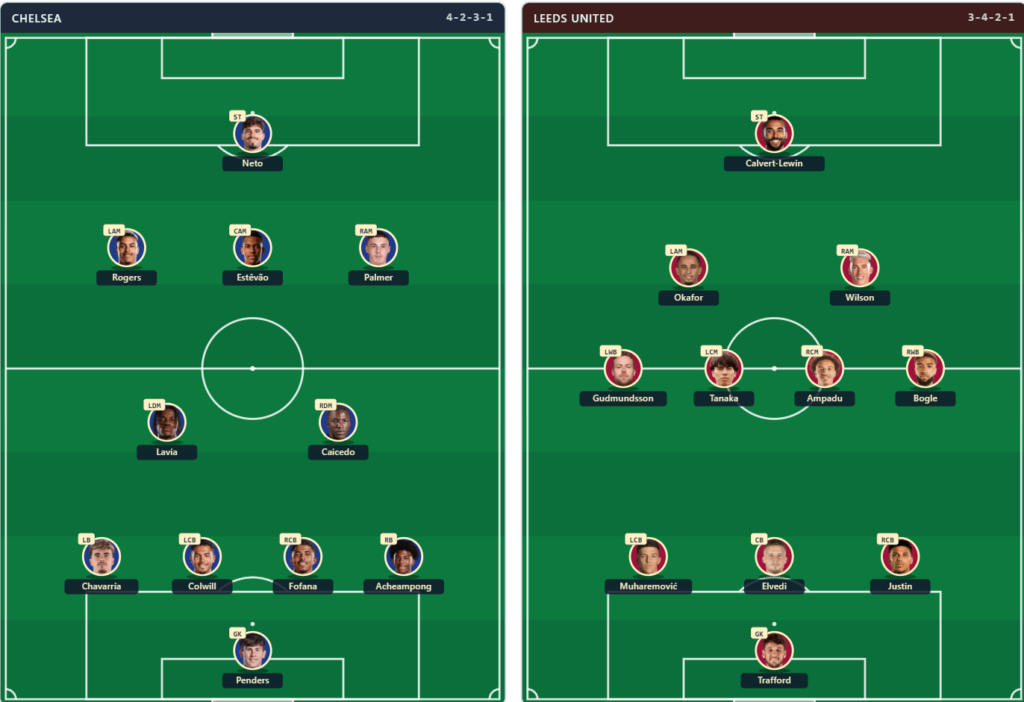
Probable Leeds United Starting Lineup (3-4-2-1): Trafford; Justin, Elvedi, Muharemovic; Bogle, Ampadu, Tanaka, Gudmundsson; Wilson, Okafor; Calvert-Lewin
Leeds have only Mateo Joseph in the treatment room, with a knee injury expected to keep him out for a prolonged period. Anton Stach is returning, but he is not part of the probable eleven. Daniel Farke’s side should continue with the 3-4-2-1 formation that has been their shape throughout the recent run.
James Trafford starts behind Tarik Muharemovic, Nico Elvedi, and James Justin. Muharemovic has started every one of his ten appearances and has two assists, while Justin has also started all ten and has one goal. That continuity gives Leeds a stable platform when their wing-backs move forward.
Ao Tanaka and Ethan Ampadu should operate centrally, with Gabriel Gudmundsson and Jayden Bogle providing the width. Ampadu has started ten matches and supplied ten key passes, while Tanaka has eight starts and one assist. Gudmundsson’s eight starts make him the established left-sided outlet. Bogle is expected to continue on the right despite a quieter attacking run; he has two goals and ten key passes from ten starts.
Noah Okafor should play in the left attacking-midfield position, with Harry Wilson likely to take the other narrow role. Wilson has eight key passes in a smaller starting sample, while Dominic Calvert-Lewin leads the line after ten starts, three goals, one assist and 10 shots on target from 19 attempts.
Tactics: Chelsea’s width vs Leeds United’s release valve
Chelsea’s 4-2-3-1 setup is designed to take the initiative without leaving the double pivot completely exposed. Cole Palmer and Morgan Rogers occupy the advanced lanes, while Romeo Lavia and Moises Caicedo provide the cover that allows the full-backs to support the attack.
Leeds United’s 3-4-2-1 system keeps three centre-backs behind two wing-backs and two narrow attacking midfielders, preserving an outlet on each side whenever Chelsea’s pressure becomes too central. The profiles show a clear difference in how the sides use the ball.
Chelsea average 51.5 in ball dominance against Leeds United’s 48, with the league typical figure at 48.5. So, the home side are more likely to make the game reflect their preferred initiative. The Blues also average 14 crosses per match, compared with the visitors’ 21.5, either side of the league’s 16.5 norm.
That matters because Leeds United’s width is not just a way to advance; it is how they can turn a defensive shape into territory and service for Dominic Calvert-Lewin. Chelsea’s lower crossing figure suggests a greater dependence on combinations through the attacking midfielders and on dribbling to break the first line. The directness gap is similarly important.
Chelsea average 47.5 long balls per match and Leeds 57.5, against a league typical of 49.75 benchmark. The Whites can therefore bypass the first pressure and look for Calvert-Lewin before Chelsea have settled their defensive spacing. Xabi Alonso’s men have allowed 1.16 xG per match across the latest five. So, possession will not be enough if their midfield pair leave the area in front of Wesley Fofana and Levi Colwill open.
Leeds United’s controlled approach can become dangerous when a direct pass wins territory without requiring them to chase the match. The main system contest is Chelsea’s initiative against Leeds United’s wide release. Pep Chavarria and Jayden Bogle meet in the mirrored channel, with Chelsea needing the home left-back to offer an outlet while still preventing Bogle from delivering the service that makes the away side’s back-three structure useful.
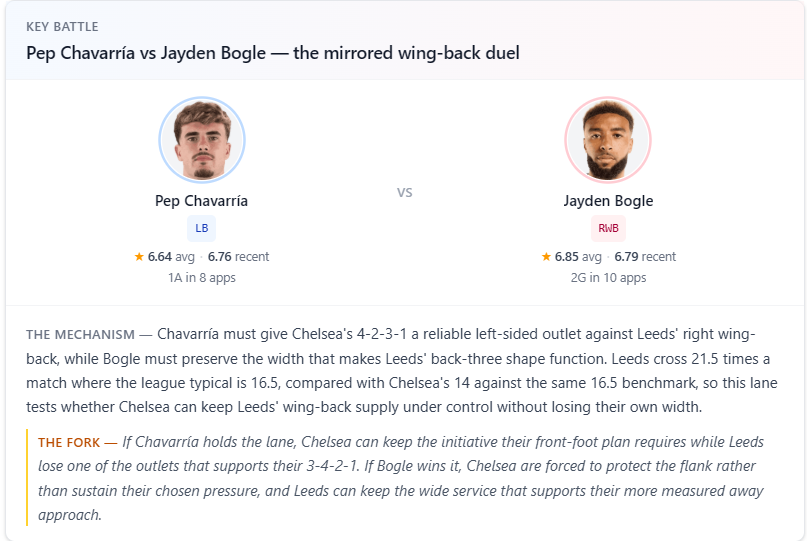
If Chavarria holds that lane, Chelsea can keep Leeds pinned and sustain the pressure their shape is built to produce. If Bogle wins the exchange, the West Londoners may have to send extra protection towards the flank, reducing the number of players available to attack the area.
Wesley Fofana’s contest with Dominic Calvert-Lewin is the second mechanism behind that battle. The English striker is the target when the direct route is chosen, and the home side’s centre-back must stop those passes from becoming clean first contacts or useful lay-offs.
Fofana’s current form gives Chelsea a strong individual defender for the job, but the space behind the double pivot still matters. If Calvert-Lewin brings the ball down and Leeds United’s narrow attackers collect the second phase, The hosts’ front-foot shape can be forced backwards. If Fofana contains him, Leeds lose the simplest way to make their away plan secure.
Prediction: Chelsea have the stronger case, but not a free run
We are leaning towards a Chelsea win, held with low confidence rather than as a result to treat as certain. The home side’s 4-2-3-1 setup should have more initiative, and their recent scoring output has been stronger than Leeds United’s while their defensive record has also been the cleaner of the two.
The deeper attacking signal points the same way: Chelsea’s xGD is 5.141, compared with the away side’s -3.466. That is the clearest reason to prefer the home side once the recent momentum and the tactical matchup are weighed together. The strongest case against Chelsea is Leeds United’s ability to make the game awkward without needing to dominate it.
Lean: Chelsea win
Range: 2-1/2-2/1-1
Their wing-backs can stretch the home full-backs, while the direct route towards Dominic Calvert-Lewin can turn Chelsea’s possession into defensive running. If Jayden Bogle and Gabriel Gudmundsson keep their lanes active and Leeds win the first and second balls around the striker, the hosts may be forced into the slower, less productive attack that failed at Sunderland.
The draw is therefore a possible outcome, especially because the Whites can accept a controlled contest rather than opening the match in pursuit of a win. The scoreline is most likely to settle in the 2-1, 2-2 or 1-1 range.
The shape Chelsea can change if Leeds United take control
Chelsea’s in-game lever is the move to a 3-4-2-1 if the wing-back contest begins to pull their full-backs too deep. Adding a centre-back would give them more protection against the direct route and allow the wide players to engage Leeds United higher without leaving the central defensive unit exposed.
That switch would sacrifice some of the double-pivot security in the starting plan, but it gives the home side a way to alter the structure rather than simply asking the same 4-2-3-1 to solve a problem it has not solved.