Manchester City vs Brighton & Hove Albion at the Etihad on Saturday will be a second meeting in four days between these teams after the midweek EFL Cup clash.
Manchester City and Brighton meet at the Etihad only three days after City survived a dramatic Carabao Cup penalty shootout following a 2-2 draw. The Premier League meeting carries a different pressure. Enzo Maresca’s men are responding to their first league defeat under the new head coach, a 2-1 loss at Aston Villa, while Brighton are trying to recover from a 2-0 defeat at Liverpool that ended a run of four straight league wins.
City remain top despite the defeat to Villa, Brighton sit third, and both are protecting meaningful early-season positions rather than playing a decisive match. For the home side, a victory would steady a title challenge that has just lost its perfect record and keep their response under new manager Enzo Maresca moving in the right direction.
A draw would avoid another setback but leave the leaders with less room to absorb further dropped points; defeat would allow the challengers behind them to apply more pressure. Their last league outing at Aston Villa exposed defensive mistakes, and the cup tie against Brighton demanded a different kind of concentration before the league response arrived.
Brighton’s result carries a different balance. They can pursue a significant away win while knowing that their Champions League position remains secure for now. However, another defeat would make the Liverpool loss look less like an interruption and more like a change in direction.
At Anfield, two early goals put them behind despite the chances they created. Fabian Hurzeler has called for detailed analysis and fewer errors, so Brighton arrive needing a more controlled performance without losing the attacking confidence that carried them through their previous winning run.
Team News: The picks after the cup rematch
Antoine Semenyo is unavailable for Manchester City because of a knee injury, while Matheus Nunes faces a late fitness test to determine his availability. The wider issue for City is replacing Semenyo’s contribution to the squad, though the expected team still has a clear attacking reference through Erling Haaland.
City should retain the 4-2-3-1 setup they have used under Enzo Maresca so far. Gianluigi Donnarumma will start behind a back four of Abdukodir Khusanov, Ruben Dias, Marc Guehi, and Josko Gvardiol. Dias has started all eight of his appearances and played 720 minutes, giving that central pairing continuity, while Gvardiol brings a more progressive left-sided option after contributing four assists in eight appearances.
The midfield is likely to place Enzo Fernandez alongside Elliot Anderson in the double pivot, with Rayan Cherki operating centrally behind Haaland. Fernandez has five starts and eight key passes, although his recent form has been less convincing; Anderson provides the cover required on the right side of the pivot. Meanwhile, Cherki is the creative hinge.
The Frenchman has four goals, two assists and 16 key passes in seven appearances, and his central position should remain important against Brighton’s player-oriented defensive movements. Jeremy Doku is expected on the left and Iliman Ndiaye on the right, with Haaland leading the line. Haaland has scored nine times from eight outings, including 15 shots on target from 30 attempts, so the selection gives City a direct route into the penalty area.
Probable Manchester City Starting Lineup (4-2-3-1): Donnarumma; Khusanov, Dias, Guehi, Gvardiol; Anderson, Enzo Fernandez; Ndiaye, Cherki, Doku; Haaland
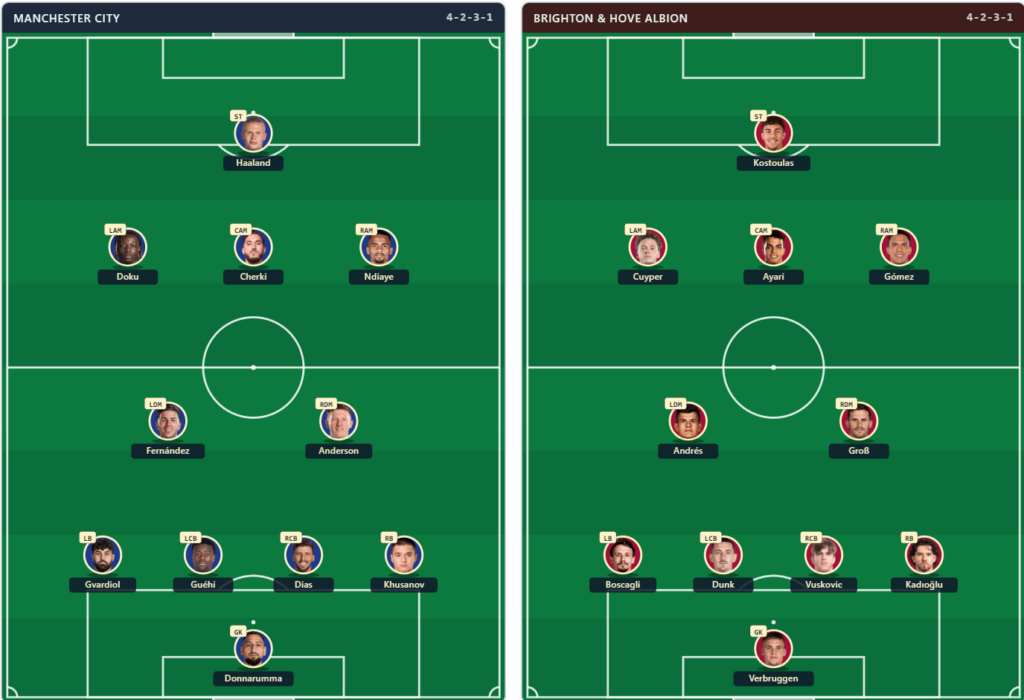
Probable Brighton & Hove Albion Starting Lineup (4-2-3-1): Verbruggen; Kadioglu, Vuskovic, Dunk, Boscagli; Gross, Andres; Gomez, Ayari, De Cuyper; Kostoulas
Brighton are without Zadok Yohanna due to a lack of fitness. Additionally, Pascal Struijk (hamstring), Kaoru Mitoma (thigh), Evan Ferguson (ankle), Femi Azeez (thigh), and Stefanos Tzimas (knee) remain in the treatment room. The good news is Ferdi Kadioglu is returning from a hip injury and is likely to start for the away side. So, his selection is one to watch rather than a settled absence. Chema Andres is also available after being rested in the midweek EFL Cup tie.
The away side’s likely XI also keeps the 4-2-3-1 as their regular choice, though the 4-3-3 remains the alternative if Fabian Hurzeler wants another midfielder. Bart Verbruggen starts in goal behind Ferdi Kadioglu, Luka Vuskovic, Lewis Dunk, and Olivier Boscagli. Kadioglu’s return gives Brighton their preferred right-back option. Dunk should anchor the defence, while Boscagli, with 11 key passes from left-back, provides a creative outlet from his flank.
As for the midfield unit, Chema Andres and Pascal Gross form the double pivot, with Gross the more established controller after eight starts, three goals, four assists and 23 key passes, the most in the Premier League. Andres has five appearances and four starts, and his role is to balance the midfield rather than dominate the attacking numbers.
Diego Gomez and Maxim De Cuyper should flank Yasin Ayari behind Charalampos Kostoulas. De Cuyper leads Brighton’s expected wide creativity with 19 key passes and three big chances created. Kostoulas is the central outlet, carrying three goals and three assists from seven starts. Ayari’s three goals give him an intriguing attacking return, although his involvement has been brief.
Tactics: Two possession-oriented teams, one central test
Manchester City’s 4-2-3-1 setup is built to keep two midfielders behind the attacking line, give Rayan Cherki room between the lines and leave Erling Haaland as the fixed reference in the box. They should carry the game forward from a settled structure rather than chase it recklessly.
Brighton’s version of the same shape keeps a double pivot behind three attacking midfielders, offering protection when the wide players advance and leaving Charalampos Kostoulas available as the forward outlet. Their plan is more measured. The Seagulls can pursue the win, but they do not need to turn the match into an open exchange.
The two profiles point to a meeting between two sides that want substantial control of the ball. Manchester City average 65.5% possession and Brighton also average the same figure, both well above the league’s typical 48% norm. Enzo Maresca’s men also shoot 15 times per match against a league figure of 12.5, while Brighton shoot 17 against that same mark.
City’s habit is therefore not simply to circulate the ball; it is to turn territory into repeated attempts. Brighton’s comparable control comes with a greater willingness to attack the goal from varied positions. The important difference is what happens when the first build does not produce clean progress.
Brighton play 55.5 long balls per match against a league typical 49.25, while City play 43 against the same figure. The visitors can therefore go over the midfield and contest the next ball when City’s patient build-up is blocked. The home side’s front-foot approach depends on keeping the game in front of their defensive line; Brighton’s more direct outlet can pull the match into second-ball contests and expose the space behind City’s advancing structure.
That is where the selected shapes meet. Jeremy Doku should attack Brighton’s right side from City’s left, with Ferdi Kadioglu asked to keep the defensive spacing intact while also coping with the returning defender’s limited starting rhythm.
On the other side, Iliman Ndiaye and Maxim De Cuyper will look to stretch the full-backs and create crossing routes; both clubs operate in a high-crossing range, but neither has a clear measured edge there. The larger question is whether City can use the width to open the middle for Cherki, or whether Brighton can keep their two midfielders close enough to deny him the space behind the forwards. The main duel remains Erling Haaland against Lewis Dunk.
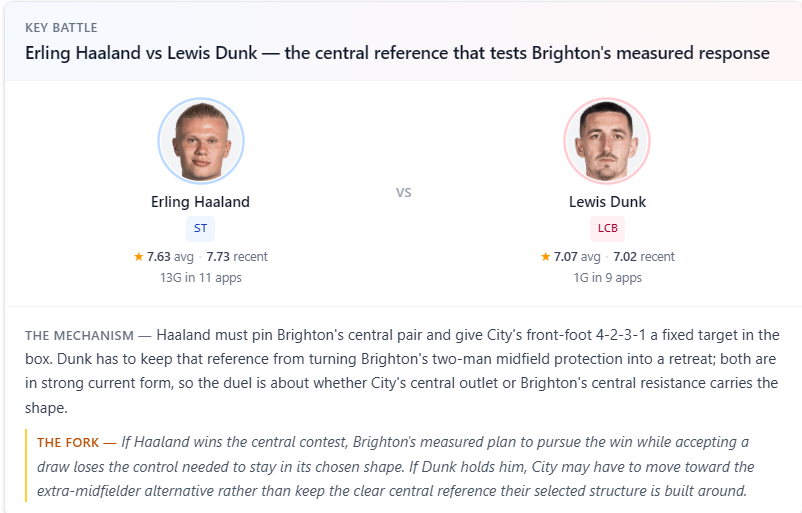
Haaland is a central target who pins defenders and gives City a reliable destination when possession reaches the final third. Dunk’s job is not only to challenge him in the air or on the ground; he must stop Haaland from fixing Brighton’s centre-backs so firmly that the double pivot is forced backwards to protect them.
Both players bring strong current form, making this less about an individual mistake and more about which team’s central idea survives contact. If Haaland, a top FPL captaincy pick for Gameweek 9, wins that contest, City can keep Brighton defending around a fixed point and force the visitors into a deeper version of their chosen plan.
If Dunk holds the reference, Maresca’s side may find that their attacks become more dependent on the wide players and Cherki’s movement, while Brighton retain enough midfield protection to play the controlled away game they want. Behind Dunk, Brighton have two holding midfielders who can narrow the space, but their presence becomes defensive cover rather than an attacking platform if Haaland repeatedly wins the first contact.
Prediction: City lean home, but Brighton can make it uncomfortable
We predict a Manchester City win, though only with medium confidence. The clearest separation is the attacking baseline. The Citizens average 2.32 xG per match across the recent five-game aggregate, compared with Brighton’s 1.91. That does not remove the visitors’ threat, but it supports the expectation that City will create the larger volume of dangerous pressure if their central reference remains effective.
City’s home advantage in the call is also tied to the way Erling Haaland fits their selected structure. If he occupies Lewis Dunk and the other centre-back consistently, Rayan Cherki can receive in the spaces that open around the central pair, while Jeremy Doku and Iliman Ndiaye can attack the full-backs from wider areas.
Lean: Manchester City win
Range: 2-1/2-2/1-1
The hosts’ recent run also shows 14 goals scored across five matches, but they have conceded nine in that same run. So, so the prediction lean is based on their ability to sustain attacks rather than on a fully reliable defence. The strongest case against City is Brighton’s ability to turn their possession into a different kind of pressure.
Their attack has scored 23 league goals, more than City’s 20, and their direct outlet can bypass the home midfield when the host commit numbers forward. If Charalampos Kostoulas contests the first ball and Brighton collect the second, Diego Gomez, Maxim De Cuyper, and Yasin Ayari can attack a defence that has already been exposed by errors at Aston Villa.
That route could produce the 2-2 and 1-1 outcomes in the range, even if City remain the more likely winner. The scoreline band is 2-1, 2-2, or 1-1.
The change that can rescue City’s central control
Enzo Maresca has a clear adjustment if Lewis Dunk prevents Erling Haaland from becoming the fixed point of the attack. Manchester City can move to a 4-3-3 and add another midfielder to the first line.
That would give the home side an extra passing option against Brighton & Hove Albion’s double pivot, but it would also change the protection behind the wide attackers. The decision should depend on whether City are failing to reach Haaland or merely failing to win the second ball after finding him.