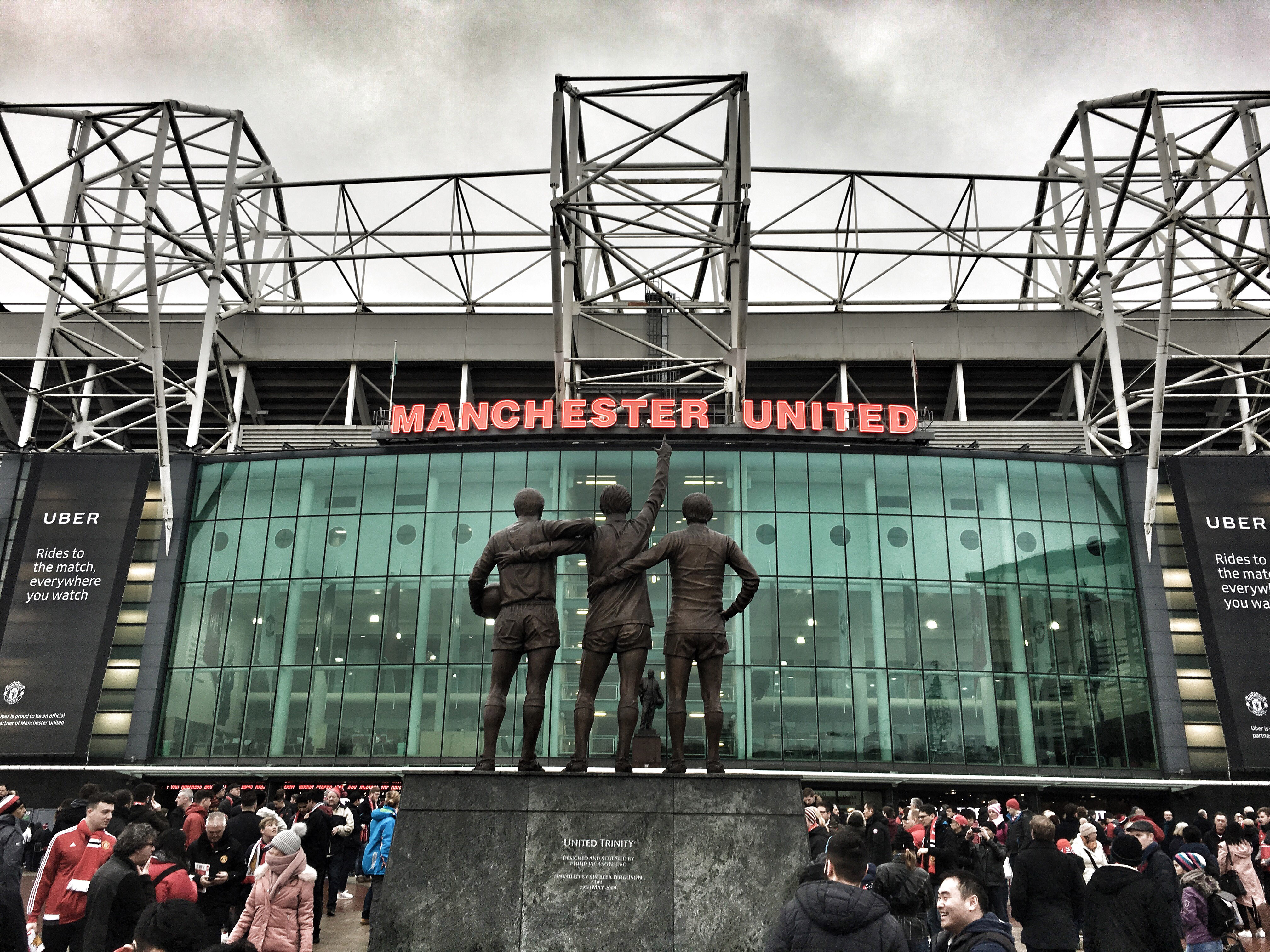
It is a statement opportunity for Manchester City and a recovery test for Manchester United heading into the Manchester Derby at Old Trafford on Sunday.
Manchester City’s 2-0 win over FC Porto in the UEFA Champions League on Tuesday, with Erling Haaland scoring twice, extended their perfect start to the 2026/27 season and sharpened the contrast before this derby. The new midfield has clearly settled quickly under new manager Enzo Maresca.
Meanwhile, Manchester United had to absorb the demands of a 4-0 European win over Sabah only three days before City’s visit. The match is worth more to United in practical table terms. A win moves them into the Champions League places, while a draw will be another setback at the start of the season.
City remain atop the table heading into Gameweek 4 and should remain in the top four whatever the result. However, a victory would turn early momentum into a significant away statement. United need the win to make their recovery against Sabah look real rather than merely possible. Their four points from three Premier League matches leave little room for another passive result, even though the European performance restored some confidence.
They have won their last three home Premier League games, but conceding twice in those matches shows why this is not yet a settled defensive proposition. Their recent chance creation has been strong, and the home side should carry the belief that an aggressive performance can change the direction of the campaign. The short turnaround from Thursday’s European outing can still affect how long they can sustain that intensity.
Manchester City arrive with the more convincing run and more freedom over the result. Four straight wins across the Premier League and the UEFA Champions League have given Maresca’s side a platform, and they can pursue the derby without treating a draw as a damaging outcome.
Haaland’s brace in Portugal underlined the threat Manchester United must manage, while the new midfield has shown enough cohesion to support an assertive away performance. City’s established shape should help them control the game, but the opening derby of the new regime asks whether that control survives the emotional and tactical pressure of Old Trafford.
Team News: Manchester United’s settled core faces one City selection question
Manuel Ugarte is out for Manchester United with an ACL tear. Amad Diallo is unavailable due to an ankle complaint, while Carlos Baleba remains out with an ankle injury and Matthijs de Ligt continues his rehabilitation from a long-term lower-back problem. Those absences reduce the depth available around the midfield and defence, leaving Kobbie Mainoo and Youri Tielemans as the expected double pivot and making the established back four particularly important.
The home side should line up in a 4-2-3-1 formation, the system they have used throughout their run in the 2026/27 season thus far. Senne Lammens should feature between the sticks behind Luke Shaw, Lisandro Martínez, Harry Maguire and Diogo Dalot. Shaw has supplied one assist and five key passes in three appearances, while Maguire has started all three Premier League matches and has played 270 minutes.
As for the midfield unit, Kobbie Mainoo should continue beside Youri Tielemans. He has one assist from three appearances, and Tielemans has started all three of his games while producing five key passes. The pair gives United the cover needed for Bruno Fernandes to move higher, rather than asking the captain to spend the whole match building from deep.
Fernandes takes creative charge for Manchester United. He has three goals, one assist, and eight key passes in three Premier League outings thus far, making his role between the lines the clearest route into City’s defensive structure. Marcus Rashford is expected to start from the left wing after two starts and eight key passes in three appearances, while Bryan Mbeumo holds the right-sided role after scoring twice and putting four of eleven shots on target.
Finally, Matheus Cunha should lead the line; he has created two big chances and supplied one assist in three starts. Manchester United’s front four therefore has enough recent production to justify playing forward, but the balance depends on the two midfielders protecting the spaces left behind.
Probable Manchester United Lineup (4-2-3-1): Lammens; Dalot, Maguire, Martinez, Shaw; Tielemans, Mainoo; Mbeumo, Bruno Fernandes, Rashford; Cunha
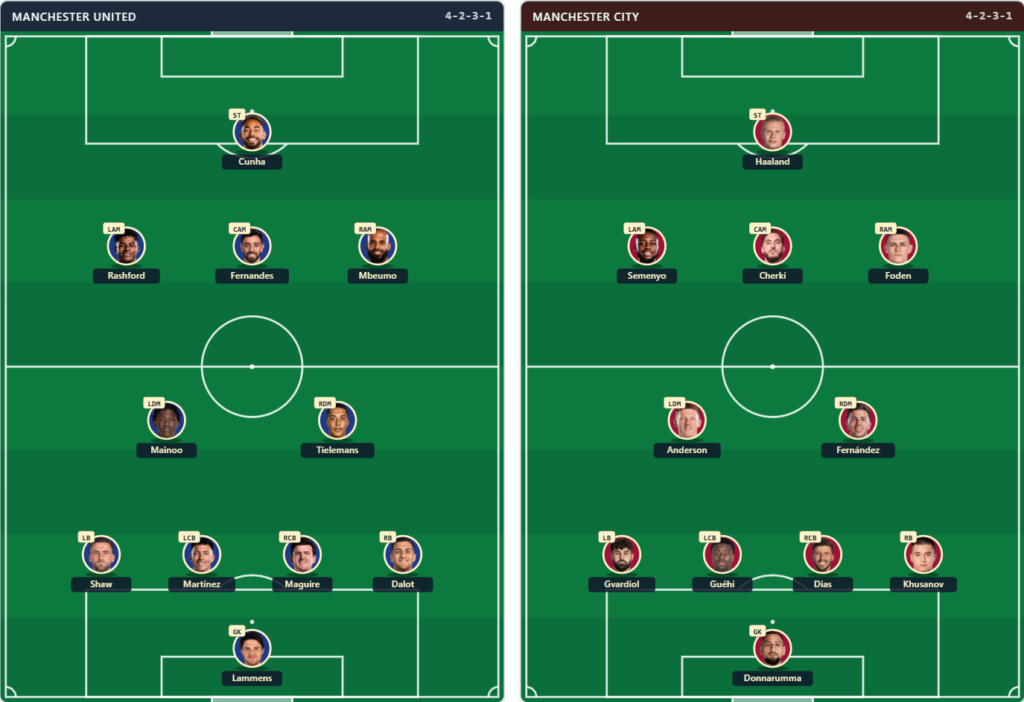
Probable Manchester City Lineup (4-2-3-1): Donnarumma; Khusanov, Guehi, Dias, Gvardiol; Enzo Fernandez, Anderson; Foden, Cherki, Semenyo; Haaland
Jeremy Doku is doubtful for Manchester City with a calf injury, and he should return next week. Rayan Cherki should start centrally behind Erling Haaland, pulling the strings in the advanced areas. Antoine Semenyo will feature on the left flank, with Phil Foden getting the nod over Iliman Ndiaye on the right wing.
Cherki has two goals, two assists and ten key passes in three appearances, while Foden has supplied two assists and created three big chances. Elliot Anderson should anchor the midfield, with Enzo Fernandez likely to line up alongside him in the double pivot.
At the back, Josko Gvardiol, Marc Guehi, Ruben Dias, and Abdukodir Khusanov should form the backline, with Gianluigi Donnarumma behind them. Haaland starts as the fixed central reference after three goals and eight shots on target from fourteen attempts.
Tactics: The central spaces decide whether Manchester United can impose themselves
Manchester United’s 4-2-3-1 setup is designed to keep Kobbie Mainoo and Youri Tielemans behind Bruno Fernandes while allowing the skipper to receive between Manchester City’s midfield and defence. At home, Michael Carrick’s men should carry the game forward rather than retreat into a low-risk approach. Their measured profile supports that intention.
United have had 60% of the ball per match against a league-typical figure of 44%, while City have had 72% against the same benchmark. City are the stronger possession side, but the home side’s numbers still point to a team comfortable trying to dictate rather than simply defend. That is where the two plans meet.
City’s double pivot gives them a platform to circulate the ball and keep the match under control, while Manchester United need Fernandes to find the pockets behind it. The away side’s 4-2-3-1 setup also frees Rayan Cherki or Phil Foden to connect with Erling Haaland without sacrificing the protection of two deeper midfielders.
The visitors should pursue the win, but they can also accept a draw and avoid turning the contest into an open exchange. Manchester United are more likely to keep committing players forward because their recovery objective demands initiative. The wider tactical danger for City is the dead ball.
Manchester United’s recent European and Premier League output has included substantial set-piece chance creation, while City’s recent attacking work has been more dependent on open play. If Carrick’s men sustain pressure and force fouls around the penalty area, they can turn their aggressive approach into a different kind of threat.
The away side will want to keep the match moving and avoid giving Manchester United repeated transitions, because defending those situations would pull them away from the controlled structure that has carried their start. Meanwhile, the main duel is Bruno Fernandes against Elliot Anderson.
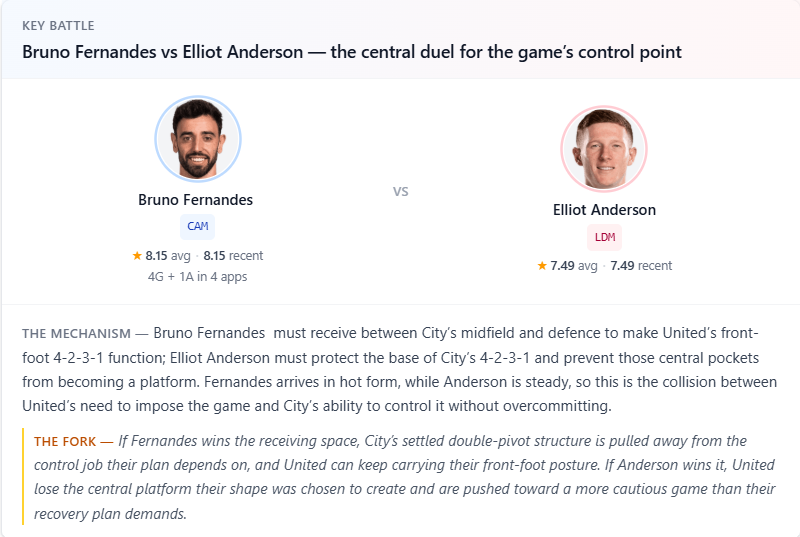
That duel also has consequences behind it. Fernandes is not simply trying to beat one midfielder; he is trying to expose the gap before Ruben Dias and Marc Guehi are forced to step out. Anderson, meanwhile, has the protection of City’s centre-backs if he can delay the pass, while Manchester United’s double pivot must cover the spaces created when their creator moves higher.
Matheus Cunha versus Marc Guehi is the secondary mechanism. The Brazilian must occupy the centre-backs and connect the attack to his captain, while Guehi’s current form gives Manchester City a strong chance of containing that reference point. If Cunha cannot keep the line engaged, United’s attacking midfielders may receive too far from goal.
Prediction: City have the stronger platform, but Manchester United can make it uncomfortable
We are leaning towards a Manchester City win, held with medium confidence rather than certainty. The clearest separator is the defensive platform. The visitors have allowed 0.56 expected goals per match across their four games this season, compared with 0.91 for Manchester United over the same window.
That difference matters in a derby where both sides have enough attacking quality to create pressure, because City have shown the more reliable basis for surviving periods when the opponent carries the game. The season-long chance balance points in the same direction.
Enzo Maresca’s men sit 0.389 above their expected-goals balance, while Manchester United are 0.453 below theirs. That does not remove the home side’s route to a result. Bruno Fernandes can still receive between the lines, the Red Devils can force set pieces, and the home attack has enough recent production to punish a lapse.
Lean: Manchester City win
Range: 1-2/1-1/0-2
The strongest case against the away win is that United’s front-foot pressure turns the match into repeated attacking phases before City can establish their preferred circulation. If the hosts make Fernandes influential early and keep Cunha occupying the centre-backs, Maresca’s side may be pushed into defending rather than managing the contest.
City should still be better equipped to absorb that pressure. Their recent defensive record has been markedly tighter. Haaland gives them a fixed outlet when they regain the ball, and their ability to settle for a draw means they do not need to chase the match recklessly. The likeliest scoreline range is 1-2, with 1-1 and 0-2 also credible.
The last call is how much Manchester City trust the second pivot
The selection of Manchester City’s second holding midfielder could alter the balance without changing the nominal formation. A more progressive choice would give the away side greater help in escaping Manchester United’s pressure but could leave Elliot Anderson handling Bruno Fernandes’s receiving zones with less immediate support.
A more conservative interpretation would protect the central space and make the draw easier to secure, though it could surrender some of the initiative that has powered City’s start. That decision may determine whether the visitors control the derby from the outset or spend long spells defending their advantage.