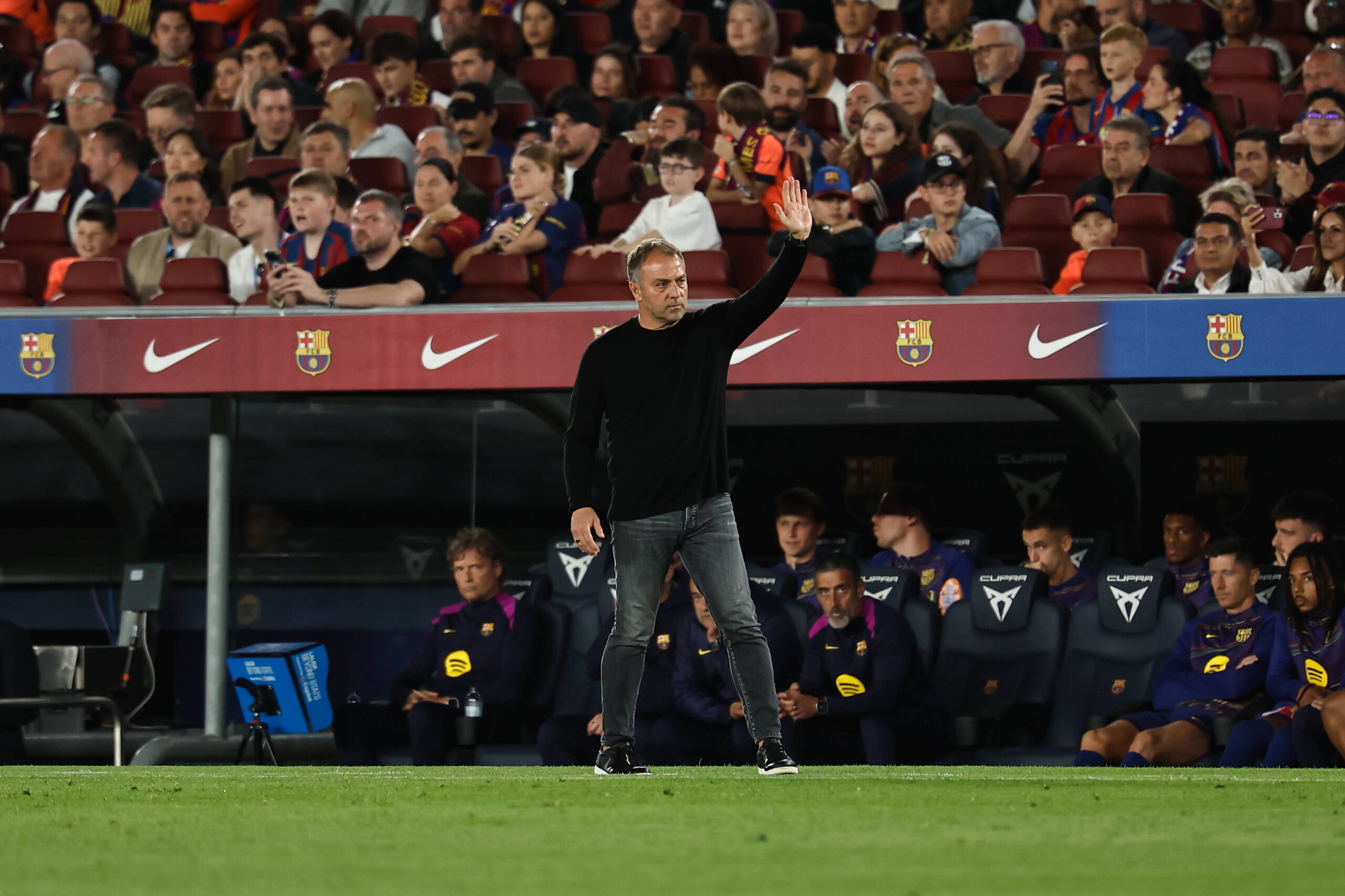
With Robert Lewandowski gone and no replacement in sight, Hansi Flick must reimagine Barcelona’s attack; here are three striker-less systems that could work.
Barcelona’s summer has been defined by absence. Robert Lewandowski left as a free agent after four seasons and 120 goals, while Ferran Torres is closing in on joining Paris Saint-Germain. The club have explored deals for Harry Kane and Julian Alvarez, but both look increasingly unlikely.
With pre-season underway and the league about to begin, Hansi Flick must find a way to field a credible front line without a traditional striker. The answer may not be to force a late signing, but to rethink the shape of the attack altogether.
Barcelona possess enough intelligent, mobile forwards to experiment with fluid systems that do not rely on a fixed number nine. Here are three viable ways Flick could line up, plus a wildcard option that could catch opponents off guard.
Anthony Gordon as the number nine

The most straightforward adjustment is to deploy Anthony Gordon as a striker, flanked by Raphinha on the left and Lamine Yamal on the right. Gordon has operated as an out-and-out striker for Newcastle, and his fluid movements along with Raphinha and Yamal could make them even more difficult to contain.
In this setup, Barcelona would not have a permanent presence in the box, but they would gain a player who constantly looks to run into space behind defences. Raphinha and Yamal, both capable of cutting inside and shooting, would provide the vertical threat. Pedri and Gavi (or Fermin Lopez) could sit deeper, controlling tempo and feeding quick combinations to the front three.
This system works best against teams that sit deep. Gordon’s movement can drag centre-backs out of position, creating channels for the wingers to exploit. It also suits Flick’s preference for verticality: controlled possession in buildup, followed by sudden acceleration into dangerous areas. The risk is a lack of physical presence in aerial duels, but against most La Liga sides, Barcelona’s technical superiority should compensate.
Dani Olmo as a false nine
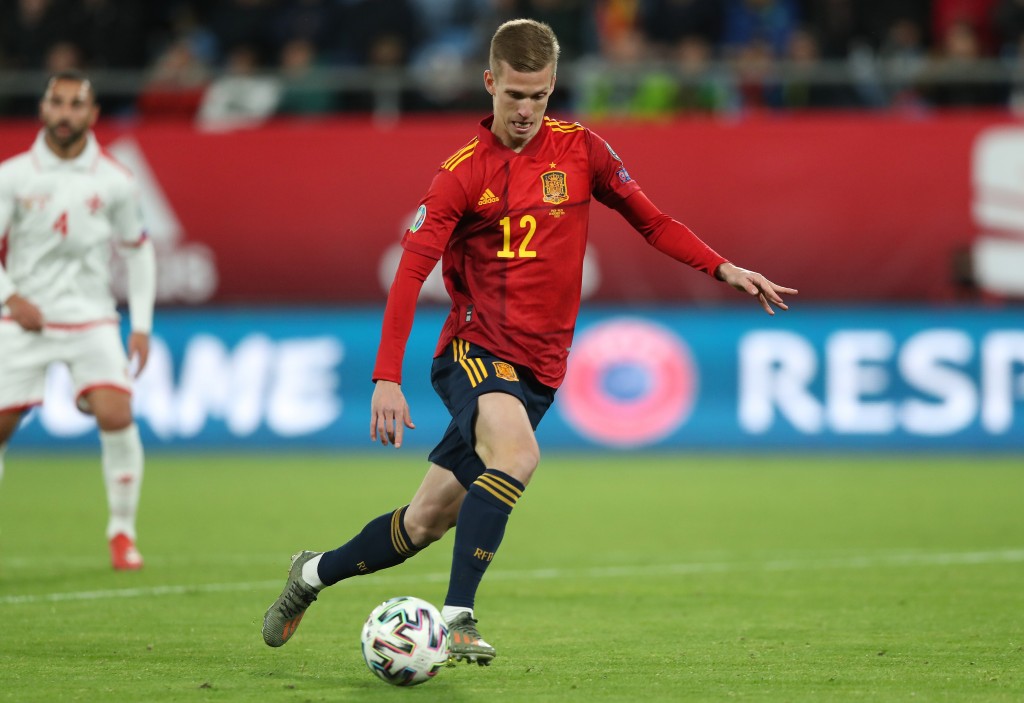
Dani Olmo is perhaps the most natural candidate for a false nine role. The Spaniard began his career as a striker at La Masia before evolving into an attacking midfielder and winger, and he has filled the central forward position on several occasions for club and country.
His ability to drop deep, link play and finish clinically makes him an ideal fulcrum in a striker-less system. With Olmo as the false nine, Flick could pair Yamal on the right with either Raphinha or Gordon on the left.
The wide players would be instructed to attack the space vacated by Olmo when he drops towards midfield. This creates a constant dilemma for opposition defenders: follow Olmo and leave space behind, or stay and allow him to turn and face goal.
This approach mirrors the fluidity Barcelona displayed under Pep Guardiola, particularly when Lionel Messi was moved centrally in 2009. Olmo would not be expected to win aerial battles, but rather to orchestrate attacks, combine with Pedri and Fermin, and arrive late in the box. It is a high-intelligence system that demands excellent timing from the wide runners, but Barcelona have the personnel to execute it.
Raphinha as the false nine
Raphinha has emerged as another strong candidate for the false nine role. His movement off the ball, pressing intensity and knack for arriving in scoring positions align closely with what Flick wants from his central forward.
During pre-season, the coaching staff reportedly viewed him as a clear option to play through the middle. In this configuration, Gordon and Yamal would occupy the wide positions, with both players encouraged to make diagonal runs behind the defence.
Raphinha’s role would be to drop into midfield, draw defenders, and release his teammates with quick passes. His experience as a winger means he understands the timing of runs better than most, which could make this system particularly effective.
This setup also allows Barcelona to maintain width without sacrificing central control. When Raphinha drops, either Gordon or Yamal can drift inside to occupy the half-spaces, creating overloads in midfield. With Raphinha as a false nine, Dani Olmo could also feature in midfield as another top creator. He could make runs into the box when the Brazilian drops deep.
The wildcard: Hamza Abdelkarim as the main striker
If Flick wishes to take a calculated risk, he could promote Hamza Abdelkarim, a young prospect who has impressed in training. While not a proven goalscorer at senior level, Abdelkarim offers pace, directness and a willingness to run into channels, traits that could unsettle defences unaccustomed to facing him.
This option would likely be reserved for specific matchups, perhaps against teams that struggle with high pressing or lack pace in defence. It would also send a message to the squad that opportunities exist for those who perform, regardless of reputation. However, it is not a long-term solution and should be used sparingly.
He is a proper striker, so he will be ever-present in the box, and while he is only 6ft, he is great in the air. So, he could give them something different in comparison to all the other options discussed.