When the 2026 FIFA World Cup draw paired Cape Verde with Spain, Uruguay and Saudi Arabia, the script appeared to have already been written.
Spain arrived as one of the tournament favourites. Uruguay possessed generations of World Cup pedigree. Saudi Arabia had recent experience of competing on football’s biggest stage. Cape Verde, meanwhile, were making their debut, representing a nation of just over half a million people that had never previously qualified for the competition.
Most prediction models gave the Blue Sharks roughly a 1% chance of surviving the group stage without being defeated. Yet, less than two weeks later, they have become the story of the tournament after producing one of the greatest underdog achievements in World Cup history.
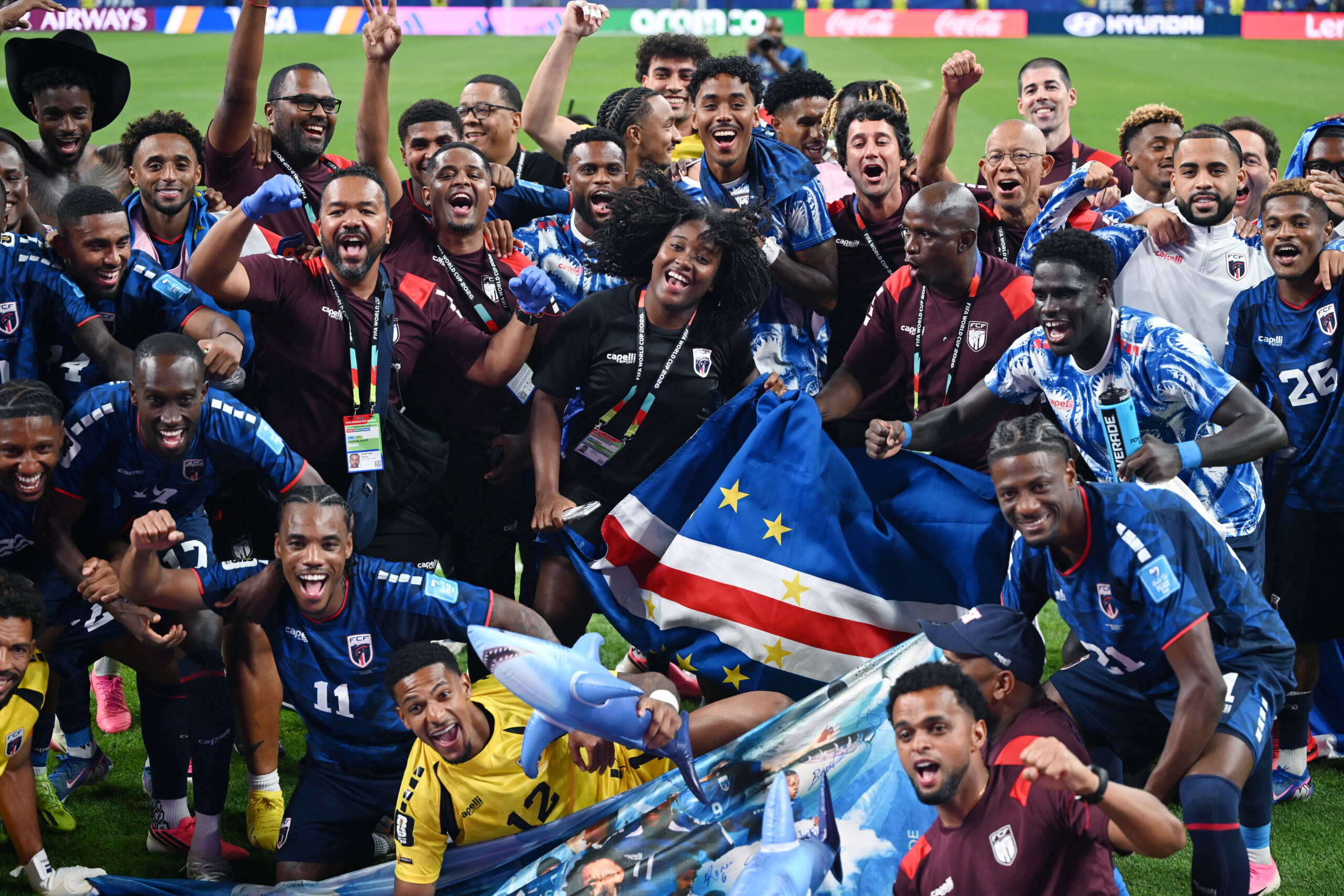
An unbeaten group campaign featuring draws against Spain, Uruguay, and Saudi Arabia was enough to secure second place in Group H. The reward for that effort has been to set up a glamour Round of 32 clash with defending champions Argentina.
The achievement is remarkable not because Cape Verde dazzled opponents with attacking football, but because they understood exactly what they were and refused to be anything else. We now take a look at how this tiny island nation has rewritten history on the biggest stage.
The art of survival
International tournaments are often won by teams capable of adapting. Cape Verde have taken that principle to its absolute extreme. Rather than trying to match technically superior opponents in open contests, coach Bubista has built one of the most disciplined defensive units in the competition.
Every player understands his role. Defensive distances remain compact, midfield runners are relentlessly tracked, and possession is treated as a valuable commodity rather than an obligation.
Against Spain, they frustrated one of the world’s finest passing sides into a frustrating goalless draw, with Vozinha the hero of the game. Six days later, they recovered from setbacks twice to hold Uruguay 2-2 in perhaps the most entertaining performance of their campaign. Finally, knowing a point could be enough, they delivered another disciplined defensive display to draw 0-0 with Saudi Arabia before celebrating qualification once Spain defeated Uruguay.
Three draws may not appear spectacular on paper, but context changes everything.
Cape Verde finished ahead of two nations with vastly superior footballing resources and decades of World Cup experience. They conceded only two goals across three matches, demonstrating defensive consistency that few expected from tournament debutants. For a country with limited infrastructure, a relatively small pool of professional players, and modest financial resources, every point felt like a victory.
Maximising every available resource
Cape Verde’s rise has not happened overnight. For years, the national team has depended heavily on players born or developed abroad, particularly in Portugal, the Netherlands, France, and other European countries with significant Cape Verdean communities. Rather than viewing that diaspora as a compromise, the federation embraced it.
Many members of this squad developed inside respected European academies before choosing to represent the land of their parents or grandparents. That has given Bubista a squad filled with players accustomed to professional environments despite the country’s limited domestic football infrastructure.
Recruitment has also been intelligent rather than glamorous. Instead of chasing big names, Cape Verde have prioritised players who understand the tactical identity of the national side. Every selection appears based on functionality rather than reputation.
There are no passengers. The collective works because everyone buys into the same defensive philosophy. That unity has become their greatest competitive advantage. But a few players, in particular, have impressed.
Deroy Duarte: The midfield conductor
Among the standout performers has been midfielder Deroy Duarte. His influence extends far beyond statistics. The 26-year-old has provided the calmness that every underdog requires in possession. When opponents have dominated territory, he has consistently found the right pass to relieve pressure, allowing Cape Verde to move higher up the pitch instead of defending wave after wave of attacks.
His work without the ball has been equally valuable. Duarte covers enormous distances, protects the back four and repeatedly disrupts opposition transitions before they become dangerous. It was no surprise that Duarte was recognised as Player of the Match after helping secure qualification. Afterwards, he described reaching the knockout rounds as a dream come true, sentiments shared across the entire nation.
Vozinha: The veteran guardian
Every team that is a surprise package needs a goalkeeper capable of producing moments that statistics cannot fully explain. For Cape Verde, that man has been Vozinha.
The experienced goalkeeper has been one of the tournament’s quiet stars, producing a string of important saves while organising one of the competition’s most disciplined defensive units. His positioning has been outstanding throughout the group stage.
Rather than spectacular acrobatics every few minutes, Vozinha has excelled through anticipation, commanding his penalty area and making difficult saves appear routine. Against Spain, his composure frustrated elite attackers.
Against Saudi Arabia, the 40-year-old delivered another assured display under immense pressure with qualification on the line. Tournament football often rewards dependable goalkeepers over spectacular ones, and Vozinha has embodied exactly that principle, the outing against Uruguay notwithstanding..
Pico Lopes: Symbol of the Cape Verde story
If one player represents Cape Verde’s extraordinary journey, it may be defender Pico Lopes. His personal story mirrors the nation’s rise. Once balancing life away from elite football, the 34-year-old has become an inspirational figure in one of the World Cup’s biggest surprises.
His performances throughout the group stage combined aggressive defending with excellent positional awareness, helping Cape Verde remain unbeaten despite facing technically superior opposition. Lopes’s celebrations after qualification were famously interrupted by a mandatory doping test, a fittingly surreal ending to one of the greatest nights in Cape Verdean sporting history.
Can the dream continue?
The reward for finishing second is hardly generous. Waiting in the Round of 32 are reigning world champions Argentina, one of the favourites to lift the trophy once again. On paper, the gap between the two nations is enormous.
Argentina possess world-class talent across every position, tournament-winning experience and attacking quality capable of overwhelming almost any defence. Yet Cape Verde has already spent three matches proving that paper means very little once the whistle blows.
Spain failed to score. Uruguay could not beat them. Pressure has never truly rested on Bubista’s side because expectations have already been exceeded. That freedom could become their greatest weapon.
Argentina will dominate possession, but Cape Verde have repeatedly demonstrated they are comfortable defending for long periods before capitalising on isolated moments in transition or from set pieces.
No one is suggesting they are favourites. But then, nobody expected them to escape Group H either.
A legacy beyond results
Whatever happens against Argentina, Cape Verde has already transformed perceptions of what smaller footballing nations can achieve. Their success validates FIFA’s expanded tournament format by demonstrating that emerging nations are capable of competing rather than merely making up the numbers.
Coach Bubista himself has argued that football’s biggest competition should belong to every nation willing to dream, not only the traditional elite. For young footballers growing up across the islands, qualification alone would have been historic. Progressing to the knockout rounds changes everything.
It provides belief. It attracts investment. It inspires another generation. Perhaps most importantly, it reminds the football world that international tournaments remain unique because they occasionally allow organisation, unity and courage to overcome wealth, reputation and history.
Cape Verde arrived in North America, expected to leave quietly after three group matches. Instead, the Blue Sharks have become the heartbeat of the 2026 World Cup. Their journey has already entered football folklore. And if this extraordinary tournament has taught us anything, it is that writing off Cape Verde has become a very dangerous habit indeed.