Liverpool vs Arsenal at Anfield on Sunday will be a battle of two Premier League title hopefuls eager to keep pace with Manchester City.
Arsenal’s 3-0 defeat to Brighton & Hove Albion remains the warning attached to an otherwise excellent opening, while Liverpool have built a five-game winning run that has carried them into this contest. The Gunners responded to the defeat to Brighton with a five-game unbeaten run but then lost their EFL Cup tie to Fleetwood Town on penalties, adding a small question mark to a side otherwise positioned to control the early title race.
This meeting matters to both clubs without becoming a win-only scenario. Liverpool need progress from fourth and 15 points, while Arsenal are second on 21 and can keep their target live with a draw. The historical backdrop favours the hosts less than the venue does, with Arsenal winless in their last 13 league visits to Anfield.
For Liverpool, the result is valuable because it would turn momentum into a direct statement against one of the sides above them. A draw would not derail their season, but a defeat would leave their excellent run looking less convincing against the strongest opposition they have faced in this spell.
The Reds have beaten Brentford and Brighton in their two more recent Premier League outings, with both teams being top-four opponents at the time. So, they carry the attacking outlet that makes this a difficult assignment for Arsenal. Alexander Isak has scored six times in seven league appearances and has become Liverpool’s clearest route from early pressure to a goal.
The one selection issue that could alter the balance is Dominik Szoboszlai’s thigh problem; his doubt matters because Liverpool already have to decide how much central running they want from their double pivot. On the other hand, Arsenal can treat this as an opportunity to protect their position rather than a night that demands reckless pursuit.
Winning would strengthen their title platform, but a draw would still keep the target live, whereas defeat would give Liverpool a result that narrows the gap and validates the hosts’ rise. Arsenal have won seven of their opening eight league matches, and their latest league performance showed the control Liverpool must disrupt.
The Gunners had 58% possession and produced 20 shots. The visitors also arrive with a more established managerial platform, although the absence of Bukayo Saka means their right side has to be rebuilt for this test. The North London club’s inability to beat Liverpool at Anfield is also a challenge they must overcome.
Team News: The predicted teams and the roles altered by absences
Dominik Szoboszlai is doubtful after suffering a hamstring injury at Brentford, while Giovanni Leoni (ACL), Conor Bradley (knee), Jeremie Frimpong (hamstring), and Hugo Ekitike (Achilles tendon rupture) are also unavailable. The latter absences reduce the alternative routes Liverpool could use if the usual shape fails, while Ryan Gravenberch inherits more responsibility in midfield.
Liverpool’s expected 4-2-3-1 setup has been the clear choice, used in all five of their recent matches. Alisson Becker is an automatic pick in goal, with the familiar back four of Ronald Araujo, Jeremy Jacquet, Virgil van Dijk, and Milos Kerkez likely to provide the platform behind Alexis Mac Allister and Ryan Gravenberch.
Van Dijk has started all eight of his appearances and has a 7.10 average rating, while the impressive Jacquet has also started every match and has played 685 minutes. Those two selections give Liverpool continuity in the central defence. The midfield pairing is more important than the settled names around it.
Mac Allister should start on the left of the double pivot after making six starts, and his eight key passes underline his value when Liverpool regain the ball and need the first forward pass. Gravenberch is expected to take the other holding role despite a colder recent spell; he has made four starts and supplied one assist.
Florian Wirtz should operate behind Isak, with Cody Gakpo on the left and Bradley Barcola on the right. Wirtz has produced 22 key passes in eight appearances and should be the player connecting Liverpool’s midfield release to the striker. Gakpo and Barcola give the hosts two wide threats rather than a system built entirely around Isak. The Swede has put nine of his 20 shots on target, so the direct service has a clear finishing point.
Probable Liverpool Starting Lineup (4-2-3-1): Alisson; Araujo, Jacquet, van Dijk, Kerkez; Gravenberch, Mac Allister; Barcola, Wirtz, Gakpo; Isak
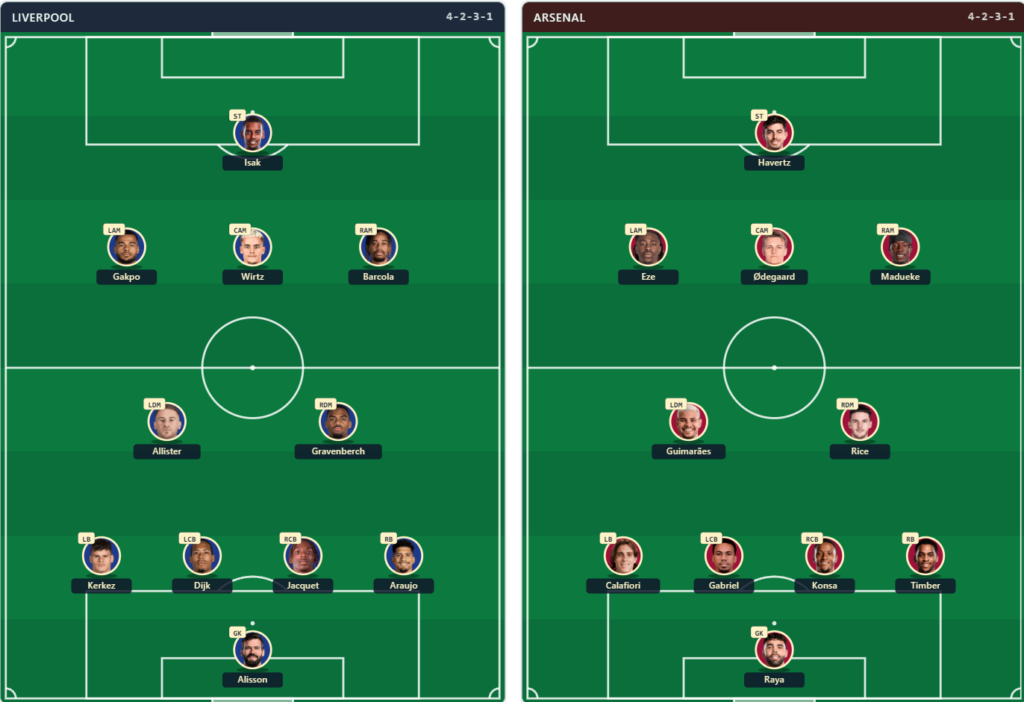
Probable Arsenal Starting Lineup (4-2-3-1): Raya; Timber, Konsa, Gabriel, Calafiori; Rice, Guimaraes; Madueke, Odegaard, Eze; Gyokeres
Mikel Arteta has a new roster issue to worry about ahead of the trip to Anfield. Max Dowman is suspended for three games following his red card against Fleetwood Town and the subsequent failed appeal, leaving Arsenal with fewer alternatives if the match becomes stretched. Bukayo Saka is the most notable absentee due to a muscular injury, while William Saliba (back) remains unavailable.
Arsenal are also expected to use a 4-2-3-1 formation this weekend. David Raya starts behind Jurrien Timber, Ezri Konsa, Gabriel Magalhaes, and Riccardo Calafiori. The central defensive pairing will be asked to absorb Liverpool’s direct release. Meanwhile, Saka’s absence means Noni Madueke should take the right attacking position.
As for the midfield unit, Declan Rice and Bruno Guimaraes form the base, with Rice bringing four assists and 15 key passes from eight starts. Martin Odegaard remains the central creator after starting all eight matches, and Eberechi Eze should play from the left, as Christos Tzolis is unlikely to be fit enough to start. Kai Havertz is likely to lead the line after scoring twice and putting seven of his 14 shots on target.
Tactics: Arsenal’s control meets Liverpool’s direct release
Liverpool’s 4-2-3-1 setup is designed to keep two midfielders behind Florian Wirtz and the wide attackers while still leaving Isak as the forward reference. They can carry the game at home, but the shape only works if the first pressure leads quickly to a forward action rather than a long spell of harmless circulation.
Arsenal’s version is more conservative in its spacing. Declan Rice and Bruno Guimaraes sit behind Martin Odegaard, allowing the wide players to support Kai Havertz without exposing the centre. The two profiles show the central contrast.
Arsenal average 59% possession and Liverpool 55.5%, with both above the league’s 48% typical figure. So, neither side is naturally a purely defensive team. The Reds are the more direct of the two, using 50 long balls per match against Arsenal’s 39.5, with the league-typical norm at 49.25. That does not make Liverpool a long-ball side in isolation, but it does show where their quickest route lies when the away side’s midfield line is set.
Arsenal’s territorial control also comes with a dead-ball threat. They generate 0.514 xG from set pieces per match, compared with Liverpool’s 0.1575, against a league typical 0.2465. The hosts therefore have to defend the first phase of the match without conceding the fouls and corners that allow the Premier League champions to turn possession into a different kind of pressure.
The Merseyside club’s own recent win over Brighton & Hove Albion came with only 36% possession, which shows that Liverpool can survive without the ball. The key question is whether they can turn those moments of recovery into enough danger here. The main system contest runs through Alexis Mac Allister and Declan Rice.
Mac Allister has to support the pressure and release Alexander Isak from the left side of Liverpool’s midfield, while Rice must connect Arsenal’s first build-up to Martin Odegaard without allowing Andoni Iraola’s team to lock the game in the visitors’ half.
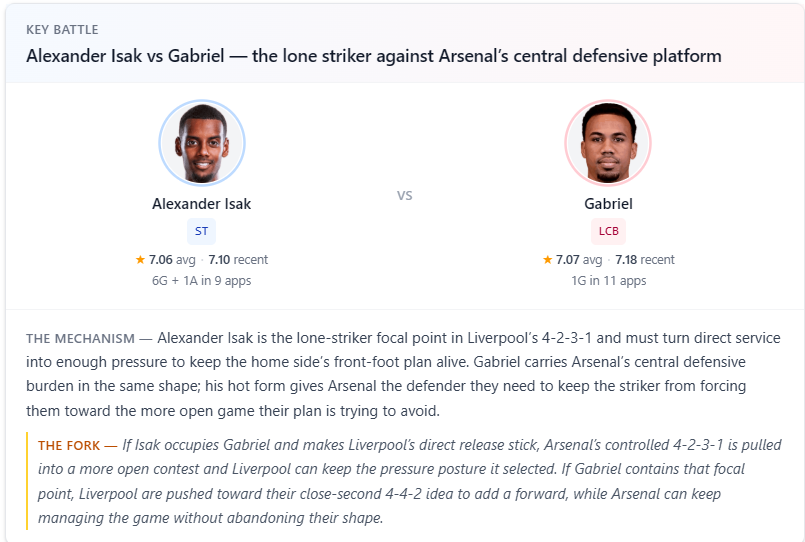
If Mac Allister wins that first central release, Arsenal’s controlled approach loses its route into sustained possession. If Rice wins it, the away side can keep the ball moving and make Liverpool defend for longer phases. Neither player needs to dominate individually for his team to benefit; the important point is which shape can remain connected. The decisive duel is Isak against Gabriel.
Isak is the lone-striker focal point for the home side, while Gabriel is the central defender most responsible for preventing the direct ball from becoming a platform for Liverpool’s attacks. If the Swede occupies Gabriel, makes the first contact, and keeps the Merseyside club’s pressure alive, Arsenal will be pulled into the open contest they would rather avoid.
If the Brazilian defender contains Isak, Liverpool may have to move toward a 4-4-2 by adding a second forward, which would increase the threat but reduce the midfield cover behind it. Arsenal would then be able to manage the match without abandoning their basic structure.
Prediction: Arsenal have the stronger platform, but Liverpool can make it uncomfortable
We predict Arsenal to secure a historic win for the first time at Anfield in 13 years, held with medium confidence rather than certainty. Their ability to keep the match in the areas they prefer is the main separator. The Premier League champions have averaged 0.95 xGA in their recent five-match run, while Liverpool have created 1.83 xG per game across the same window but conceded 1.43.
That combination points to a contest where the Reds can score, yet Arsenal have shown the more reliable defensive floor. The strongest case against our prediction is Alexander Isak winning the central battle with Gabriel Magalhaes.
Lean: Arsenal win
Range: 1-2/1-1/0-0
If Liverpool’s direct service sticks, Florian Wirtz and the wide attackers will receive the second ball closer to Arsenal’s penalty area, and the home side can sustain the pressure their shape is built to produce. The visitors’ preference to protect the draw could then become a problem.
Sitting in the match without regaining control would invite Liverpool to turn territory into repeated chances. Liverpool’s momentum is real, and this is the route by which it can overwhelm Arsenal’s careful management.
The expected scoreline sits in the 1-2, 1-1 or 0-0 range. Arsenal’s defensive base and greater control make the away win the more likely outcome, but the goals angle is less clean than the result call because Liverpool have enough attacking quality to score.
The late adjustment that can change Arsenal’s control
Arsenal have a clear structural change available if Liverpool begin winning the central release. A move to 4-3-3 would add another midfielder to contest the second line and help protect the possession platform. Liverpool’s alternative is more aggressive, shifting to 4-4-2 to put another forward beside Alexander Isak. That gives the hosts a way to change the match, but it also asks them to surrender some of the cover that makes their pressure sustainable.