Chelsea vs Manchester United at Stamford Bridge on Saturday will feature two teams desperate to end their recent winless runs.
Manchester United’s 3-0 home defeat to Bournemouth has made this a test of whether their possession can produce anything more than territory, while Chelsea’s 4-3 loss on penalty shootouts to Liverpool followed a 2-0 league loss to Tottenham. Both sides arrive needing to stop a poor domestic sequence, but the pressure points are different.
Chelsea are trying to protect their platform while keeping the higher targets within reach; United need a result that begins to repair a season already below expectation. The meeting is worth more than a routine three points, even though neither side is at the stage where one result settles its campaign.
For Chelsea, victory would strengthen their position near the European places and keep the UEFA Champions League route open. A draw would protect some ground but leave their recent league record looking increasingly unstable, while defeat would deepen the sense that their difficult run is becoming a pattern.
Their response at Anfield was competitive enough to take Liverpool to penalties, yet the league defeats around it mean the home side cannot afford another flat performance. The selection also has to absorb several absences, with the central striker position particularly important to how much threat Chelsea can carry into the penalty area.
Manchester United have a more urgent need to change the direction of the season. A win would keep the European targets alive and give the under-fire Michael Carrick relief after a run without success, while a draw would leave them close to the bottom of the immediate pack and a loss would compound the damage of the Bournemouth defeat.
The Red Devils are not playing a final, but the pressure is visible. They have dominated the ball in their broader profile without converting that control into enough goals, and the latest loss offered the clearest example. Their established shape gives them a route into the match, though the visitors must make their possession more productive than it was last time out.
Team News: The expected teams and the jobs they must perform
Chelsea are without Emiliano Martinez (surgery on broken jaw), Reece James (knee), and Joao Pedro (thigh), while Pep Chavarria is a doubt because of an unknown injury. Joao Pedro’s absence removes the leading recent scoring contributor from the selection pool. So, Danny Welbeck is expected to lead the line as the available central forward.
Emiliano Martinez’s absence leaves Mike Penders likely to continue in goal, with Chelsea lining up in a 3-4-2-1 formation vs Manchester United. Wesley Fofana is also a probable call, as Maxence Lacroix may miss out due to a hamstring complaint. The rest of Chelsea’s expected structure is recognisable.
Levi Colwill should occupy the left side of the defence, while Josh Acheampong is likely to take the right-sided centre-back position. Jorrel Hato should provide the left wing-back width, with Pedro Neto on the other side. Hato has six starts and three assists, while Neto has started seven times and produced three goals and one assist, although his recent form has been uneven.
As for the midfield unit, Moises Caicedo and Jordan Henderson should form the double pivot. Caicedo supplies the screening work, while Henderson brings a more secure selection and has two goals and one assist in four starts. Morgan Rogers and Cole Palmer remain the creative pair behind Welbeck.
Rogers has four goals, one assist, and 14 key passes from eight starts; Palmer has two goals, three assists and 17 key passes from the same number of starts. Chelsea should therefore line up in their usual 3-4-2-1, the shape used in three of their last four matches.
Probable Chelsea Starting Lineup (3-4-2-1): Penders; Acheampong, Fofana, Colwill, Hato; Henderson, Lavia, Caicedo; Neto, Palmer, Rogers
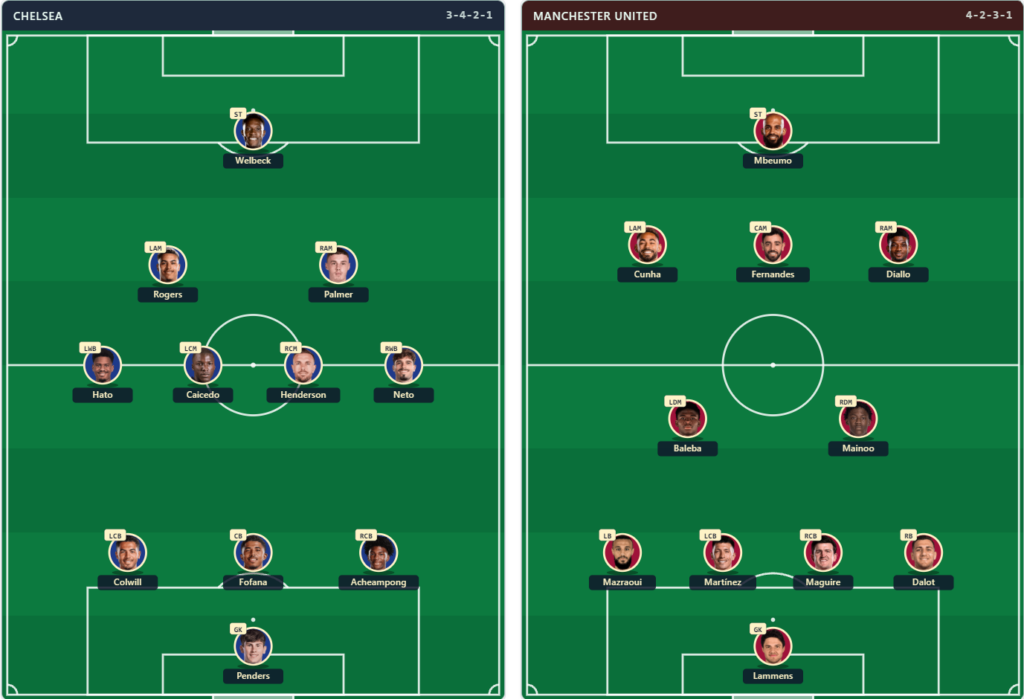
Probable Manchester United Starting Lineup (4-2-3-1): Lammens; Dalot, Maguire, Martinez, Mazraoui; Mainoo, Baleba; Amad, Fernandes, Cunha; Mbeumo
Manchester United are missing Manuel Ugarte (knee), Patrick Dorgu (thigh), and Benjamin Sesko (shin), with Luke Shaw also unavailable due to an unspecified issue. Sesko’s injury removes another central attacking option behind Bryan Mbeumo. Noussair Mazraoui is expected to fill the left-back slot.
Harry Maguire and Lisandro Martinez should form the centre-back pairing, with Mazraoui and Diogo Dalot being the two full-backs. As for the midfield unit, Carlos Baleba and Kobbie Mainoo are the expected double pivot.
Amad Diallo is likely to start from the right side of the attacking unit. Matheus Cunha should operate from the left, with Bruno Fernandes between the midfield and the striker after his clear-the-air talks with Carrick. The skipper has three goals and 16 key passes in seven starts, while Mbeumo has scored four times in eight starts and remains the clearest central scoring outlet.
Tactics: Neto’s lane and the battle for central access
Chelsea’s 3-4-2-1 setup is designed to keep three defenders behind the ball while allowing the wing-backs to supply width and Rogers and Palmer to play close behind Danny Welbeck. In possession, that can become a 3-2-5, but without the ball it should retain enough central protection for Chelsea to pursue the win without turning the match into an open exchange.
Manchester United’s 4-2-3-1 system keeps Bruno Fernandes between the double pivot and the front line, with Carlos Baleba and Kobbie Mainoo responsible for protecting the space behind him. Both sides should try to win while preserving the draw, so the first phase is likely to be controlled rather than reckless. The two profiles point to a clear difference in how the match may reach the box.
Chelsea average 13 crosses per match against a league-typical figure of 17, while United average 19.5 so far. Xabi Alonso’s men also sit at 47.5% for ball dominance against the league’s 48% norm, whereas United are at 56%. The visitors are therefore more likely to seek territory and delivery, while Chelsea’s profile is closer to a controlled, selective use of the ball.
Chelsea’s long-ball figure is 49 per match against a league typical 49.25, compared with Manchester United’s 43.5 against the same mark. That suggests the visitors are not simply planning to bypass midfield despite their stronger crossing route. That creates the wider system contest.
Chelsea’s wing-backs must stop Manchester United turning possession into repeated deliveries, while the away side’s full-backs have to prevent Pedro Neto and Jorrel Hato from giving the home side a clean outlet around the back four. Neto meets Noussair Mazraoui in the most important lane.
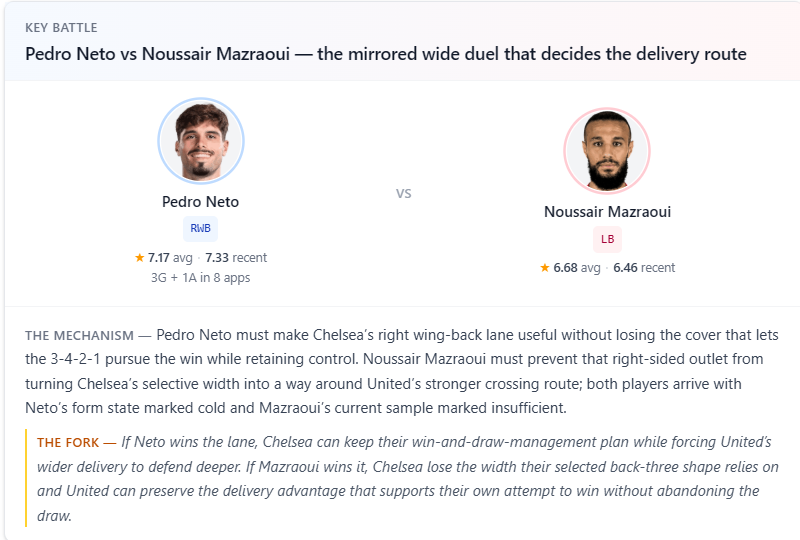
If Neto can push Mazraoui back, Chelsea can keep their two attacking midfielders connected to Welbeck and make Manchester United defend rather than cross. If Mazraoui contains the Portuguese international, Manchester United can preserve their wider route and force the home side’s back three to defend a greater number of balls into the area.
This is also where Manchester United’s latest performance matters without being treated as a forecast. They had only 37% possession in the defeat to Bournemouth, despite their longer-window profile showing a strong preference for having the ball.
Chelsea’s compact three-man base can test whether United can recover that control. If Fernandes receives cleanly between the lines, the visitors can keep the match in the structure they prefer; if Palmer finds that pocket first, Chelsea can attack through the two-number-ten setup without exposing Moises Caicedo and Jordan Henderson.
The key duel is Pedro Neto against Noussair Mazraoui because it links the two sides’ contrasting routes. The Portuguese international must provide the right-sided width without leaving Chelsea’s defensive cover exposed, while Mazraoui has to prevent that outlet from turning the home side’s selective attack into a way around United’s stronger delivery game.
There is no spare specialist behind Neto if he is pinned, because Chelsea’s shape relies on the wing-back to stretch the pitch. Conversely, Mazraoui cannot simply retreat. Doing so would give Chelsea territory and leave Manchester United’s crossing plan dependent on deeper, less stable possession.
If Neto wins the lane, Chelsea can manage the game with their three-man base and keep Manchester United’s wide players defending. If Mazraoui wins it, the Blues lose a major source of width and United can keep their own plan intact without abandoning the draw. Palmer and Fernandes form a second, central version of the same contest. The player who gets cleaner access behind the midfield line will decide whether the lone striker is supported or isolated.
Prediction: Chelsea have the steadier route, but not a safe one
We predict a Chelsea home win, but with medium confidence rather than strong conviction. Their shape gives them a more stable platform for the attacking midfielders, and the home side’s recent attacking baseline is marginally stronger. Xabi Alonso’s charges average 0.95 xG per match across their latest four, compared with 0.85 for United across their latest five.
Manchester United have 1.37 xGA per match in that window, while Chelsea have allowed 1.13. Those figures do not guarantee a home victory, but they support the hosts as the side more likely to turn its structure into enough chances. The strongest case against that call is Chelsea’s finishing running ahead of the quality of chances created across the season.
Lean: Chelsea win
Range: 2-1/1-0/1-1
The Blues have scored 17 goals from 10.6655 xG, leaving the home win vulnerable if that conversion rate falls back. Manchester United can also make the counter-case through Bruno Fernandes, Bryan Mbeumo, and their stronger crossing profile. If the Red Devils control the wide areas and force Chelsea’s wing-backs deep, the home side may struggle to connect Palmer and Rogers to Welbeck.
A 1-1 draw is therefore a realistic outcome if Manchester United’s possession finally becomes productive. The likely scoreline range is 2-1, 1-0 or 1-1. Chelsea are the better bet on the match result, but the edge is narrow enough to demand caution rather than an aggressive position.
The shape change Chelsea can still make
Chelsea’s clearest in-game adjustment is to move from the 3-4-2-1 into a 4-2-3-1 if the two attacking midfielders are being crowded out. That would add a central midfielder and give the home side another way to protect the middle without relying so heavily on wing-back progression. Manchester United’s structure is more settled, so this is the selection and tactical lever most likely to change the match after the opening phase.