Hull City vs Brentford at the MKM Stadium on Sunday will feature two teams eager to bounce back after narrow defeats in Gameweek 7.
Hull City’s 1-0 defeat at Fulham exposed a side that, in Sergej Jakirovic’s assessment, lost the possession battle, the first and second balls, and the physical contests. Brentford’s setback was different. They lost 2-1 to Liverpool, ending a remarkable run in which they had scored first in each of their opening seven league matches. This is therefore a meeting of two teams seeking a response, but not from the same kind of disappointment.
The result matters to both clubs because European ambitions are still live. Hull can move towards that part of the table with a win, but another poor result would make the pressure around their early-season position harder to ignore, particularly after an impressive start.
Brentford are already in the European conversation and can strengthen their push towards the Champions League places, while a draw would at least stop their Liverpool defeat becoming the beginning of a slide. Neither side has been placed in a win-or-collapse situation.
Hull’s task is to show that defeat to Fulham was an isolated performance rather than a return to the problems of last season. Their earlier wins over Manchester United and Coventry City, together with draws against Aston Villa, Chelsea, and Everton, give them a more convincing platform than the latest defeat suggests.
The Tigers are carrying a settled defensive structure into this game, but the response has to be more competitive without abandoning the protection that has defined their recent approach. Any result that leaves them passive for long spells would make the European route feel less credible.
Brentford arrive with the stronger recent momentum despite losing to Liverpool, having scored first in every league match before that game. They want to recover immediately, but the cost of chasing too recklessly is giving Hull the kind of open second phase their direct attack needs.
The away side should therefore try to impose themselves without turning the match into a frantic contest. Their midfield absences make that balance more difficult, because the response must come within the same basic structure rather than through a wholesale tactical change.
Team News: Suspensions reshape Brentford’s midfield
Hull City have several players unavailable, including Jack Butland (elbow), Eliot Matazo (ACL), Darko Gyabi (groin), and Charlie Hughes (inguinal hernia). Lucas Gourna-Douath is set to return from a calf problem this weekend. The absences reduce the depth available around the squad, but the predicted starting structure still has its established spine.
Konstantinos Tzolakis is an automatic pick in goal, John Egan centrally and Semi Ajayi on the right side of the back three. The uncertain calls are on Hull’s left side of midfield and in the central roles. Lucas Herrington is expected to join Egan and Ajayi after six appearances, although only two have been starts.
Regan Slater should continue on the left of the midfield pairing; he has started seven matches, created two big chances, and provided five key passes. Matt Crooks is likely to take the right-sided central role, a selection that gives Hull continuity around second balls even though his involvement has been less productive, with one key pass in 338 minutes.
Ryan Giles and Lewie Coyle should hold the wing-back positions, while Sorba Thomas provides the left-sided from an advanced role. Giles has created four big chances and nine key passes, and Mohamed Belloumi brings the clearest attacking numbers on the other side: three goals, two assists, and six shots on target from eighteen attempts.
Oli McBurnie should lead the line for Hull City vs Brentford in the 5-4-1, the shape Hull have used throughout their recent run. He has started all seven Premier League games, with one assist and seven key passes, and his presence gives the long forward pass a fixed target rather than leaving the attack dependent on runners arriving late. The selection should therefore look familiar from back to front, with Belloumi the main call for turning a second ball into an actual attack.
Probable Hull City Starting Lineup (5-4-1): Tzolakis; Coyle, Ajayi, Egan, Herrington, Giles; Belloumi, Iroegbunam, Slater, Thomas; McBurnie
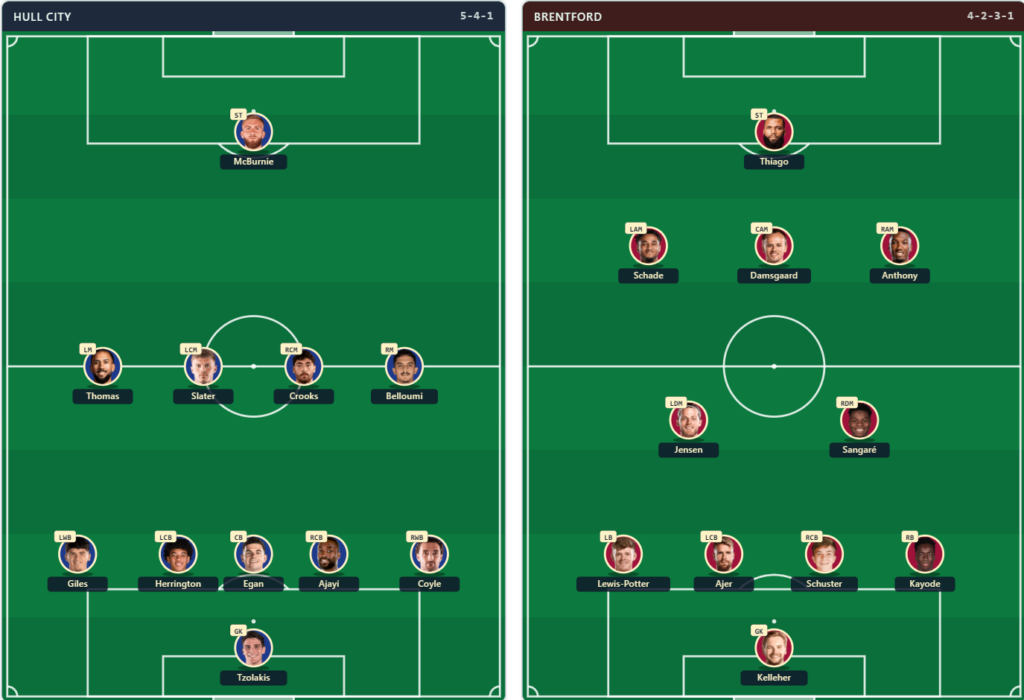
Probable Brentford Starting Lineup (4-2-3-1): Kelleher; Kayode, Schuster, Ajer, Lewis-Potter; Sangare, Jensen; Anthony, Damsgaard, Schade; Thiago
Brentford are without Vitaly Janelt and Yegor Yarmolyuk after they were sent off against Liverpool last week. Antoni Milambo is out with a match-fitness issue, while Kaye Furo is recovering from foot surgery. However, there is some positive news, as Kevin Schade is returning from a shoulder injury.
The two midfield suspensions remove the usual options from the screen in front of the defence, so Mathias Jensen and Mamadou Sangare are expected to form the unfamiliar pairing. Caoimhín Kelleher should continue in goal behind Kristoffer Ajer, Jannik Schuster and Michael Kayode, with Keane Lewis-Potter at left-back. Ajer has started every match and scored once, while Schuster has made three starts and carries a 7.08 average rating.
Mikkel Damsgaard is the central attacking link, with Kevin Schade and Jaidon Anthony supplying the wide support for Igor Thiago. Anthony has a goal, an assist and eight key passes; Thiago has contributed one goal, one assist and six key passes. Brentford’s likely formation remains 4-2-3-1, but the central screen is the part of the team most likely to affect how confidently it functions.
Tactics: Hull’s long route vs Brentford’s wider pressure
Hull City’s 5-4-1 system is designed to keep an extra centre-back behind the direct outlet and protect the draw while still offering a route towards three points. Their profile shows a side that plays with 31% of the ball against a league typical 49.5%, while Brentford’s share is 43% against the same figure. That gap should leave the visitors with more of the territory, but Hull will not regard possession alone as a problem if Oli McBurnie can make the first forward pass playable.
The contrast is also visible in how the teams attack. Hull make 56 long-ball attempts per match against the league typical 49.5, whereas Brentford are at 49 against that same figure. The Bees are more inclined to stretch the structure from the outside. They produce 18 crosses per match against a typical 16.5, compared with Hull’s 15.
The away side also carry the greater dribbling volume, with 15 take-ons per match against Hull’s 10, either side of the league typical 14.5. That gives Brentford several ways to move the home side’s five-man line before looking for Igor Thiago. Both managers should take a controlled risk.
Hull will seek a response but can accept a draw, so their full-backs should not be asked to attack simultaneously for the whole game. Brentford are in the same position. They can pursue the win without exposing themselves as if only victory mattered. Their shape should try to keep the two midfielders connected to the defence, then use Keane Lewis-Potter and Jaidon Anthony to work around Hull’s outer centre-backs.
The away side’s recent four-match attack has produced 1.37 xG per game, while Hull have 1.46 xGA per game in that same recent window. That is the clearest numerical reason to expect Brentford to create the more sustained pressure. The systems meet first in the wide lanes and then around the central target.
Belloumi attacks from Hull’s right, where Lewis-Potter has to defend from Brentford’s left, while Ryan Giles and Sorba Thomas support Hull’s opposite side against Anthony and Michael Kayode. The away side’s wider route can force Hull’s full-backs deeper, cutting off the supply around Oli McBurnie.
Hull’s answer is to win the next contest after the first clearance and keep the ball moving forward rather than retreating into a long defensive spell. The Tigers’ recent run has brought no clean sheets, so the five-man line cannot rely on shape alone. The decisive duel is McBurnie against Ajer.
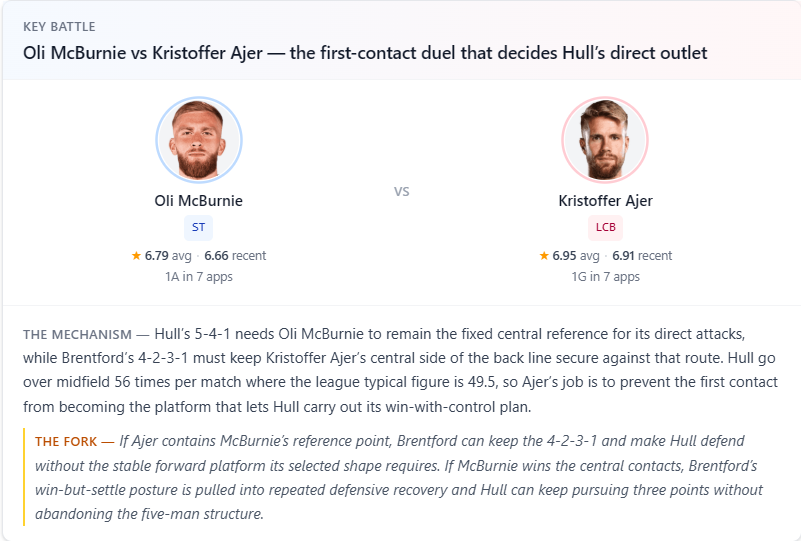
McBurnie is the fixed reference for Hull’s direct game; Ajer is the central defender expected to prevent that first contact becoming a platform. If the Norwegian defender contains the forward, Brentford can keep their two banks connected and make Hull defend without the stable outlet their formation needs.
If McBurnie wins enough central contacts, Brentford will be pulled into repeated recovery actions, and Hull can keep attacking without changing the five-man structure. Behind the duel, the hosts need Regan Slater, Matt Crooks, and Belloumi to collect the loose ball; alongside Ajer, Brentford need Jannik Schuster and the midfield pair to avoid leaving the striker isolated.
The secondary collision between Belloumi and Lewis-Potter may decide whether that central battle repeats often enough to matter. The Hull winger brings the stronger current attacking signal, while Lewis-Potter has the responsibility of preserving Brentford’s width from the deeper position.
If Belloumi wins the duel, Hull can turn clearances into forward pressure. If Lewis-Potter controls it, Brentford can keep the five-man block moving from side to side and make the home side’s direct outlet increasingly difficult to find.
Prediction: Brentford have the clearer route, but not a free pass
We are leaning towards an away win, held with medium confidence rather than strong conviction. Brentford’s 4-2-3-1 setup has the better route to stretch Hull City’s defensive shape, and the visitors’ crossing output gives them a way to attack without forcing Thiago to beat three centre-backs through the middle.
Hull’s direct plan can work, but it depends on winning the first contact and the second phase often enough to prevent Brentford from settling into territorial control. Keith Andrews’s men also carry the stronger dead-ball threat. Their set pieces produce 0.5 xG per match against a league typical 0.229, an edge that could punish Hull if the home side spend too much time defending wide deliveries and recoveries.
The away side have scored eight goals and conceded six across their last four matches, while Hull have scored five and conceded seven in the same run. The numbers point towards Brentford having the more reliable attacking pressure, even though their midfield replacements add uncertainty.
Lean: Brentford win
Range: 1-2/0-1/1-1
The strongest case against Brentford is Hull winning the contest between Oli McBurnie and Kirstoffer Ajer. If the striker holds the ball up, Mohamed Belloumi can attack the loose phase and Brentford’s reshaped midfield may be forced to defend facing its own goal.
That would make the visitors’ controlled approach less comfortable and could turn the match into a series of set plays and second balls rather than the wide, sustained pressure they want. The likely scoreline range is 1-2, 0-1 or 1-1. Brentford are the more credible winner, but a narrow game or a draw remains firmly in play.
Damsgaard’s link play can decide the final margin
The selection call that may quietly determine the match is Mikkel Damsgaard’s position behind Igor Thiago. If he connects the midfield pair to the front four, Brentford can attack the spaces created when Hull City’s full-backs are pinned back.
If that link disappears, the visitors may have possession without enough access into the striker or wide attackers. Hull are likely to make the game physical and direct; Brentford’s margin depends on whether their central attacking midfielder can turn that pressure into usable possession in the final third.