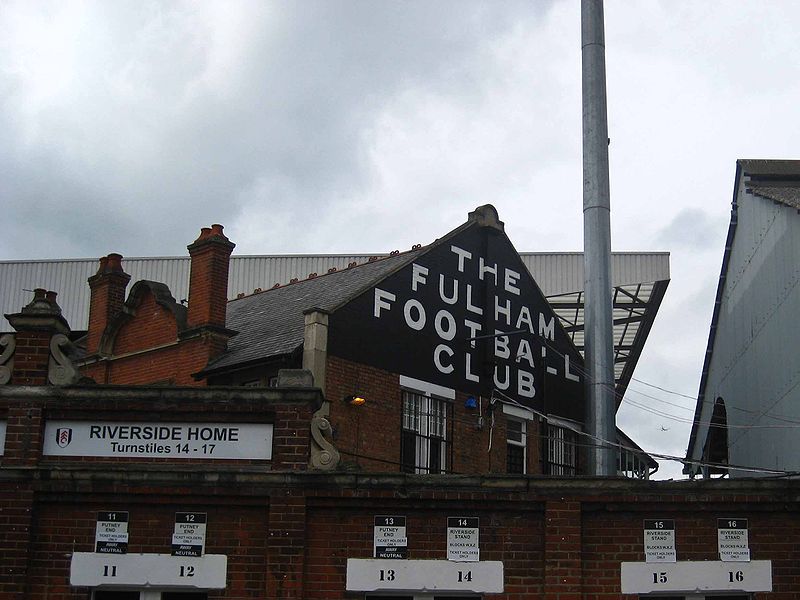
Fulham vs Hull City at Craven Cottage on Saturday will be a match between a struggling established team and a high-flying promoted side.
Fulham’s latest collapse against Ipswich Town has changed the mood around this fixture. The West Londoners led through Ryan Sessegnon’s second-half goal, only to concede twice after the 87th minute and suffer another defeat after surrendering a late advantage. That makes this a match about whether the Cottagers can turn initiative into control, rather than simply create promising moments.
On the other hand, Hull City arrive with a much stronger platform, but both sides have meaningful points to protect at this early stage. The hosts need their first league victory to ease the pressure around Alvaro Arbeloa. They are bottom with two points from six matches, and another draw would leave them in the relegation zone, while a win would only lift them into the lower mid-table range rather than transform their season immediately.
The defeat to Ipswich followed a pattern of narrow losses from winning positions. So, the hosts carry attacking evidence but little security. Their route to relief is to keep taking the game forward without allowing the same late defensive exposure. The availability of Antonee Robinson, Tom Cairney and Hugo Larsson remains relevant to that balance, with each player doubtful for different reasons.
On the other hand, Hull’s equation is less urgent. They have taken nine points from six matches and sit in the European qualification conversation, with a victory capable of moving them into fourth, while a draw keeps that wider target alive.
Sergej Jakirovic’s team therefore do not need to turn the match into an open exchange. They can protect their position, frustrate Fulham and wait for the opportunities created by their direct approach. Their momentum as a promoted side is a useful counterweight to the West Londoners’ pressure, although an injury crisis potentailly spells trouble.
Team News: The expected elevens reflect two very different problems
Fulham’s expected 4-2-3-1 shape should retain Bernd Leno in goal, with Timothy Castagne, David Affengruber, Calvin Bassey, and Ryan Sessegnon making up the likely back four. Sessegnon is the probable choice at left-back because Antonee Robinson is unlikely to be fit enough to start. Bassey is the defender Fulham will want handling Hull’s direct central service.
As for the midfield unit, Shea Charles and Sander Berge are expected to form the double pivot. The latter has been short of his best recently, so the midfield’s protection of the defence matters as much as its ability to start attacks. Josh King should operate between the lines, where his two goals and six key passes from six starts make him the clearest central attacking outlet.
Alex Iwobi and Oscar Bobb should occupy the wide attacking roles around Gonzalo Garcia. Iwobi’s thirteen key passes and four big chances created make the left side particularly important, while Bobb has supplied nine key passes and one big chance created from six starts. Garcia’s return of one goal shows why Fulham need the supporting players to create clean chances rather than leave him isolated.
Probable Fulham Starting Lineup (4-2-3-1): Leno; Castagne, Affengruber, Bassey, Sessegnon; Berge, Charles; Bobb, King, Iwobi; Garcia
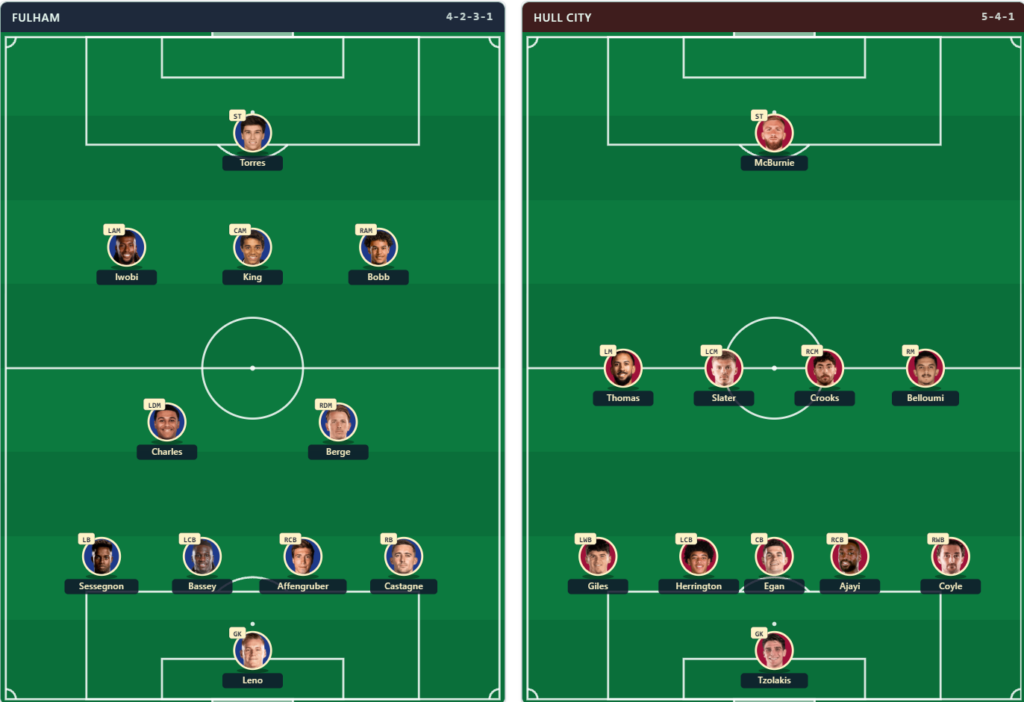
Probable Hull City Starting Lineup (5-4-1): Tzolakis; Coyle, Ajayi, Egan, Herrington, Giles; Belloumi, Crooks, Slater, Thomas; McBurnie
Hull City should line up in their established 5-4-1 formation vs Fulham. Konstantinos Tzolakis is an automatic pick between the sticks, behind a defensive unit of Lucas Herrington, John Egan and Semi Ajayi, with Ryan Giles and Lewie Coyle expected to operate as the wing-backs. Herrington deputises for Nobel Mendy, who misses out due to a groin injury.
As for the midfield unit, Regan Slater and Matt Crooks should sit in the central spots, with Sorba Thomas and Mohamed Belloumi supplying the wider support to Oli McBurnie. Belloumi is Hull’s most productive attacking selection with three goals, two assists, and six shots on target from fifteen attempts. McBurnie has contributed seven key passes and one assist, giving Hull a way to connect their direct passes even when he does not receive the ball in the box.
Apart from Nobel Mendy, Hull are without Matt Targett, Jack Butland, Eliot Matazo, Darko Gyabi, Lucas Gourna-Douath, Charlie Hughes, Oscar Zambrano, Jens Hjerto-Dahl and Ilyas Ansah, which helps explain the preference for retaining the five-man defensive structure.
Tactics: Iwobi’s space against Coyle may decide whether Fulham can pin Hull back
Fulham’s 4-2-3-1 setup is designed to let the double pivot protect the centre while Josh King, Alex Iwobi, Oscar Bobb, and Gonzalo Garcia connect the attack. The home side should be able to begin with familiar movements rather than spend the opening phase finding their positions. The risk is that the attacking quartet and advancing full-backs leave Shea Charles and Sander Berge exposed if possession breaks down.
Hull’s 5-4-1 system has the opposite purpose. The three centre-backs and two wing-backs give the visitors a compact defensive platform, while Oli McBurnie provides the first target for a more direct route forward. Fulham average 55% possession and Hull 31.5%, compared with a league-typical figure of 48%. So, the likely territorial picture is clear.
Fulham will have to circulate possession against a crowded defence, while Hull will be comfortable defending without it. Alvaro Arbeloa’s men are also more willing to carry the match to their opponents, whereas Hull can pursue the win without abandoning the draw if the block remains intact.
The wider areas are where those approaches meet. Iwobi’s left-sided position draws him toward Lewie Coyle’s right-wing-back zone, while Oscar Bobb’s right-sided role engages Ryan Giles on Hull’s left. The hosts need those players to hold Hull’s wing-backs deep and then connect inside to King. On the other hand, the Tigers need their wide defenders to close the route without losing the outlets that make the counterattack possible.
The Cottagers have averaged 17 dribbles per match against Hull’s 8.5, with the league-typical figure at 13.5. So, Fulham’s wide players are more likely to try to carry the ball beyond the first defender. The wider system also creates a second-ball test.
Hull use 58 long balls per match and Fulham 51.5, both above the league typical 49.75. So, this is not simply a possession side facing a team that refuses to play forward. Sergej Jakirovic’s men will try to bypass Fulham’s midfield and make the contest about the first contact around McBurnie, the next challenge and the space left behind the home full-backs.
Fulham’s recent four-match output has been 1.83 xG and 1.44 xGA, but only one clean sheet. That gives Hull a credible route into a game the hosts may otherwise dominate territorially. The primary duel is Alex Iwobi against Lewie Coyle.
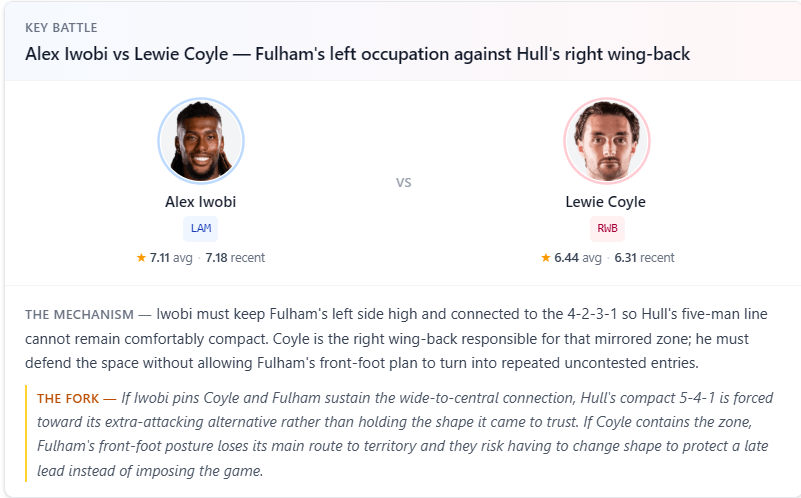
Iwobi’s recent attacking form and greater creative involvement make him the player most likely to turn Fulham’s left occupation into sustained pressure. However, Coyle’s job is not merely to block crosses. He must decide when to step out, when to hold the five-man line and when to follow Iwobi into the inside channel.
If Iwobi keeps Coyle pinned and links with King, Hull may have to abandon the compact 5-4-1 for a more attacking midfield shape if they fall behind. If Coyle contains the zone, Fulham lose their clearest route to territory and could be forced toward a back-three adjustment later if they need to protect rather than extend a lead.
Oscar Bobb and Ryan Giles provide the other important contest, but it is a different mechanism. The Norweigan winger must keep Hull’s left wing-back defending, while Giles is the visitors’ best chance of escaping pressure down that side.
If Bobb holds his marker deep, Hull lose one of their natural release points and McBurnie becomes easier to isolate. If Giles gets forward regularly, Fulham’s attacking shape will have to turn and defend, reducing the pressure it can sustain on Egan and the rest of the back three.
Prediction: A draw is the sensible lean despite Fulham’s home initiative
We predict a draw with medium confidence. Fulham should have more of the ball and the clearer obligation to attack, but their season output sits well below expectation, with a negative expected-goal difference of 3.696. Hull’s corresponding figure is positive at 1.465, which points to a side currently getting more from its chances and game management than the hosts have managed. That gap makes it difficult to trust Fulham simply because they are at home.
The strongest case against the draw is Fulham finally converting their pressure before Hull can settle. Alex Iwobi and Oscar Bobb can stretch the visitors’ five-man line, and Josh King has the positioning to receive behind Hull’s midfield if the wing-backs are pushed back.
Should the hosts score first, Hull may need to replace the extra defender with an attacking midfielder, creating the open spaces Fulham have been seeking. The opposing danger is equally practical. The away side’s long passing can send the game over Fulham’s midfield, and repeated second phases around Oli McBurnie or dead-ball situations could expose a defence that has struggled to close matches.
The scoreline band is 1-1, 2-2 or 0-0. Fulham’s pressure should produce enough territory to keep them competitive, but Hull’s compact structure and willingness to accept a controlled game make a home win too difficult to support confidently.
Fulham’s late-game switch could matter most
The selection that could change the match is Fulham’s ability to move into a 3-4-3 formation if they take the lead and need extra protection. That would allow the West London club to defend the central area with another centre-back while reducing the space Hull can attack after the first direct pass.
The Tigers have a corresponding attacking switch into 4-2-3-1 setup if they fall behind. However, Fulham’s defensive change is the more relevant late-game lever because it addresses the precise problem that has damaged their recent results: protecting an advantage without surrendering the game’s structure.