
Manchester United vs Aston Villa at Old Trafford on Sunday will be a meeting between two teams yearning for momentum.
Manchester United came from two goals down to beat AS Roma 3-2 at Old Trafford on Tuesday, ending a nine-game winless run. On the other hand, Aston Villa’s European momentum stopped with a 3-0 defeat to Barcelona at Camp Nou. Those results leave this meeting balanced between United’s renewed belief and Villa’s need to restore defensive control.
For Manchester United, the result is about building on the reaction to the Roma comeback rather than solving everything in one afternoon. They are 17th with seven points, and another failure to turn possession into a win would leave the pressure on Michael Carrick.
The comeback has lifted the mood, but their Premier League run remains the more important measure of whether that lift lasts. United’s repeated usage of the 4-2-3-1 formation gives them continuity, and the onus is now on them to build momentum amid links with Carrick’s opposite number.
Aston Villa, on the other hand, arrive with a different calculation. They are 10th on 12 points, and victory would keep the European places within reach. However, their league position allows Unai Emery to avoid turning this into an uncontrolled chase. Their five-match unbeaten league run gives them a platform that the Barcelona defeat shook rather than erased.
The concern is defensive. The Villans conceded thrice against the Blaugrana and now have to rebuild part of the right side, which may encourage a more careful approach away from home. Manchester United therefore have the emotional lift and the responsibility to make the running; Aston Villa have the steadier league base and more reason to accept a match that remains level deep into the second half.
That difference should shape the contest more than the midweek scorelines themselves. The managerial background also adds intrigue to the clash, particularly with Emery ready to snub Manchester United and commit his future to Aston Villa.
Team News: The predicted teams after two disruptions
Manchester United have Manuel Ugarte (knee) and Benjamin Sesko (shin) out with long-term injuries, while Luke Shaw is unavailable for the foreseeable future. Meanwhile, Patrick Dorgu (thigh) and Marcus Rashford (hip) are doubtful. Lisandro Martinez is suspended after being sent against Chelsea, while . However, Carlos Baleba is the latest absentee after sustaining a hamstring injury earlier this week against AS Roma.
The absences matter most in the defensive structure. Ayden Heaven is expected to join Harry Maguire in the centre, with Diogo Dalot and Leny Yoro completing the back four. Senne Lammens is an automatic pick in goal. Meanwhile, the double pivot will need to fill Baleba’s void.
Kobbie Mainoo and Andrey Santos are expected to sit behind Bruno Fernandes, whose central creative role is essential to the shape. The skipper has three goals and 19 key passes in eight appearances, ranking first in the squad for that chance-creation figure.
The attacking line should place Amad Diallo and Matheus Cunha in the wide attacking slots, with Bryan Mbeumo leading the line for Manchester United vs Aston Villa. Mbeumo has four goals from nine starts and has remained a regular presence across the campaign.
Probable Manchester United Starting Lineup (4-2-3-1): Lammens; Yoro, Maguire, Heaven, Dalot; Santos, Mainoo; Amad, Bruno Fernandes, Cunha; Mbeumo
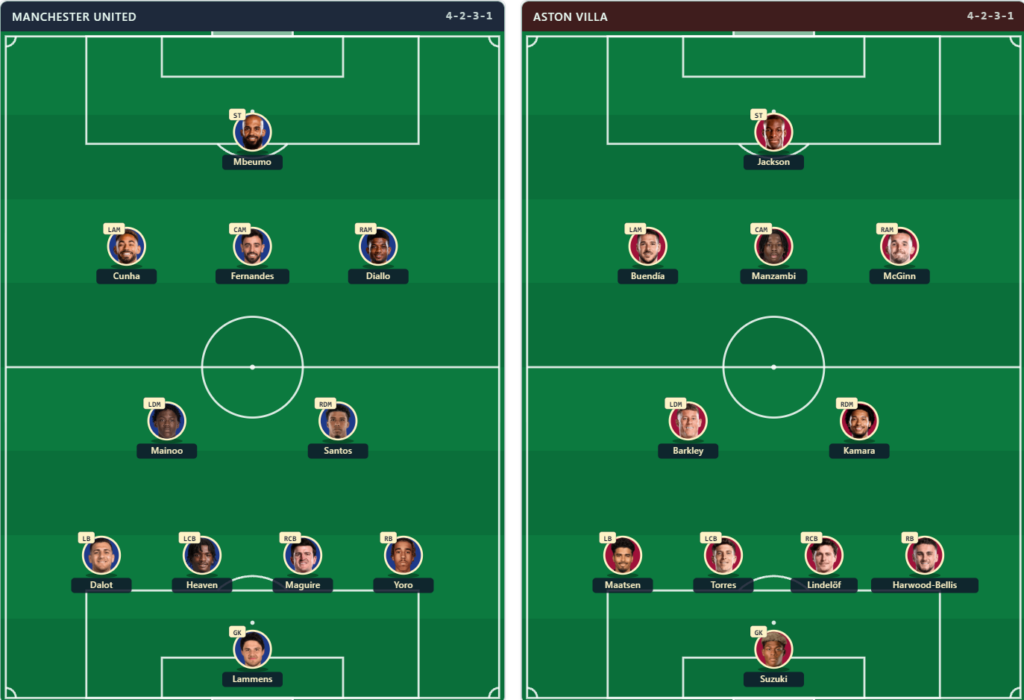
Probable Aston Villa Starting Lineup (4-2-3-1): Suzuki; Harwood-Bellis, Lindelof, Torres, Maatsen; Kamara, Barkley; McGinn, Manzambi, Buendia; Jackson
Aston Villa’s list is more disruptive on the right. Aaron Wan-Bissaka remains doubtful after missing five matches with a hamstring problem, while Matty Cash is suspended after collecting his fifth yellow card against Fulham. Amadou Onana is out for the season with an ACL tear, and Matteo Ruggeri is continuing his recovery from a hamstring injury.
Taylor Harwood-Bellis is expected to fill the right-back position, with Victor Lindelof and Pau Torres forming the central defensive pairing and Ian Maatsen being the left-back. Boubacar Kamara should anchor the midfield alongside Ross Barkley, with Leon Goretzka being an alternate pick for the double pivot.
John McGinn works from the right of the attacking three; he has three assists and 17 key passes in nine appearances, placing him first in Villa’s squad for that latter figure. Johan Manzambi brings two goals and three assists from six appearances, and Emiliano Buendia is expected to complete the attacking midfield line. Nicolas Jackson leads it from the centre after scoring five times in eight starts. So, Villa’s shape retains a clear focal point despite the changes behind him.
Tactics: United must turn possession into pressure
Both teams should use a 4-2-3-1 formation, but the shapes have different instructions. Manchester United are likely to carry the game forward at home, keeping two midfielders behind Bruno Fernandes and asking Bryan Mbeumo to connect the attacking line rather than simply wait for service.
Aston Villa, on the other hand, should stay compact, use their double pivot to protect the centre and attack the spaces United leave when they move forward. They want the win, but can also accept the draw if the home side’s pressure becomes harmless. The two profiles underline that contrast.
Manchester United have averaged 55% of the ball against a league typical 49.5%, while Aston Villa have averaged 45% against the same benchmark. So, the Red Devils are the side more likely to establish territorial control. United also shoot 16 times per match against a typical 13, whereas Villa sit on that legue average figure. That points to a side willing to take attempts, though not necessarily one producing enough clear chances from its control.
Meanwhile, the hosts’ crossing average is 16 per match, level with the league typical figure, while Aston Villa’s is nine against that same norm. The visitors are therefore less likely to build their attack through repeated wide deliveries. Their direct route is also selective. Unai Emery’s men play 42 long balls per match and United 44, both below the league typical 49.25.
The gap is not large enough to make this an aerial contest by itself, but it does suggest Nicolas Jackson will need movement and timing rather than constant service into a crowded central duel. That puts the main system question in front of Bryan Mbeumo and Victor Lindelof.
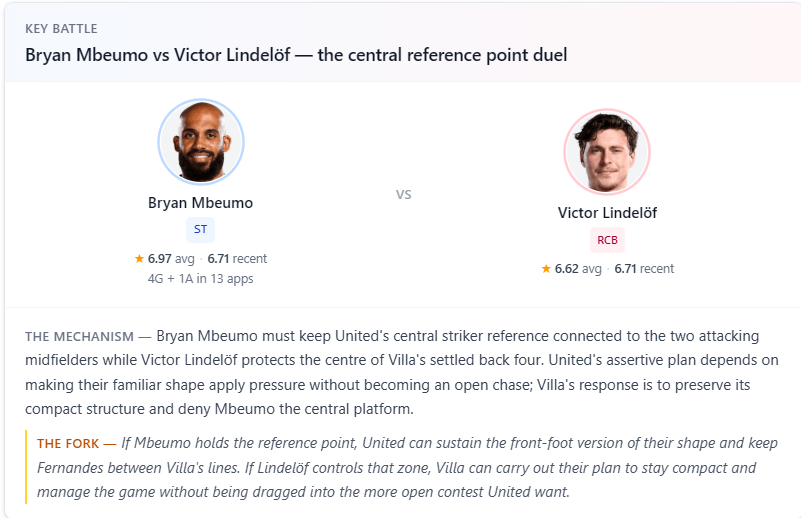
Mbeumo has to hold the central reference point so Fernandes can receive between Villa’s midfield and defence; the Swede has to prevent that connection and keep the away side’s back four compact. If Mbeumo succeeds, Manchester United can sustain attacks without abandoning their double pivot. If Lindelof controls the zone, Villa can absorb the initiative and turn the match into the managed contest Emery prefers.
The second important meeting is Bruno Fernandes against Boubacar Kamara. The Manchester United captain has the freedom to make the home side’s possession move forward, while Kamara is the screen that can close the central route before the ball reaches the edge of the box. The Red Devils’ structure gives Fernandes support, but Villa’s two holders can keep the space in front of Lindelof and Pau Torres narrow.
This is where Manchester United’s territorial advantage could become sterile. They may have the ball and still struggle to create the decisive central pass. Aston Villa’s best route is not simply to defend. John McGinn’s position on their right can test the home side’s left defensive corridor when the full-back advances, while Jackson’s movement can pull the centre-backs away from their preferred spacing.
Manchester United’s double pivot must remain connected to the back four, because Aston Villa’s recent chance output has been sharper even though their possession habit is more restrained. The match will swing between United trying to make the game larger and the Villans trying to keep its central spaces small.
Prediction: A draw is likelier than a clean home win
We predict a draw, held with medium confidence. Manchester United should have more of the initiative, but the evidence does not make their control reliable enough to justify a strong home-win position. Across their last five matches, Michael Carrick’s men have averaged 1.20 xG per game and Aston Villa 1.57, a reminder that Villa’s quieter possession style has recently produced the more substantial attacking output.
The strongest case against the draw is a Manchester United breakthrough before Aston Villa settle. Bruno Fernandes can find the space Boubacar Kamara is trying to close, and Bryan Mbeumo’s movement could pull Victor Lindelof away from the central platform. If the hosts turn their possession into sustained pressure rather than circulation, Villa may be forced to defend deeper than planned and their cautious approach could become passive.
Lean: Draw
Range: 1-1/2-2/1-2
Manchester United’s momentum from the comeback against AS Roma makes that a credible route. The counterweight is that the home side’s season output has fallen 4.347 goals below their expected total, while Villa’s gap is only 0.745. That does not predict a repeat scoreline, but it does explain why United’s control may not translate cleanly into goals.
Aston Villa, on the other hand, can remain competitive without taking excessive risks, especially if Kamara limits Fernandes and Nicolas Jackson finds the spaces behind Manchester United’s advancing midfield. The likely scoreline range is 1-1, 2-2 or 1-2, with the draw the most useful betting lean.
The right side may force Emery’s first adjustment
Aston Villa’s rebuilt right-back area is the selection detail most likely to alter the match once Manchester United begin to establish their left-sided attacks. If that side cannot hold its spacing, Emery may need to bring the midfield screen across earlier and accept less freedom for John McGinn.
The visitors, meanwhile, can keep their double pivot and familiar attacking structure. That gives the home side a clearer in-game adjustment if the opening plan becomes stretched, even though the broader balance still points towards a level contest.