Football has spent the better part of the last decade trying to strike a delicate balance with VAR, but Argentina vs Switzerland did not feature that.
The technology was never designed to eliminate every refereeing mistake; rather, it was introduced to correct the game’s biggest and most obvious errors without fundamentally changing the flow of the sport. Goals, penalties, straight red cards and genuine cases of mistaken identity were deemed worthy of intervention. Everything else, including ordinary yellow cards and second cautions, remained part of the referee’s domain.
That balance came under fresh scrutiny during Switzerland’s World Cup quarter-final against Argentina on Saturday night, when Breel Embolo was sent off after VAR intervened in what was officially classified as a case of ‘mistaken identity’. On the surface, justice appeared to have been served.
Embolo had clearly simulated contact, and a booking for diving, his second of the match. was arguably the correct punishment. Yet the manner in which football’s officials arrived at that decision has exposed a far more significant issue than the dismissal itself. It has raised legitimate questions about whether IFAB’s latest interpretation of the laws has quietly expanded VAR’s powers through the back door.
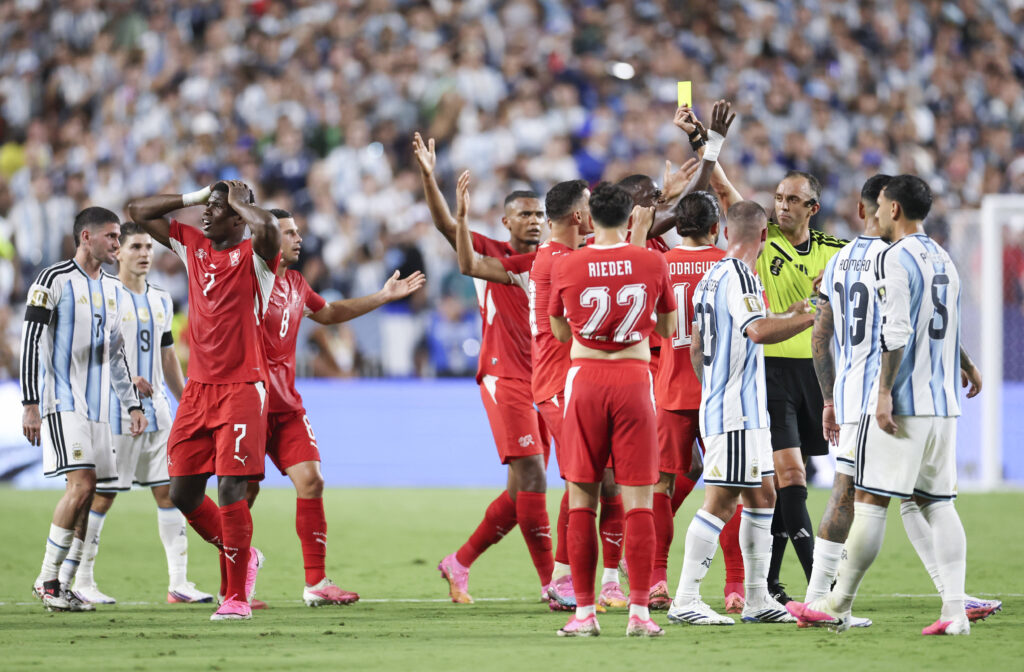
The incident itself was relatively straightforward. Embolo went down inside the penalty area under pressure from an Argentine defender, prompting the referee to believe a foul had been committed. Instead of cautioning the Swiss forward for simulation, he booked the Argentine player for the supposed infringement.
Under normal VAR protocol, the story should have ended there. A second yellow card is not reviewable, nor is a standard caution for simulation. Football’s lawmakers have deliberately kept those decisions outside VAR’s remit to avoid endless interruptions over routine disciplinary matters. However, before this World Cup, IFAB amended its wording regarding mistaken identity.
The updated guidance states, “When the referee shows a yellow or red card but has clearly penalised the wrong player of either team for the offence in question, the offence itself cannot be reviewed except in the context of mistaken identity.”
It was this amendment that allowed VAR to step in. The yellow card shown to the Argentine defender was rescinded; Embolo was instead cautioned for diving, and because it was his second booking of the evening, he was dismissed.
Few could argue with the final outcome. Embolo had attempted to deceive the referee and, under the Laws of the Game, simulation is a bookable offence. If football wants to discourage diving, then punishing players who exaggerate or invent contact is entirely reasonable. Yet the controversy lies not in the punishment but in the justification used to reach it.
Calling the incident one of mistaken identity feels, at best, an extremely generous interpretation of the law. The referee did not confuse one player for another. He knew exactly who Embolo was and exactly which Argentine defender he had booked. There was no administrative mix-up, no confusion over shirt numbers and no uncertainty about who had committed the offence. The referee simply believed the defender had fouled Embolo when, in reality, the Swiss attacker had deceived him. That is not mistaken identity; it is mistaken judgement.
The distinction might sound like legal semantics, but it is a hugely important one because it changes the very purpose of VAR intervention. Traditionally, mistaken identity has referred to situations where the referee correctly identifies an offence but punishes the wrong individual. If Defender A commits the foul but Defender B receives the yellow card, VAR can correct the administrative error without re-refereeing the incident itself. The offence has already been accepted; only the offender’s identity is incorrect.
That is not what happened in Embolo’s case. Here, the offence itself changed. The referee initially believed there had been a foul. VAR ultimately concluded there had been no foul at all and that the actual offence was Embolo’s simulation. In other words, officials were not correcting who committed the offence; they were correcting what the offence actually was. That represents a significant shift in how the laws are being interpreted.
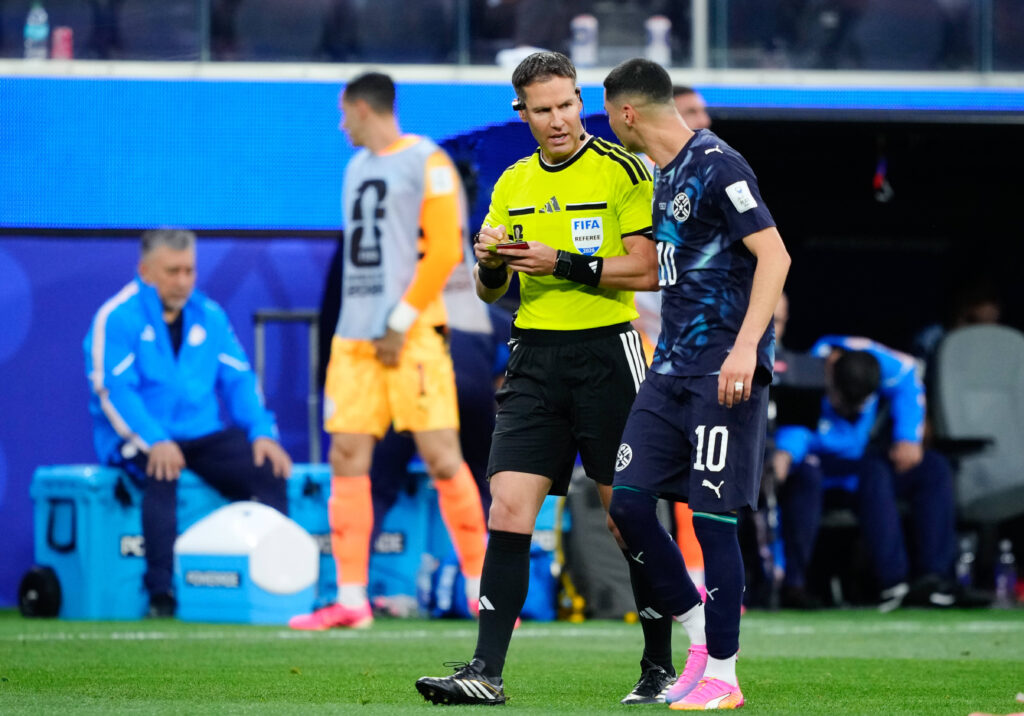
What makes the situation even more noteworthy is that it was not an isolated incident. Earlier in the tournament, during USA’s meeting with Paraguay, a remarkably similar scenario unfolded. Tim Ream was initially booked after the referee judged that he had fouled Miguel Almiron. VAR intervened, the decision was revisited, and officials concluded that there had been no foul.
Instead, Almiron was cautioned for simulation. Once again, the final decision felt correct. Once again, the review was justified under the banner of mistaken identity. And once again, nobody had actually mistaken one player’s identity for another.
These two incidents establish what increasingly appears to be a pattern rather than an exception. In both cases, referees were deceived by dives rather than confused about which player had committed an offence. Yet the mechanism used to overturn those decisions was the same. Football has effectively created a pathway for VAR to revisit yellow-card incidents that were previously beyond its reach.
That is where concerns begin to emerge. If this interpretation becomes standard practice, it effectively broadens VAR’s authority without openly acknowledging it. Rather than formally expanding reviewable incidents to include certain yellow-card offences, football appears to be stretching the definition of mistaken identity to cover situations that are fundamentally different in nature.
Supporters may welcome the punishment of divers, but they are equally entitled to ask where the line now lies. If VAR can intervene whenever a referee mistakes simulation for a foul, can it also intervene when a referee wrongly books a defender for a reckless tackle that never actually happened? What if a player receives a yellow card for handball that replays show never occurred? Are those now also cases of mistaken identity, or are they simply incorrect refereeing decisions? Once the definition begins to shift, establishing consistent boundaries becomes increasingly difficult.
This matters because one of VAR’s founding principles was clarity. Football accepted that some decisions would remain imperfect because reviewing every contentious call would fundamentally alter the rhythm of matches. Yellow cards, second cautions and routine fouls were intentionally excluded from review to preserve that balance. Every time another exception is introduced, those boundaries become a little less clear.
Perhaps IFAB believes this is a necessary evolution. After all, allowing obvious simulation to go unpunished because of procedural limitations hardly feels satisfactory either. Nobody wants players to benefit from successful deception simply because VAR’s hands are tied. If technology can identify a blatant dive, many would argue that officials have a responsibility to correct it.
But if that is the direction football intends to take, then it would be healthier for the game to acknowledge it openly. Rather than relying on an increasingly elastic interpretation of mistaken identity, IFAB could simply amend the VAR protocol to allow reviews of simulation where disciplinary consequences are significant. Such a proposal would undoubtedly spark debate, but at least it would be transparent. Everyone would understand the law, the limits of intervention and the rationale behind it.
Instead, football finds itself in an uncomfortable middle ground. The correct outcome is being achieved, but through wording that many referees, players and supporters will struggle to reconcile with the traditional meaning of mistaken identity. That ambiguity risks creating further confusion whenever similar incidents arise.
Embolo’s dismissal may ultimately be remembered as little more than a dramatic moment in Switzerland’s World Cup exit. Yet its lasting significance could extend far beyond one quarter-final. It may come to represent the point at which VAR quietly expanded its influence, not through a headline-grabbing rule change, but through an interpretation that blurred the distinction between mistaken identity and mistaken judgement.
Justice may well have been served in Buenos Aires’ favour on Saturday night. The bigger question is whether football has set a precedent that could prove far more controversial than the decision it was trying to correct.