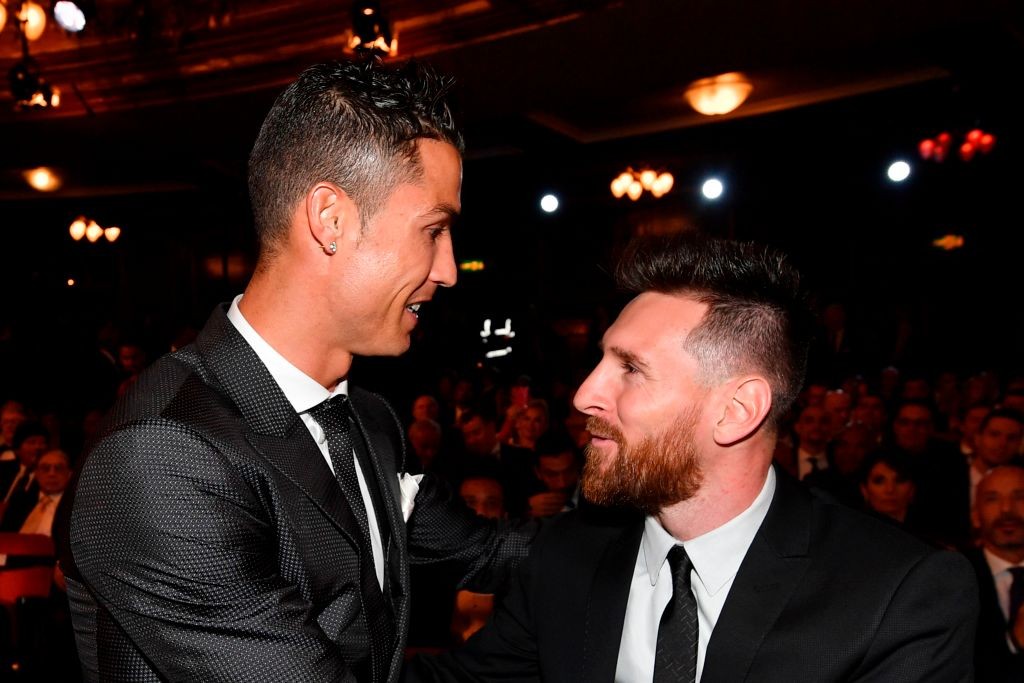
At 41 and 38, Cristiano Ronaldo and Lionel Messi are set to play their sixth World Cup, the final chapter of football’s greatest rivalry.
Many believed the 2022 FIFA World Cup in Qatar would be the last time we witnessed both Cristiano Ronaldo and Lionel Messi at the biggest stage of football. Yet, these legendary forwards, who have defined an era in world football, had other ideas. At 41 and 38 years old, respectively, they are once again set to light up the stage in 2026, preparing to make their record-breaking sixth World Cup appearance.
Ronaldo and Messi’s World Cup journeys
The tale of Messi and Ronaldo at the World Cup begins in Germany 2006, when they were merely 18 and 21 years old. The former, having made just 35 senior appearances for Barcelona, assisted Hernan Crespo and scored himself in Argentina’s 6-0 rout of Serbia and Montenegro, becoming the only player since 1966 to both score and assist as a teenager in the same World Cup match.
Ronaldo’s 2006 campaign saw him score his first World Cup goal from the penalty spot against Iran and net the decisive spot-kick in Portugal’s quarter-final victory over England, though he remains best remembered for his involvement in Wayne Rooney’s red card. Portugal finished fourth in that tournament, still their best World Cup finish to date.
By 2010, in South Africa, both players had won their first Ballon d’Or awards and were established as the world’s best. Messi played every minute of Argentina’s five games but registered only an assist against Mexico, while Ronaldo scored and assisted in Portugal’s 7-0 rout of North Korea.
The 2014 World Cup in Brazil offered contrasting fortunes. Ronaldo, now Portugal’s all-time leading goalscorer with 49 goals at the time, could not prevent his team from failing to progress through the group stage for the first time since 2002.
Messi, meanwhile, led his team all the way to the final, scoring in each of Argentina’s group wins over Bosnia, Iran and Nigeria. No player scored more goals than the diminutive magician in the 2014 group stage, and he was awarded the Golden Ball.
Russia 2018 saw Ronaldo produce the tournament’s most memorable moment with a hat-trick in Portugal’s 3-3 draw with Spain, becoming the oldest-ever player to score a World Cup hat-trick at 33 years and 130 days. Messi’s 2018 campaign was less successful, exiting at the round-of-16 stage after assisting twice against France.
Qatar 2022 proved Messi’s crowning moment. He scored seven goals and provided three assists, powering Argentina to their third World Cup trophy with exceptional performances, including two goals against France in the final.
Ronaldo made history by becoming the first male player to score in five different World Cups with a penalty against Ghana, though Portugal reached only the quarter-finals.
How Ronaldo and Messi changed football
The longevity of both players has redefined what we consider possible in modern football. Their professionalism, maintaining peak physical condition into their late thirties and early forties, has set new statistical standards for the sport.
Messi’s 13 goals and 8 assists across 26 World Cup appearances, compared to Ronaldo’s 8 goals and 2 assists in 22 games, demonstrate different but equally remarkable approaches to the game. Their social media influence has globalised football fandom, transforming the sport into a truly worldwide phenomenon.
Messi averages 8.13 match rating with 10 Man of the Match awards across World Cups, while Ronaldo holds 7.04 average rating with just 1 MOTM. Messi’s 125 successful dribbles versus Ronaldo’s 36 show his wing-play style, whereas the Portuguese attacker’s 20 aerial duels against his famous rival’s 7 highlight his physical approach.
The state of their careers in 2026
Ronaldo, now at Al-Nassr, sits at 973 official senior career goals, just 27 goals away from the historic 1,000-goal milestone once considered impossible in modern football. His Saudi Pro League tally has reached 102 goals, with 123 overall for Al-Nassr.
Messi is enjoying life at Inter Miami, having extended his contract until 2028. The 38-year-old is Argentina’s top scorer in World Cup history with 13 goals, placing him tied for fourth on the all-time scoring list, just three goals shy of Germany’s Miroslav Klose. Messi has appeared in a record 26 World Cup matches and produced 21 total goal contributions, sharing the record with Brazilian icon Pele.
The emotional core
What happens when football loses Messi and Ronaldo from the World Cup stage? Their combined 21 World Cup goals and 10 assists across six tournaments represent an era that will not be repeated. Messi’s 5 knockout goals and 6 assists versus Ronaldo’s zero knockout goals and assists reveal a crucial difference in their big-match fortunes.
The pair share a strange quirk: a combined 1,270 minutes of World Cup knockout action with 48 shots and 16 shots on target, yet not a single knockout goal has been scored by Ronaldo. Should Ronaldo break his knockout duck in 2026 at age 41, he could become the second-oldest player in World Cup history to score in a knockout stage after Cameroon’s Roger Milla in 1990.
The final showdown
We could witness one of the biggest games in World Cup history if Argentina and Portugal meet in the knockout rounds. The respective sides will face off in the quarter-final if they both win their groups and their last-32 and last-16 matches.
They will also clash in the quarter-finals if both sides finish the group stage in second place before winning their subsequent knockout games. Fans will be desperate to see the two legends face off, though that may not happen until the final if both sides finish third in their respective groups.
If Argentina finish second and Portugal take first place, or vice-versa, even then they will not meet until the final. The possibilities extend to the round of 32, the round of 16, quarter-finals or semi-finals, depending on where they rank among third-place finishers.
Neymar: The third giant
While focus will be on Ronaldo and Messi, Neymar, the player who was supposed to be as good as the duo, could also define the tournament with his performances. The former Barcelona star has been officially named in Brazil’s 26-man World Cup squad by head coach Carlo Ancelotti, marking his participation in a fourth World Cup after competing in 2014, 2018, and 2022.
His inclusion sent shockwaves across the football world after two years and seven months without playing for the Selecao, with his last appearance ending in a devastating knee injury against Uruguay in October 2023. Neymar, Brazil’s all-time top male scorer, extended his contract with Santos until the end of 2026 specifically to target this World Cup appearance.
At 34 years old, Neymar brings a goalscoring pedigree for Brazil and remains one of the most exciting talents in world football. Though he never reached the same sustained heights as Messi and Ronaldo, his momentary brilliance has often suggested he could be their equal. In 2026, he could finally deliver the tournament-defining performances that would cement his legacy alongside the two giants.
The 2026 World Cup represents the final chapter of football’s greatest rivalry. Whether they meet in a quarter-final, semi-final, or the final itself, the mere possibility of Messi versus Ronaldo on the biggest stage keeps fans dreaming.
Their combined legacy, 21 World Cup goals, 10 assists, six tournaments each, has redefined what longevity means in football. Messi holds the records for most World Cup matches played (26) and most minutes (2,314). When they eventually walk off the World Cup stage for the final time, an era will truly end, but their impact on the sport will endure forever.