A deep dive into Arsenal’s triumph and how Mikel Arteta outsmarted Pep Guardiola to pip Manchester City to the Premier League title.
Arsenal’s Premier League title win was never going to be just another championship story. It arrived as a statement of purpose, a reward for patience, and, above all, a changing of the guard. In Mikel Arteta, Arsenal have found the manager who not only revived their sense of belief but also carried them past the shadow of Pep Guardiola, the very coach under whom he once learned the craft.
That is what gives this title win its force. Arsenal did not merely win a race; they beat the standard-bearer of modern football. Guardiola’s City have been the benchmark for control, depth and sustained excellence for so long that any team finishing above them must have done something extraordinary. The Gunners did exactly that, and they did it in a season that demanded intelligence, nerve and consistency from first whistle to last.
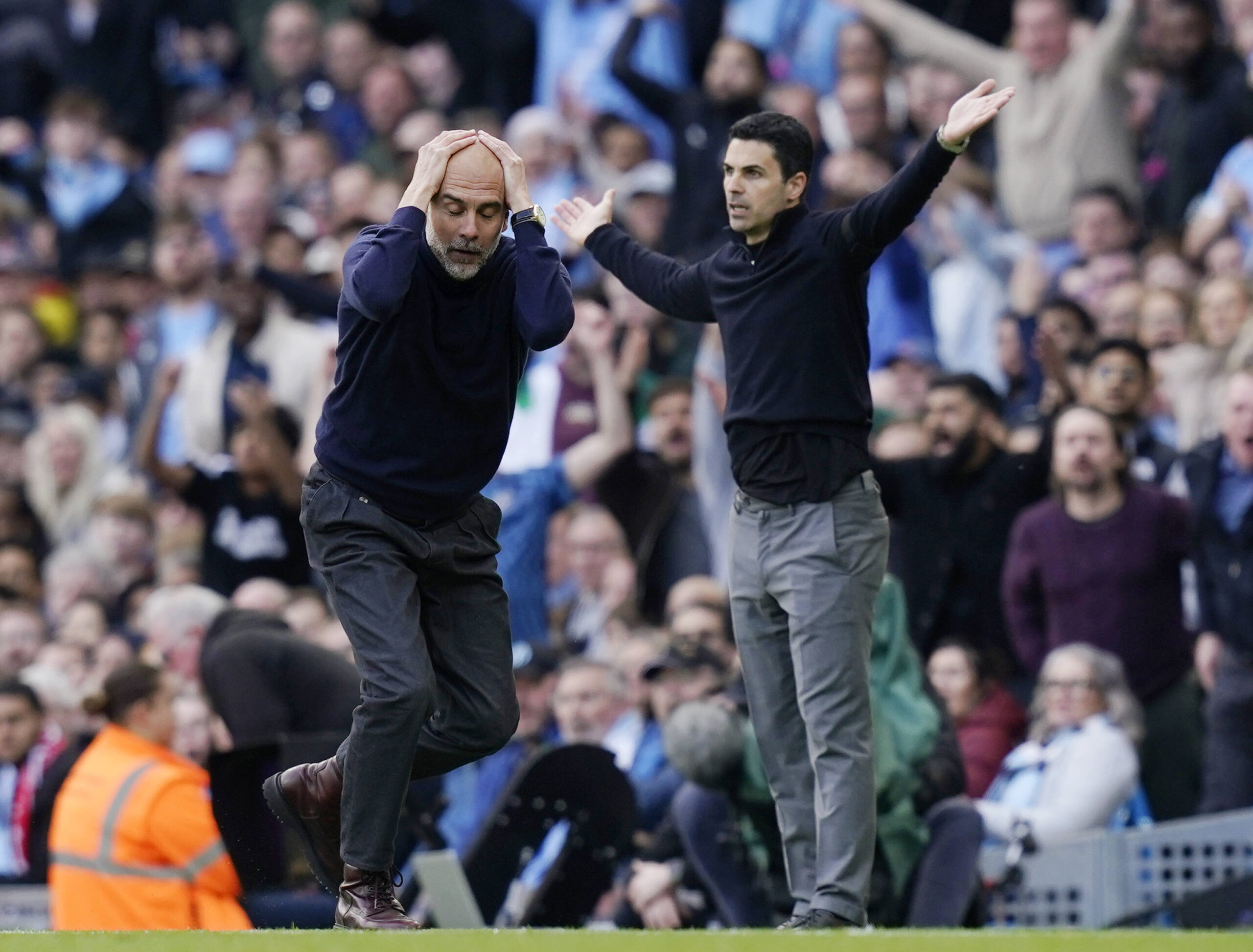
This was also a victory that felt deeply symbolic. For years, Guardiola’s teams have often found a way in the decisive stretches of a title chase. This time, however, the final act belonged to Arteta and Arsenal as City slipped against Bournemouth. The apprentice did not just keep pace with the master. He outlasted him, out-thought him and, in the end, overtook him.
Guardiola’s standard
To understand the scale of Arsenal’s achievement, one must first understand the standard they beat. Pep Guardiola’s managerial career is not simply a list of trophies; it is a long lesson in how to dominate a league through ideas, structure and relentless refinement. From Barcelona to Bayern Munich and then to Manchester City, he has shaped teams that do not merely chase titles but expect them.
At Barcelona, Guardiola helped create one of the most celebrated sides the game has seen, a team built around possession, movement and suffocating control. At Bayern, he adapted to a different league and still made the Bundesliga feel like a laboratory for his principles, even though the odds were stacked in his favour for the most part.
At City, he turned a rich club into an era-defining machine. Across all three jobs, the pattern has been strikingly similar: Guardiola almost never lets a league title slip for long. He has never gone back-to-back seasons without a domestic league crown in his career, until now. That, in itself, is a remarkable measure of his consistency.
That is why this season matters. A manager with Guardiola’s record is not supposed to be beaten lightly, and certainly not in a title race that remained alive until the penultimate round. Arsenal’s triumph breaks the rhythm of inevitability that has followed him for years.
A rare kind of defeat
This is only the second time in Guardiola’s career that he has been beaten in a close title race, the first coming when Jose Mourinho’s Real Madrid won La Liga while Guardiola was at Barcelona. Even there, the context was different. as Mourinho’s charges ultimately pulled away in the closing stages and turned the title race into something more decisive.
Arsenal’s challenge, by contrast, stayed tense deep into the run-in, even after the North Londoners threatened to run away with it midway through the campaign. However, the pressure was telling as the weeks progressed this year. Every dropped point carried weight. Every clean sheet and late winner mattered.
That distinction is important because it tells us what Arsenal were able to do. They regrouped after a blip and forced the contest into a long, uncomfortable struggle where every detail mattered. They made a unit built to suffocate opponents feel the heat of a genuine duel. Guardiola has spent much of his career being the architect of those decisive late-season edges. Arsenal made him live through one from the other side.
Arteta’s evolution
The emotional pull of Arsenal’s triumph rests heavily on Mikel Arteta’s relationship with Pep Guardiola. He came up in the same footballing language, learned the same principles and absorbed many of the same ideas about space, pressing and control. But the best apprentices are not those who copy forever. They are the ones who eventually take the lessons and shape them into something personal.
Arteta has done exactly that at Arsenal. The first phase of his work was about order: tightening the structure, restoring discipline and giving the team a clear identity. The second phase was about belief: convincing the players that they could survive high-pressure moments and still play on the front foot. The third phase, which this title represents, was about authority. Arsenal no longer looked like a promising side with potential. They looked like champions.
What makes this more impressive is that Arteta had to build without the same safety net Guardiola often enjoys. Across his career, Guardiola has usually coached clubs that could respond quickly when a weakness appeared. When his team needed a new profile, the market often provided one.
The January 2025 moves and the additions of Antoine Semenyo and Marc Guehi earlier this year were part of that familiar pattern: identify the shortage, plug the gap, keep the machine running. It was smart squad management aided by a transfer kitty that never runs out, and it helped City stay alive in the race.
Arsenal did not have that luxury in the same way. Their rise was not built on the same kind of mid-season reset button, even if they eventually came around to spending decisive sums in the market. Instead, it came from more patient work: smarter planning, clearer squad balance, and a stronger collective identity. That difference matters. It makes Arsenal’s title feel less like a result of rescue and more like the culmination of design.
The tactical edge
The title was won not just in spirit, but in structure. Arsenal gave Guardiola’s side one of the hardest tactical examinations of his Premier League career. They were compact without being passive, aggressive without becoming reckless and disciplined without losing their attacking threat.
The key was how they handled pressure. City thrive when they can settle opponents, pin them back and force mistakes through volume and control. Arsenal refused to be trapped in that pattern for long stretches. Their defensive shape was sharp, their distances between the lines were intelligent, and their willingness to attack space behind City meant the champions could not always play the game on their terms.
Arteta also understood the value of timing. There were moments when Arsenal pressed high, moments when they dropped into a controlled block, and moments when they simply let the match breathe until the right opening appeared. That flexibility is often what separates a strong team from a title-winning one. Arsenal did not need every game to look the same. They needed every game to feel under control.
The April meeting with City still mattered, of course. Guardiola’s side won that day, and for a moment it seemed as though momentum might swing back. But Arsenal did not unravel, even when it seemed that they would a few weeks ago. That was perhaps the clearest proof of all that they were ready. Earlier Arsenal sides might have been shaken. This one held firm. They absorbed the blow and kept moving.
The weight of legacy
For Pep Guardiola, this defeat does not erase anything. His legacy remains immense and already secure. But it does mark a rare moment of vulnerability, and one that will be remembered precisely because it came against a manager who once worked under him. In that sense, this was not only a title race.
It was a passing of knowledge, confidence and ambition from one generation to the next, especially as he reportedly closes in on his departure from the Etihad. Perhaps, the pressure has finally consumed the mad genius after all these years.
For Mikel Arteta, the implications are even larger. The Spaniard has moved beyond being seen as a promising coach or a capable builder. He is now a manager who has delivered the biggest prize, and done so by defeating the most demanding opponent in the league. That changes how Arsenal are viewed, not just today but for the years ahead.
A new order
In the end, this was a title about more than points, tables, and medals. It was about a club that carried the weight of history and finally turned that decades-long burden into force. It was about a manager who learned from the best and then became the best answer to him. And it was about a giant of the modern game being pushed to the edge by a rival who simply refused to blink.
Arsenal’s title win feels like the start of something, not the end of a story. The torch has been passed, but the fire will not go out anytime soon.