
Sunderland vs Chelsea at the Stadium of Light on Sunday will be a battle between a team fighting for survival and one climbing back in Premier League title contention.
Sunderland’s poor start has made defensive clarity the central question before Chelsea arrive, On the other hand, the visitors have just restored their top-four position with a commanding 2-0 victory over Manchester United at Stamford Bridge. This is a meaningful meeting between a side trying to climb out of danger and another trying to consolidate its place in the European race.
The historical backdrop also points towards an open contest, with previous Premier League meetings between these clubs producing goals regularly. For Sunderland, the result would shape the direction of a difficult campaign without making the fixture decisive.
The Black Cats remain in and around the relegation zone after any outcome, although a win could lift them to 17th and a draw would still leave them around the bottom two. The Wearside outfit’s last league outings showed both sides of the current problem. They had 57% possession and created 1.84 xG against Coventry City, but still lost 3-1.
Across their last five matches, Sunderland have scored twice and conceded eight, and their single clean sheet underlines why Regis Le Bris has called the team’s lack of defensive consistency a crucial issue. The hosts carry a repeatable 4-2-3-1 setup and some attacking encouragement, but the pressure is on them to turn promising phases into a result.
Chelsea, on the other hand, arrive with more protection in the table and a stronger recent mood. A win would keep the UEFA Champions League target moving in the right direction, while defeat would still leave them within the top-four range. So, their task is to impose themselves without turning the match into a needless gamble.
The Blues responded to consecutive defeats by beating Manchester United 2-0, with Morgan Rogers and Cole Palmer scoring; they have scored nine goals while conceding three across their last four matches. Xabi Alonso’s new tenure has gained credibility with that return to the top four. The complication is a disrupted squad, particularly around the goalkeeper and midfield positions, which could make Chelsea’s control less smooth than their recent results suggest.
Team News: The predicted teams and the absences behind them
Sunderland are without Dan Ballard because of a hamstring injury and Romaine Mundle because of a knee injury. Additionally, Habib Diarra (thigh) remains in the treatment room, while Omar Alderete serves a suspension after being sent off against Coventry City. None of those absences changes the basic selection as much as it changes the available depth around it, Regis Le Bris is expected to retain the established 4-2-3-1.
Robin Roefs will line up behind Nordi Mukiele, Luke O’Nien and the full-backs Trai Hume and Reinildo Mandava. As for the midfield unit, Granit Xhaka should line up alongside Noah Sadiki in the double pivot, with Enzo Le Fee ahead of them. Xhaka has started every one of his nine games and supplied 21 key passes, the best total in the Sunderland squad.
The number 10 position should give Sunderland a route to connect their first pass with Brian Brobbey. Brobbey is expected to lead the line for Sunderland vs Chelsea after scoring three times and putting seven of his 15 shots on target. The wide selections give Sunderland a little more current threat.
Malick Fofana should start on the left, while Nilson Angulo remains the important right-sided outlet. The latter has started eight times, with one goal, one assist and two key passes. Trai Hume should support that side from right-back; his two big chances created and four key passes are useful evidence that his role is not purely defensive.
Probable Sunderland Starting Lineup (4-2-3-1): Roefs; Hume, Mukiele, O’Nien, Reinildo; Xhaka, Sadiki; Angulo, Le Fee, Malick Fofana; Brobbey
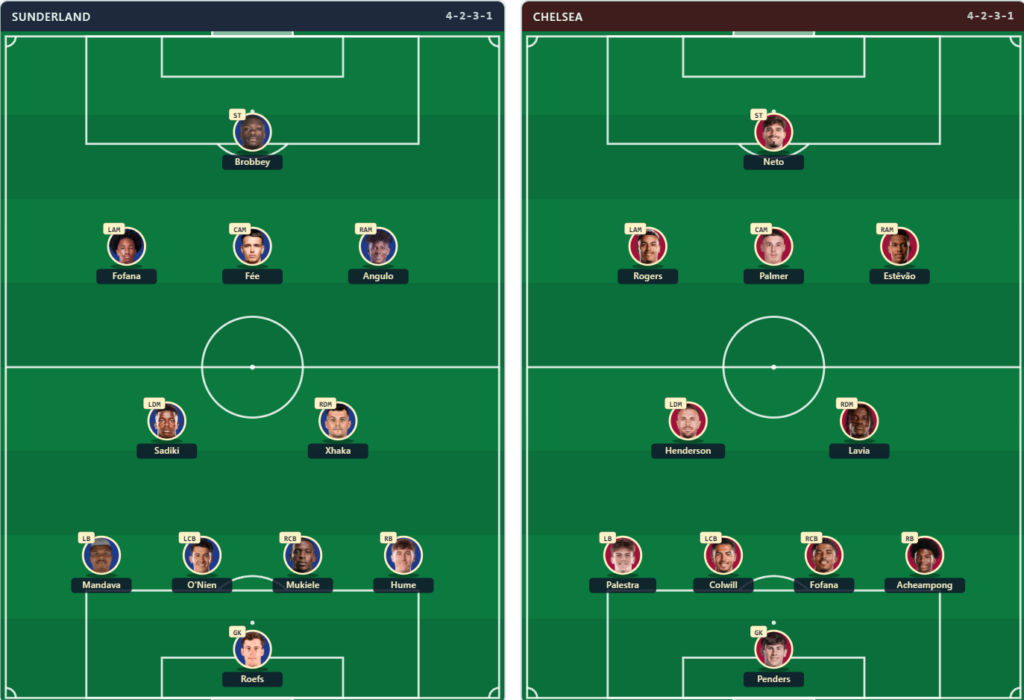
Probable Chelsea Starting Lineup (4-2-3-1): Penders; Acheampong, Wesley Fofana, Colwill, Palestra; Lavia, Henderson; Estevao, Palmer, Rogers; Neto
Chelsea have a longer injury list. Emiliano Martinez is doubtful after resuming training following jaw surgery, while Reece James (knee), Maxence Lacroix (hamstring), Joao Pedro (thigh), and Jorrel Hato (unspecified) are in the treatment room. Meanwhile, Moises Caicedo is also doubtful after missing training with discomfort described as more than a calf issue.
Mike Penders therefore holds the goalkeeper position, with Levi Colwill and Wesley Fofana in the centre of a back four. Marco Palestra is expected to cover left-back, while Josh Acheampong should continue on the right.
As for the midfield unit, Jordan Henderson and Romeo Lavia should form the double pivot, with the former deputising for Caicedo if he misses out. Cole Palmer will reprise the no. 10 role, with Estevao on the right. Palmer is Chelsea’s main creative reference, leading the squad with 20 key passes and five big chances created, while Morgan Rogers starts from the left after nine starts, five goals and 17 key passes.
Finally, Pedro Neto is expected to spearhead the Chelsea attack vs Sunderland on Sunday. Chelsea’s attacking burden is likely to fall heavily on the movement around him. The selected shape is 4-2-3-1, though Chelsea have also used a 3-4-2-1 this season. The alternative matters because the absences may eventually require an extra centre-back or a different way to protect the midfield.
Tactics: Xhaka must protect the lane Palmer wants to occupy
Both teams should begin in a 4-2-3-1 formation, but they will use it differently. Sunderland’s shape is designed to keep Granit Xhaka involved as the deeper organiser, leave Enzo Le Fee between the lines and give Nilson Angulo and Malick Fofana support around Brian Brobbey. They will try to win the match without making the draw protection disappear. So, their first attacking route is likely to be direct rather than patiently built through the centre.
That habit is clear in the measured profile. Sunderland play 59 long balls per match against a league typical figure of 49.25, while Chelsea play 48 against the same benchmark. The away side’s distribution is therefore closer to the league norm, and their 4-2-3-1 setup should ask Sunderland to contest the second ball after the first pass goes over midfield.
Chelsea also carry slightly more of the ball, at 50% compared with Sunderland’s 51%, with both figures around the league’s 49.5% typical level. That is not a possession mismatch; it is a question of what happens when Sunderland choose to bypass the midfield rather than use it.
Xabi Alonso’s team will come forward from their shape while keeping enough cover to avoid turning a top-four challenge into an open gamble. Cole Palmer should receive between Sunderland’s midfield and defence, with Morgan Rogers moving from the left to connect the attack and Estevao offering the corresponding threat on the other side.
Sunderland’s problem is that their controlled plan depends on Xhaka protecting the central lane without dropping so deep that Brobbey becomes isolated. The system-level concern for the home side is that recent attacking promise has not always produced control. The Black Cats had the ball and created chances at Coventry but still conceded three times. So, Chelsea’s ability to turn possession into repeated pressure could force the home side into the reactive game they are trying to avoid.
Sunderland’s dead-ball route may help’ they produce 0.336 xG from set pieces per match against a league typical 0.248, while Chelsea sit at 0.278 against that same norm. If open-play chances come few and far between, Sunderland need those situations to keep Brobbey supplied and prevent Chelsea from deciding where the match is played. The main contest is Xhaka against Palmer.
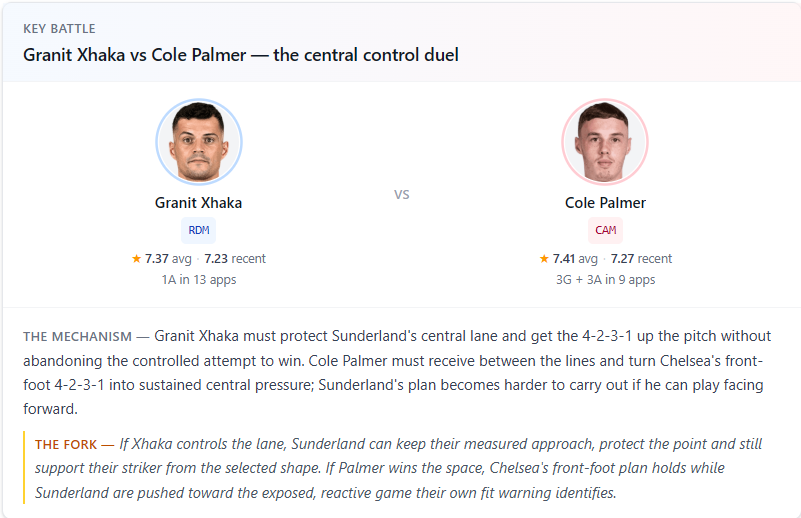
Xhaka has to screen the space in front of the centre-backs and still move Sunderland’s shape up the pitch; Palmer wants to receive facing forward and turn Chelsea’s front-foot approach into sustained central pressure. The Englishman’s current form gives Chelsea the more dangerous attacking presence, but Xhaka’s influence is shown by his leading creative return from a deeper position.
There is little spare protection if Xhaka is drawn away from the lane, because Sunderland’s plan already asks the two central midfielders to cover a lot of ground. If the Swiss midfielder controls that space, the Wearside outfit can keep their direct outlet, support Brobbey and remain willing to attack without abandoning the draw.
If Palmer wins it, Chelsea can pin the home midfield back, make the long pass a defensive clearance rather than an attacking platform, and force Sunderland away from the controlled balance their selection is meant to provide. The secondary battle between Trai Hume and Rogers matters for the same reason.
Hume has to defend Chelsea’s strongest left-sided connection without losing Sunderland’s route forward, while Rogers can keep Chelsea on the front foot if he makes that side run repeatedly. The Englishman’s form has earned him a spot in our FPL captaincy pick tips for Gameweek 10.
Prediction: Chelsea have the clearer route to a narrow win
We predict a Chelsea win, but only with medium confidence. The Blues have the healthier underlying process. Their season xGD is 5.918, compared with Sunderland’s -6.446. That gap fits the tactical picture, because Chelsea can create pressure through Cole Palmer and Morgan Rogers, while the hosts need their direct game and set pieces to work efficiently.
Chelsea’s recent defensive aggregate is another reason to prefer them. They have allowed 0.87 xGA per match across their last four, compared with Sunderland’s 1.61 across their last five. The home side can certainly create chances, as the Coventry performance showed, but Xabi Alonso’s men have been better at limiting the quality of what opponents produce.
Lean: Chelsea win
Range: 0-1/1-2/0-2
The away side’s greater stability should matter if this remains close into the second half. The strongest case against Chelsea is not that Sunderland will dominate possession; it is that the home side can bypass the central control altogether.
If Brian Brobbey wins the first contact, Nilson Angulo and Malick Fofana attack the second ball, and Sunderland force enough set pieces, Chelsea’s disrupted squad may have to defend more box entries than expected. A goal from that route would make the away side chase a match they would rather manage, particularly if Mike Penders and the altered defensive group are exposed early. The likely scoreline range is 0-1, 1-2 or 0-2.
Chelsea can change the defensive picture if Sunderland find a way through
The important in-game adjustment sits with Chelsea. If Sunderland’s direct outlet begins to win second balls and the home side’s wide players start reaching Brian Brobbey, Chelsea can move towards a 3-4-2-1, provided the wing-back options are available, to add a centre-back and protect the penalty-area spaces without abandoning their attacking midfielders.
Sunderland’s selected shape has no comparable alternate formation. So, their response is more likely to depend on changing the roles within the same structure rather than replacing it.