AC Milan vs Inter Milan at San Siro on Saturday will be the first Derby della Madonnina of the 2026/27 season as both teams look to build momentum.
AC Milan’s collapse from a 2-1 half-time lead to a 4-2 defeat at home to Bologna changed the mood around this derby. Their unbeaten start in Serie A under Ruben Amorim ended when Bologna repeatedly found space down Milan’s left. On the other hand, Inter Milan’s 2-0 win at Venezia arrived through two late deflections and left Cristian Chivu admitting that his side had been fortunate.
The meeting is therefore about more than local pride. Milan need a result to revive their UEFA Champions League push, while Inter can protect their lead and remain in a strong European position even if they fail to win.
For Amorim’s side, victory would pull them back toward the leading group and restore momentum after a damaging first defeat. A draw would keep their challenge alive, but another loss would make the gap to Inter harder to dismiss and increase the pressure on the Portuguese tactician.
Their latest performance showed the problem clearly. Milan had the ball and led at the interval, yet their defensive structure broke when the match demanded repeated recovery runs. Across their last five matches they have scored 11 and conceded nine, a run that contains enough attacking production to trouble Inter but not enough defensive control to make an open derby comfortable.
The Rossoneri carry a familiar attacking shape and the return of important players to training. However, fatigue remains a factor in how aggressively they can defend after losing the ball. Inter, on the other hand, arrive with a different calculation.
They can pursue another win, but a draw keeps them at the top and a defeat would still leave them in the Champions League places, so they do not need to turn the match into a race. That is useful after the Venezia performance, when their control did not always look as secure as the result suggested.
The Nerazzurri have won four of their last five league matches and remain unbeaten, carrying a much cleaner defensive run than Milan into the fixture. Their concern is psychological rather than structural. The late victory preserved the perfect-looking momentum, but the admission that they were lucky leaves Milan with a reason to believe the leaders can be made uncomfortable.
Team News: The returning pieces around two settled back threes
AC Milan will be without Pietro Terracciano (shoulder), Matteo Gabbia (hamstring), Fikayo Tomori (muscular), Alexis Saelemaekers (ankle), Samuel Chukwueze hip), and Ruben Loftus-Cheek (thigh). The absences affect more than the bench. Tomori and Gabbia would have offered additional centre-back cover, while Terracciano’s absence narrows the goalkeeping options.
Mario Gila and Diego Moreira are returning after resuming training, and both are picked to start, so the predicted XI restores the three-man defence and the right-sided wing-back role rather than changing the system to compensate.
Mike Maignan will take his spot in goal behind Mario Gila, Koni De Winter, and Strahinja Pavlovic in the 3-4-2-1 formation. Pavlovic has been a mainstay at the back and carries a 7.02 rating, making him the most settled part of the backline.
In midfield, Adrien Rabiot and Luka Modric should provide the distribution from the two central slots, with Rabiot the former player with four goals, three assists, and nine key passes. Pervis Estupinan and Diego Moreira give the shape its width, while Christian Pulisic and Alphadjo Cisse should play behind Goncalo Ramos. Cisse has scored four times in seven appearances, but Ramos’s form remains a concern.
Probable AC Milan Starting Lineup (3-4-2-1): Maignan; Gila, De Winter, Pavlovic; Moreira, Modric, Rabiot, Estupinan; Cisse, Pulisic; Ramos
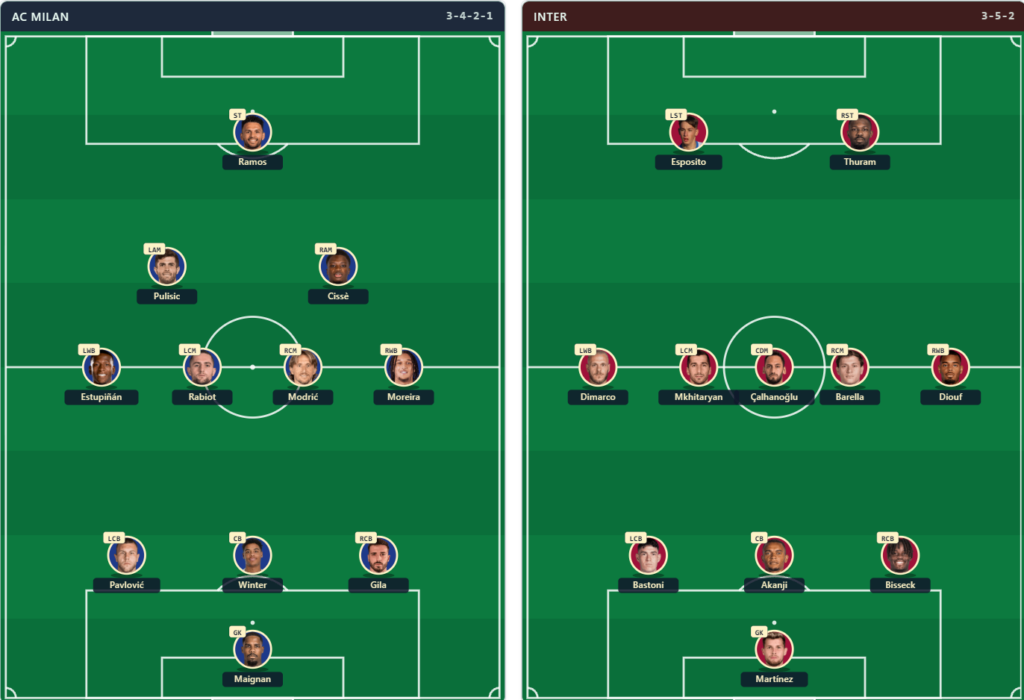
Probable Inter Milan Starting Lineup (3-5-2): Josep Martinez; Bisseck, Akanji, Bastoni; Diouf, Barella, Calhanoglu, Mkhitaryan, Dimarco; Thuram, Esposito
Inter Milan are missing Benjamin Pavard (groin), John Stones (hamstring), Luis Henrique (adductor), Curtis Jones (adductor), and, Lautaro Martinez (thigh). Lautaro’s absence changes the forward pairing most directly, leaving Marcus Thuram as the main attacking reference alongside Pio Esposito. The other absences reduce defensive and midfield alternatives, but Inter’s expected 3-5-2 shape remains the same shape they have used throughout their recent run.
Josep Martinez should keep goal behind Manuel Akanji, Yann Bisseck, and Alessandro Bastoni. Akanji provides the central cover that allows the other two defenders to defend wider spaces. Federico Dimarco and Andy Diouf should operate as the wing-backs, with Dimarco especially important to the build-up after producing 20 key passes.
Hakan Calhanoglu is expected to sit at the base of the midfield five, alongside Henrikh Mkhitaryan and Nicolo Barella. Barella has two assists, 18 key passes, and six big chances created. Finally, Thuram’s five goals and two assists make him the clearest finishing threat in the team.
Tactics: Milan’s possession has to survive Inter’s extra midfielder
AC Milan’s 3-4-2-1 setup preserves three centre-backs while keeping Christian Pulisic and Alphadjo Cisse close enough to Goncalo Ramos to attack Inter Milan’s back three. It is a structure designed to seek the win without making the draw irrelevant, which matters after the Bologna defeat exposed what happens when their pressure and defensive recovery stop working together.
Inter Milan’s 3-5-2 shape has a simpler purpose. Three defenders stay behind the ball, five midfielders can circulate through the centre, and two forwards occupy Milan’s three centre-backs. Both sides are prepared to pursue victory while avoiding unnecessary exposure, but Inter’s away approach gives them more reason to slow the game if the Rossoneri’s first attacking wave does not land.
The two profiles point to a possession contest rather than a long-ball derby. Milan have held 59% of the ball per match and Inter 65%, compared with a league-typical figure of 48%. Cristian Chivu’s men therefore carry the larger share of control between these two teams. Milan’s route to breaking that control is individual carrying.
The Rossoneri average 15 take-ons per match against Inter’s 10, with the league-typical figure at 13. That gives Milan a way to move the ball beyond Inter’s midfield five, but it also asks their inside attackers to beat pressure before the away side can settle into its preferred circulation.
The latest matches show why possession alone will not settle the contest. Milan had 66% of the ball against Bologna but still lost, while Inter had only 34% at Venezia and won. The issue is what each side does after the first phase.
Milan need Adrien Rabiot, Luka Modric, and the two inside attackers to turn possession into entries around Goncalo Ramos, whereas Inter can accept stretches without the ball if their midfield five eventually regain control and bring Marcus Thuram into the next attack. The Serie A champions’ recent attacking base is also stronger, and Milan’s defence must avoid repeating the left-sided disorganisation that Bologna exploited.
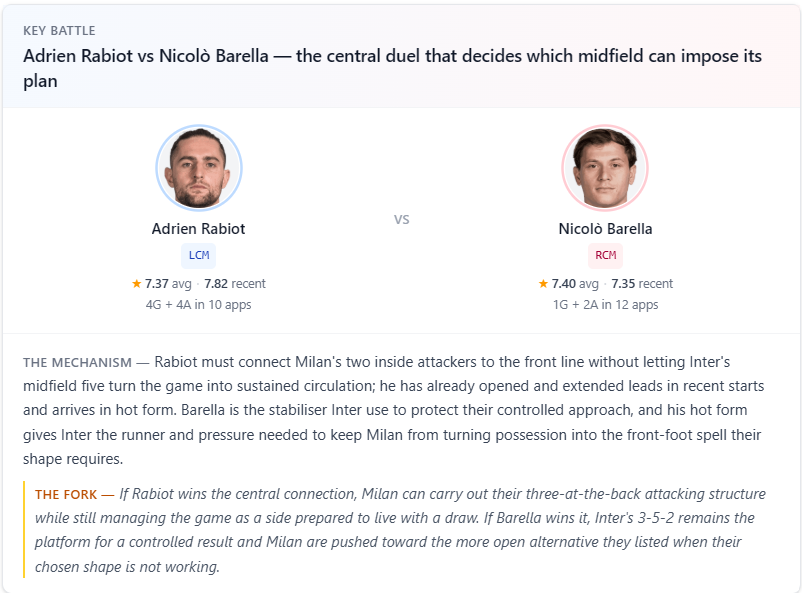
The central duel is Adrien Rabiot against Nicolo Barella. The French midfielder is the player who must connect Milan’s left half-space to the front line without allowing the away midfield to turn the match into uninterrupted passing. His recent starts included an opening goal and two occasions when he extended a lead, while Barella offers Inter the running and pressure needed to keep Milan from converting possession into sustained attacks.
If Rabiot wins that duel, Milan can keep both inside attackers near Ramos and retain enough structure to manage the match. If Barella wins it, Inter’s five-man midfield can protect the controlled approach, leaving the “home side” with the more open alternative of adding another attacking line and weakening their cover.
Behind that duel sits a second problem on Milan’s left. Pervis Estupinan has to provide width and recover against Andy Diouf, whose right-sided running can turn Inter’s midfield shape into a five-man attacking line.
The Ecuadorian international arrives in stronger form, but if Diouf gains repeated access to the outside lane, Milan’s wing-back is forced deeper and the inside attackers become detached from Ramos. If Estupinan contains it, the Rossoneri can keep their three defenders behind the ball and preserve the shape that gives them their best chance of attacking without losing control.
Prediction: Inter’s extra body makes the away win the narrowest lean
We predict an Inter Milan win, but only with medium conviction. Their settled 3-5-2 shape gives them an extra central player against AC Milan’s two-man midfield, and the contest between Adrien Rabiot and Nicolo Barella should decide whether the Rossoneri’s possession becomes genuine attacking pressure or merely circulation in front of Inter’s block.
Inter also arrive with the stronger recent chance-creation profile, averaging 2.77 xG per match against Milan’s 1.91 over the same five-match period. Their defensive figures are almost identical, with Inter at 1.42 xGA and Milan at 1.43. So, the distinction is more about how often the Nerazzurri can create danger than about a huge defensive gap.
Lean: Inter Milan win
Range: 1-2/0-1/2-2
The strongest case against our prediction is Milan’s ability to turn a controlled possession spell into a quick lead. Christian Pulisic, Alphadjo Cisse, and Rabiot give the home side three different routes into the spaces around Inter’s back three, and the “away side’s” cautious approach could allow Milan to keep pressure on without facing constant counterattacks.
If Pervis Estupinan holds Andy Diouf’s lane and Rabiot receives between Inter’s midfield and defence, the home side can keep Ramos supplied while avoiding the frantic game the “visitors” would prefer to manage. Milan’s recent defeat therefore does not make them a safe opponent to oppose; it may instead force a sharper response. The scoreline is most likely to settle around 1-2, with 0-1 and 2-2 also fitting the match.
The switch Milan can make if the midfield is overrun
AC Milan’s clearest in-game adjustment is to move from the 3-4-2-1 into a 4-2-3-1 if Inter Milan’s midfield five consistently prevent Adrien Rabiot and Luka Modric from connecting with the forwards.
That change would add another central midfielder and a more conventional full-back line, giving the home side extra protection against Inter’s wide attacks, though it would also remove one of the two inside attackers currently positioned to support Gonalo Ramos. The champions’ structure is more settled, so Milan’s ability to alter the balance without abandoning all of their attacking threat could decide whether the predicted narrow away advantage remains intact.