Chelsea vs Tottenham at Stamford Bridge on Saturday will be a London Derby featuring two teams chasing momentum for different reasons.
Tottenham’s 3-1 win over Coventry City on Monday finally gave Roberto De Zerbi’s side a league victory. However, Chelsea now stand between that lift and any real recovery. The Blues beat Everton 2-0 last weekend, and their six-match winning run against Spurs gives this London derby a clear starting point. The hosts are trying to consolidate fourth place, while Tottenham need to turn improved morale into points from a difficult away fixture.
For Chelsea, the result matters without carrying a win-or-collapse feel. Victory would strengthen their position inside the Champions League places, while a draw or defeat would leave that target live rather than remove it. They bring back-to-back wins into the match, have scored nine, and conceded six across their last four outings while keeping their first clean sheet since January at Everton.
Xabi Alonso’s new project is still gathering confidence. Tottenham, on the other hand, approach the game differently. Their first win of the campaign lifted the mood, but they remain in the lower reaches and cannot afford another result that leaves the pressure on De Zerbi. A win would give the season momentum; a draw keeps the objective alive, while defeat leaves them too close to the relegation places for comfort.
Spurs have scored six and conceded five in their last four, and their last outing brought three goals from outside the box rather than a sustained attacking performance. Chelsea’s home advantage and long record in this fixture make Spurs’ task more than simply continuing the confidence gained against Coventry.
Team News: The selections behind Chelsea’s front-foot shape
Chelsea are expected to line up in a 3-4-2-1 formation vs Tottenham. Emiliano Martinez (surgery on fractured jaw), Reece James (knee), Pep Chavarria (knock), Jamie Gittens (ankle), and Emmanuel Emegha (match fitness) are unavailable.
James’s absence is the most structurally important. Pedro Neto should provide the right-sided outlet, while Josh Acheampong’s ability to cover the defensive side of that channel becomes valuable in a back three.
Mike Penders is set to start in goal, with Maxence Lacroix, Levi Colwill, and Acheampong forming the central defensive unit. Penders has only played 15 minutes this season, so this is a major responsibility in possession as well as in goal. Colwill supplies the established left-sided presence, while Lacroix gives the line a physical option against Dominic Solanke.
Ahead of them, Moises Caicedo and Jordan Henderson should form the midfield pairing, with Jorrel Hato and Neto providing the width. The attacking plan runs through Morgan Rogers, Cole Palmer and Joao Pedro.
Rogers has started seven Premier League games, scoring four goals and supplying 13 key passes, and his left-sided movement gives Chelsea a way to attack the space around Tottenham’s midfield. Palmer has three goals and 11 key passes from seven appearances, making him the connector between midfield and the striker. Joao Pedro has five goals and three assists in six starts, so his central movement should be the reference point for the two attacking midfielders.
Probable Chelsea Starting Lineup (3-4-2-1): Penders; Acheampong, Lacroix, Colwill; Neto, Henderson, Caicedo, Hato; Palmer, Rogers; Pedro
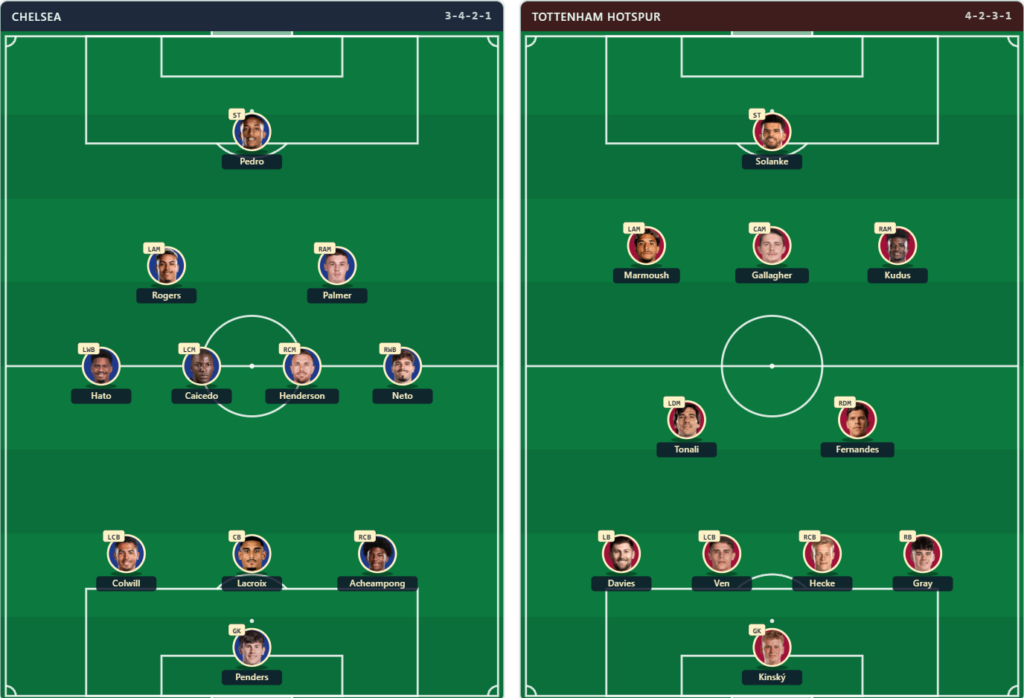
Probable Tottenham Starting Lineup (4-2-3-1): Kinsky; Gray, van Hecke, van de Ven, Davies; Fernandes, Tonali; Kudus, Gallagher, Marmoush; Solanke
Tottenham’s 4-2-3-1 is the more settled choice, having been used in three of their last four matches, although the selection is less secure in several positions. Mykhaylo Mudryk, Xavi Simons, Wilson Odobert, Lucas Bergvall and Savinho are out, while Andrew Robertson, Pedro Porro, Tosin Adarabioyo, Dejan Kulusevski and James Maddison remain doubtful. Rodrigo Bentancur is suspended and Destiny Udogie is unavailable. The missing and doubtful options particularly affect the full-back positions and the central attacking role.
Antonín Kinský should continue in goal behind Archie Gray, Jan Paul van Hecke and Micky van de Ven, with Ben Davies an open call at left-back. Van Hecke has started all seven matches, scored once and made five key passes, while Van de Ven’s recovery pace is important against Chelsea’s front three. Sandro Tonali should anchor the midfield, having started every match and contributed seven key passes and one assist. Mateus Fernandes is another unsettled call beside him, while Gallagher is expected to fill the central attacking-midfield role and has one goal from five appearances.
Marmoush should occupy the left attacking lane, with Mohammed Kudus likely to start on the right and Dominic Solanke leading the line. Marmoush has five starts and four key passes, while Solanke has one goal, one assist and four shots on target from his seven appearances. Kudus brings the dribbling outlet Tottenham’s shape needs, but his two starts make that call less secure than the core of the side.
Tactics: Palmer’s space against Tonali’s screen
Chelsea’s three-man defence and two attacking midfielders are designed to keep Cole Palmer and Morgan Rogers close enough to Joao Pedro to attack the spaces between Tottenham’s midfield and backline. The home side will try to carry the game forward without treating it like a win-only emergency.
Tottenham’s 4-2-3-1 system, by contrast, keeps two midfielders behind the attacking line so that their build-up remains protected and their possession game has a stable base. The two profiles point to a clear difference in where the contest may be played.
Chelsea keep 50% of the ball on average and Tottenham 59%, with the league-typical figure at 49.5%. So, Spurs are more accustomed to having the match on their terms. The home side’s long-ball figure is 50 per match against Tottenham’s 33, either side of the league’s 49.5 norm. That suggests the home side is more willing to bypass midfield, while the visitors prefer to maintain shorter build-up routes.
Chelsea also produce 0.278 xG from set pieces per match, compared with Tottenham’s 0.16, against a league typical 0.229; dead-ball situations offer the hosts another route to pressure. The recent matches show why that identity could be tested. Tottenham had only 34% possession against Coventry, while Chelsea had 53% against Everton.
Spurs can still settle into their patient structure, but if Chelsea stop them establishing the same control they normally seek, the visitors may have to defend for longer than their preferred plan allows. Xabi Alonso’s men, meanwhile, need enough pressure to prevent the match becoming a slow exercise in Tottenham circulation.
They will push forward inside their shape, while Spurs should pursue the result but keep enough cover to accept a draw rather than expose themselves early. Cole Palmer against Sandro Tonali is the central duel.
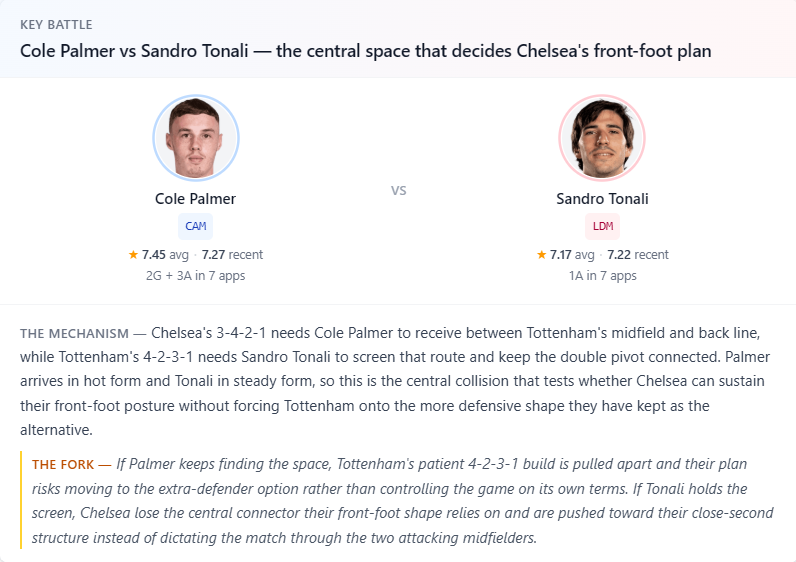
Palmer should look for the pocket behind Tottenham’s midfield, where his creativity can connect Chelsea’s two attacking midfielders with Joao Pedro. Tonali is the player responsible for screening that route and keeping the double pivot linked to the back four. Palmer arrives with stronger attacking momentum, but Tonali’s steady role gives Spurs the organiser they need to keep the centre compact.
If Palmer keeps receiving between the lines, Tottenham’s patient structure can be pulled apart and De Zerbi may need to add a defender through the 3-1-4-2 alternative. If Tonali holds the screen, Chelsea lose their main central connector and could be forced toward a wider version of their own close-second structure.
Joao Pedro’s movement against Jan Paul van Hecke is the next layer. If the striker, a top pick for FPL captain this week, pins the Dutch centre-back and draws help inward, Palmer and Rogers gain room; if van Hecke manages the reference point, Tottenham can preserve the two-line protection behind Tonali.
Prediction: Chelsea favoured, but not strongly enough to ignore Spurs’ resistance
We predict a Chelsea win, held with medium confidence rather than the certainty of a banker. The home side’s 3-4-2-1 setup gives Cole Palmer and Joao Pedro the central access most likely to trouble Tottenham’s defensive organisation, while the home side’s recent attacking process has produced 1.10 xG per match against Tottenham’s 1.15 xGA.
That is a narrow comparison, but it points to a contest in which Chelsea’s chance creation should be sufficient if their attacking players find the spaces described above. The strongest case against the home win is Tottenham’s ability to keep the match controlled.
Lean: Chelsea win
Range: 2-1/2-0/1-1
Their higher share of possession can slow Chelsea’s pressure, and Sandro Tonali’s positioning may prevent Palmer from receiving cleanly between the lines. If Spurs protect the centre, draw Chelsea’s wing-backs forward, and then find Dominic Solanke in the spaces left behind, the visitors have a realistic route to a result.
Chelsea have also scored 6.791 goals more than expected this season, which makes their excellent finishing return harder to project confidently from one match into the next. The likely scoreline range is 2-1, 2-0 or 1-1. Chelsea remain the better match-result selection, but the draw is the live danger if Tottenham’s midfield screen survives the opening phases.
Alonso’s extra outlet can change the second half
Chelsea have a clear in-game adjustment if Tottenham successfully close the central lanes. Xabi Alonso can move to the 4-2-3-1 alternative with an extra wide outlet, allowing the attack to stretch Spurs without changing its main attacking personnel.
Roberto De Zerbi’s corresponding switch would be the 3-1-4-2, adding a central defender to protect the build-up. That gives Chelsea the more direct way to alter the match if the first plan becomes too narrow.