

Bournemouth vs AC Milan at the Vitality Stadium on Thursday will be a game featuring two red-and-black stories arrive at different points of their evolution.
Bournemouth’s European resurgence now meets AC Milan’s tactical renaissance, with the symbolism adding another layer to an already meaningful UEFA Europa League test. The Cherries’ red-and-black identity was inspired by Milan decades ago; now the south-coast club face the Italian giants during their first European campaign.
Marco Rose’s men arrive into this game after consecutive home wins, including a 3-0 victory over Sturm Graz and a 2-0 success against Sunderland. On the other hand, Milan cruised to a 4-0 win over Red Bull Salzburg on Matchday 2. A win would strengthen either side’s momentum, but neither team enters with a result-or-nothing burden, making control as important as ambition.
For Bournemouth, this is a chance to show that their domestic revival can survive against a heavyweight opponent. The victories over Sturm Graz and Sunderland have changed the mood around Marco Rose’s team, but a defeat would expose the difference between a promising surge and genuine European progress.
Their latest outing against Sunderland was forceful. Bournemouth dominated the ball, produced 29 shots and created 4.32 xG. They carry confidence on the back of consecutive clean sheets at home and a clearer attacking identity into this fixture. The main question is whether that confidence encourages them to keep their balance rather than chase the occasion.
On the other hand, Milan’s need is different. Their 4-0 win over Salzburg announced the new direction under Ruben Amorim, while the 3-2 victory against Atalanta extended an unbeaten Serie A start, ending a three-year winless run against La Dea. Yet the 1-1 draw with Sassuolo showed that their improvement has not removed every complication.
Another win would confirm the tactical progress; a defeat would leave the European momentum less convincing, while a draw would still preserve a useful platform. The away side’s central attacking selection is altered by a key absence, which may make the visitors more measured when deciding how many players to commit ahead of the ball.
Team News: The selected teams and absences that define them
Bournemouth will be without Fraser Forster, Max Aarons, Julian Araujo, Juanlu Sanchez, Daniel Jebbison, Alex Scott, Eli Junior Kroupi, and Veljko Milosavljevic. Araujo (thigh), Scott (hamstring), and Kroupi (foot) are affected by injury, while the rest are unavailable because they are not eligible for the Europa League squad.
The result is less about one missing starter than about reduced depth around the European group. Bournemouth should line up in a 4-2-3-1 formation vs AC Milan, with Djordje Petrovic behind a back four of Adam Smith, James Hill, Antonio Silva, and Adrien Truffert.
As for the midfield unit, Lewis Cook and Tyler Adams should form the double pivot. Cook has three key passes from his single Europa League appearance, while Adams has started both matches in this window and gives the midfield its screening presence. The attacking line is where Bournemouth’s selection carries more threat.
Marcus Tavernier should begin from the left after creating five key passes in two starts, while Rayan’s two goals from two appearances make him the more direct inside threat from the right. Justin Kluivert is expected to operate behind Evanilson, whose two starts have brought one goal and four shots on target from six attempts.
Probable Bournemouth Starting Lineup (4-2-3-1): Petrovic; Smith, Hill, Silva, Truffert; Adams, Cook; Rayan, Kluivert, Tavernier; Evanilson
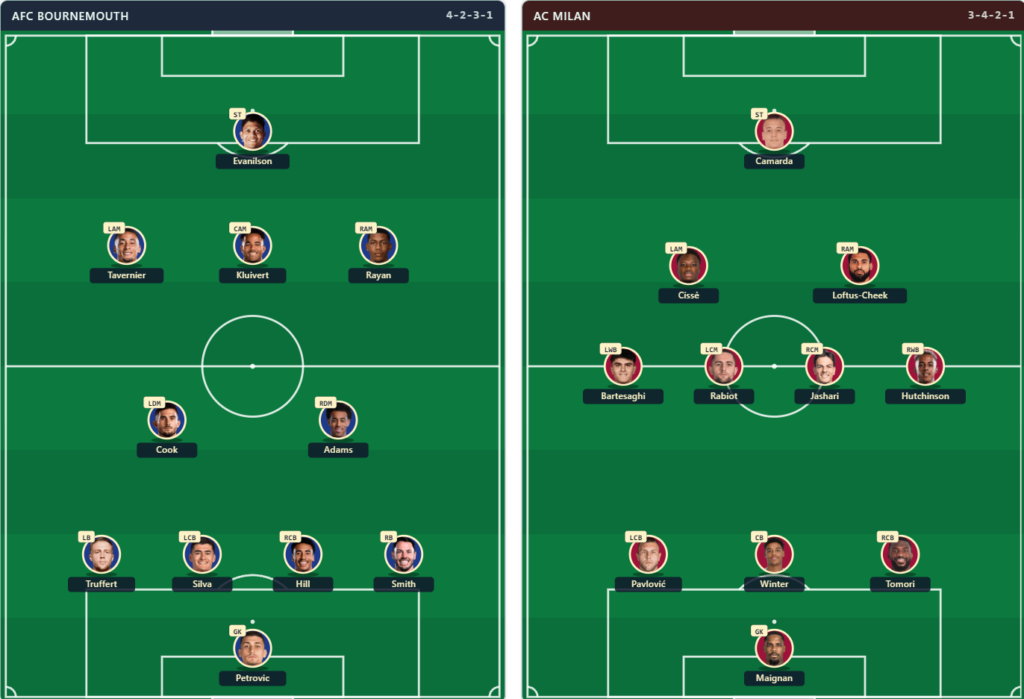

Probable AC Milan Starting Lineup (3-4-2-1): Maignan; Tomori, De Winter, Pavlovic; Hutchinson, Rabiot, Jashari, Bartesaghi; Loftus-Cheek, Cisse; Camarda
AC Milan are missing Matteo Gabbia, Alexis Saelemaekers, Goncalo Ramos, Warren Bondo, Filippo Terracciano, and Samuel Chukwueze. Gabbia (thigh), Saelemaekers (ankle surgery), Ramos (calf), and Chukwueze (hip) are in the treatment room, while Terracciano serves a suspension after his dismissal against Red Bull Salzburg last week; Bondo is ineligible in the Europa League.
Ramos’s absence matters most to the structure because it removes a central attacking option and places more responsibility on the available front line. Milan should therefore use a 3-4-2-1, their most-used recent arrangement, with Mike Maignan in goal and Koni De Winter, Fikayo Tomori and Strahinja Pavlović forming the back three.
Pavlović has started both matches and scored when he opened the scoring at Lecce, while Maignan remains the established goalkeeper after starting twice. Davide Bartesaghi should hold the left wing-back role, with Omari Hutchinson on the opposite side. Adrien Rabiot and Ardon Jashari are expected to work as the central pair: Rabiot has supplied three key passes and one assist, while Jashari has created two big chances and four key passes. Ruben Loftus-Cheek should occupy the right inside lane, Alphadjo Cissè the left, and Francesco Camarda the striker position. Cissè brings the sharpest recent attacking return, with three goals and five shots on target from six attempts.
Tactics: Bournemouth’s long route vs AC Milan’s three-man platform
Bournemouth’s 4-2-3-1 setup is designed to keep two midfielders behind the attacking line while giving Evanilson a fixed central reference and Rayan room to move inside from the right. The Cherries go forward without needing to remove their cover, which suits a match where a draw remains useful.
Their profile points to a direct route. Bournemouth have played 65.5 long balls per match against a league-typical figure of 45. While these numbers have emerged after only two Europa League matches, it still explains how they can bypass Milan’s midfield and challenge the back three before it settles.
The away side’s 3-4-2-1 system keeps three defenders behind the central pair and places Alphadjo Cisse and Ruben Loftus-Cheek close to Francesco Camarda. Milan’s attacking habit is more dribble-led, with 20.5 take-ons per match against a league-typical figure of 16.5.
The Rossoneri are likely to look for carries between Bournemouth’s midfield and defence rather than relying only on early deliveries. The away side’s shape allows them to pursue the win while keeping protection behind the ball, and their shape suggests they can accept a draw rather than turn every attack into a gamble.
That creates a clear meeting point. Bournemouth’s direct balls are intended to make Milan defend facing their own goal and contest second balls around Evanilson. Ruben Amorim’s men want to keep the match in front of their three centre-backs, then use Alphadjo Cisse and Ruben Loftus-Cheek to draw Bournemouth’s double pivot apart.
The home side’s recent five-match run has produced 1.92 xG per game, while Milan’s equivalent defensive figure is 0.89 xGA. The hosts have enough threat to disrupt the visitors, but Amorim’s charges have the platform to keep the contest controlled if they win the first contact. The main duel is Evanilson against Koni De Winter.
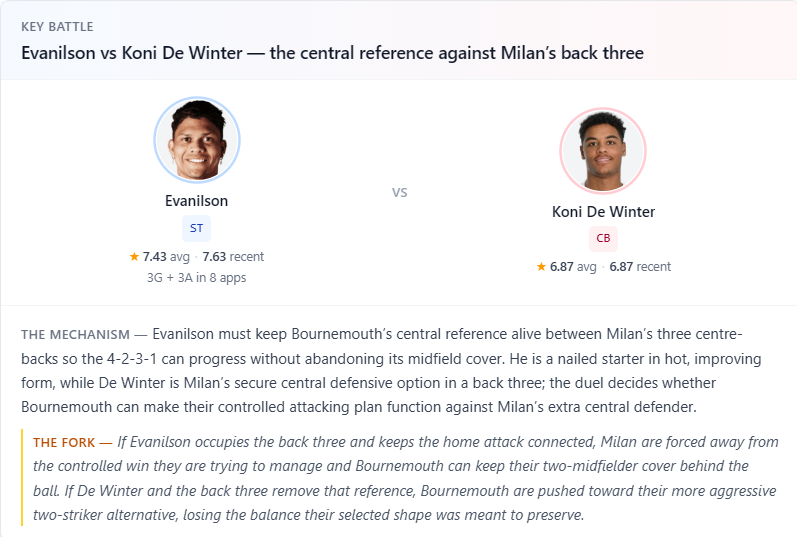

Evanilson’s job is not simply to finish moves; he must occupy the back three, protect Bournemouth’s forward connection and give Rayan and Tavernier time to arrive around him. De Winter is the anchor in Milan’s three-man line and has started both of his appearances.
If Evanilson keeps that reference alive, Bournemouth can continue attacking while Tyler Adams and Lewis Cook remain behind the ball. If De Winter and the defenders remove him from the game, Bournemouth may be forced to commit another striker earlier, sacrificing the balance their chosen system provides.
The second battle sits in the mirrored inside lane, where Rayan meets Davide Bartesaghi. The Brazilian winger’s two Europa League goals show why Milan cannot allow him to receive freely behind the wing-back. However, Bartesaghi’s width can also pin Adam Smith and open the channel for Cisse or Adrien Rabiot.
If Rayan wins those movements, Milan must send extra cover toward their left and may expose the platform behind their two inside attackers. If Bartesaghi contains him, the visitors can keep their three-man base intact and make Bournemouth attack more predictably.
Prediction: A possible draw with Milan’s defence as the separator
We predict the game to end in a keenly contested draw. Both teams have enough attacking evidence to win the match, but both selected structures also protect against an open contest. Bournemouth’s direct route can trouble AC Milan’s back three.
Meanwhile the away side’s inside attackers can test the spaces around the Cherries’ double pivot. Those competing advantages make a narrow stalemate more plausible than a clear superiority call. The strongest case against the draw is AC Milan’s defensive control.
Lean: Draw
Range: 1-1/0-0/1-2
Their recent chance-concession baseline is 0.89 xGA, and the three centre-backs give them an extra defender around Evanilson. If Koni De Winter prevents Bournemouth’s striker from connecting the attack, the home side may struggle to turn their possession and forward running into clear chances.
The Rossoneri would then have the better conditions for a narrow win, particularly if Alphadjo Cisse can receive between the lines and force Tyler Adams or Lewis Cook to leave the central lane. The case for Bournemouth is that their recent attacking output has reached 1.92 xG per match, and Evanilson, Rayan, and Marcus Tavernier offer three different ways to disturb the visitors. The likely scoreline range is 1-1, 0-0 or 1-2.
The late switch that could change the balance
Bournemouth have a clearer in-game attacking adjustment if the central reference is being removed. Marco Rose can change to a 4-4-2 and commit a second striker earlier. That would put more pressure on AC Milan’s back three, but it would also take away one layer of midfield cover.
The away side’s corresponding change would be to add another high player around the Bournemouth defence with a 3-4-3 formation. So, the final phases may depend on which manager chooses to alter the structure first rather than simply adding more bodies forward.