West Ham United vs QPR will be a key Matchday 9 fixture in the EFL Championship as the two title contenders look to settle into a rhythm after the international break.
West Ham United’s 6-0 victory over Wrexham and 4-2 win against Wolves helped lift them into the promotion conversation, while QPR’s latest 2-2 comeback against Preston North End showed why they remain difficult to dismiss. The London rivals meet in their first league game against each other since 2015, with the Hammers second and QPR sixth in an early but increasingly meaningful promotion race.
A home win would move West Ham to the top before Swansea City play on Saturday afternoon. On the other hand, QPR can strengthen their position without needing to treat a draw as a failure. Meanwhile, for West Ham, this is an opportunity to turn strong recent momentum into a statement at home.
Nuno Espirito Santo’s men have won four of their last five games and are unbeaten in six league matches. So, dropping points would not undo their progress, but it would leave the door open for the chasing pack. Their last five matches have brought 18 goals and only six conceded, a run that explains why they are expected to take the initiative rather than wait for QPR to make the first mistake.
The long international break also gave Nuno Espirito Santo time to restore his squad and prepare for another push. QPR, on the other hand, arrive with a different frame of mind. The Hoops have lost only once in eight matches, and their recovery from two goals down against Preston while reduced to ten men underlined their resilience.
Kwame Poku and Paul Smyth supplied the goals in that comeback, but another draw would keep their promotion target alive while a defeat would allow West Ham to widen the gap. Julien Stephan has asked his team to show ambition rather than simply respect the hosts, although his team’s injury troubles could make that ambition harder to sustain for the full match.
Team News: Soucek returns while QPR reshape their forward options
West Ham United have Tomas Soucek available for the matchday squad after recovering from ankle ligament damage. Joël Veltman is out after being forced off with a muscular issue last month, while Mohamadou Kante is suspended following his red card against Millwall. Those absences reduce the defensive and midfield cover around the starting group.
West Ham should line up in their usual 4-4-2 vs QPR, the shape they have used in four of their last five matches. Mads Hermansen holds the goalkeeping spot behind a back four of Morato, Maximilian Kilman, Konstantinos Mavropanos, and Kyle Walker-Peters.
The midfield should pair Arne Engels with Divine Mukasa, with Engels providing the main progression from the centre after recording two assists and 18 key passes. Mukasa has scored twice, though his recent level has been less convincing than the rest of the midfield. Manor Solomon and Jarrod Bowen give the formation its attacking width, with Joel Piroe and Taty Castellanos leading the line.
Solomon has contributed two goals, two assists and 15 key passes, while Bowen’s 24 key passes, four goals, and three assists make him the clearest attacking reference in the side; the skipper also takes penalties. Piroe should keep his place after registering three goals, and Castellanos offers movement alongside him with one goal and two assists. The settled group gives West Ham continuity even with Veltman and Kante unavailable.
Probable West Ham United Lineup (4-4-2): Hermansen; Walker-Peters, Mavropanos, Kilman, Morato; Bowen, Mukasa, Engels, Solomon; Castellanos, Piroe
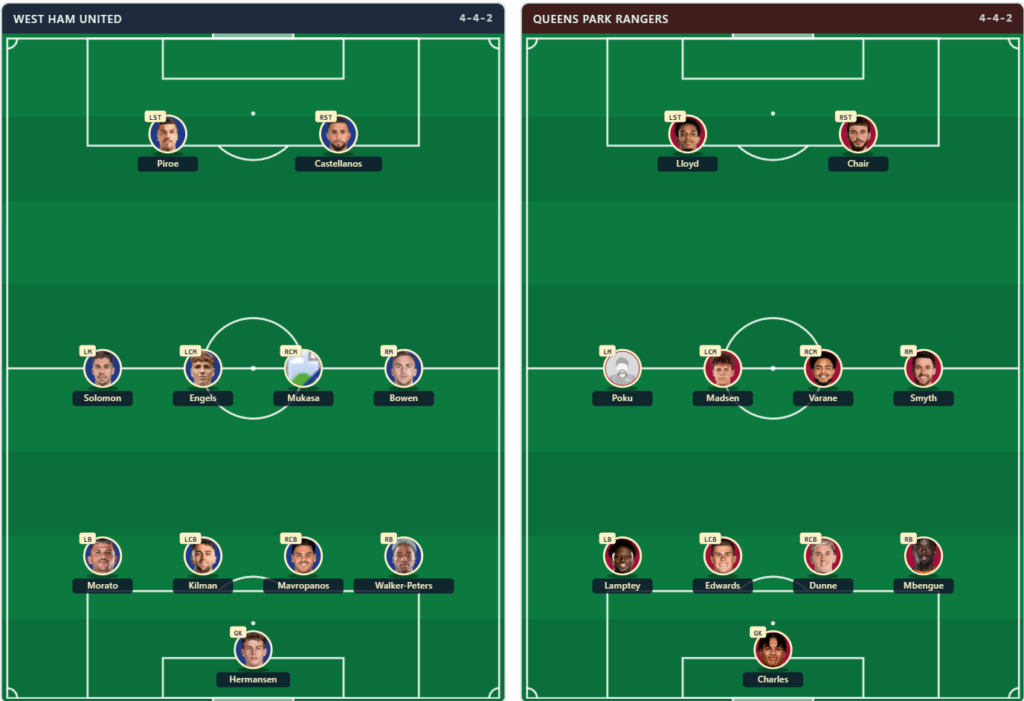
Probable QPR Lineup (4-4-2): Charles; Mbengue, Dunne, Edwards, Lamptey; Smyth, Varane, Madsen, Poku; Chair, Lloyd
QPR are also expected to use a 4-4-2 setup vs West Ham. Rumarn Burrell is expected to miss the match, while Richard Kone and Justin Obikwu remain doubts after their respective returns to training. Burrell’s absence removes one central attacking option, and Kone’s fitness affects whether QPR can later move towards a shape with an extra player between the lines.
Pierce Charles features between the sticks behind Tariq Lamptey, Ronnie Edwards, Jimmy Dunne and Amadou Mbengue. Nicolas Madsen and Jonathan Varane should form the central pairing. Madsen has supplied nine key passes, while Varane has 13 despite starting fewer matches, giving QPR some passing threat from midfield.
Poku should start on the left wing after scoring in the comeback against Preston, with Paul Smyth on the right flank. Alfie Lloyd is likely to line up alongside Ilias Chair up front; Chair has two goals, one assist and nine key passes, while Lloyd is being asked to lead the line despite having scored none so far.
Tactics: West Ham want territory; QPR need their wide exits
West Ham’s shape is designed to keep two forwards high while allowing Jarrod Bowen and Manor Solomon to stretch the visiting defensive line. Their approach is built around controlling the ball and attacking through both the wings and the centre. West Ham average 54% possession against a league-typical 49%, while QPR average 49% against that same mark. That gap gives the hosts the clearer platform for territorial control, but they still need to turn possession into entries rather than circulate harmlessly.
QPR’s route is more about attacking volume than controlling the match. They average 16.5 shots per match against a league typical 13, whereas West Ham’s shooting figure is 13. The visitors therefore have enough appetite to punish West Ham if the home side commits too many players forward, even though their overall possession profile is less commanding.
QPR will come to win but can accept a draw, so their priority should be keeping the two banks connected while still releasing Poku, Smyth and the two forwards. The important system contest is on the flanks. Bowen meets Tariq Lamptey on West Ham’s right, while Solomon faces Amadou Mbengue on the opposite side.
QPR’s wide players must help their full-backs without abandoning the front two, because West Ham’s wide outlets are what make the home 4-4-2 difficult to contain. If QPR defend too narrowly, the hosts can attack around them; if they spread too far, Ilias Chair and Alfie Lloyd may become isolated. The main duel is Bowen against Lamptey.
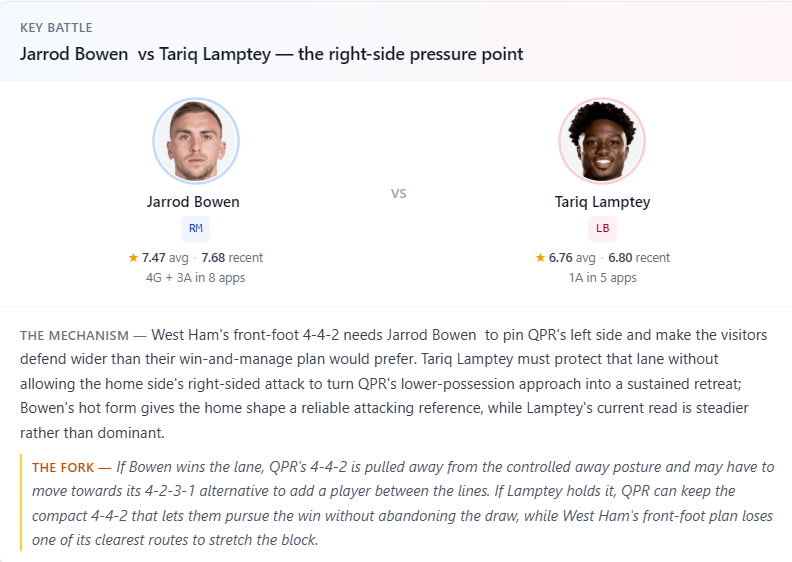
Bowen’s current level gives West Ham a reliable player to feed in that lane, while Lamptey’s steadier profile means his task is less about winning every exchange than preventing the home winger from pinning the whole QPR block. If Bowen wins the battle, QPR may need to abandon their compact 4-4-2 for a 4-2-3-1 with another player between the lines.
If Lamptey holds his own, QPR can preserve the structure that allows them to pursue the win without exposing themselves to unnecessary risk. Behind Bowen, Kyle Walker-Peters can overlap and make Lamptey defend two movements rather than one; behind Lamptey, Mbengue, and Jimmy Dunne must keep the back line connected. The other wide contest carries a different problem.
Solomon against Mbengue tests whether QPR can absorb pressure on both sides at once. Mbengue has been a settled selection and is in good current form, but Solomon’s role is to keep forcing him backwards and stop QPR from turning every recovery into an attacking release. Should both wide lanes open, West Ham’s central forwards will receive the benefit. Should QPR contain them, their higher shooting volume gives them a credible way to punish the home side’s over-commitment.
Prediction: The home side has the stronger route to a narrow win
We are leaning towards a West Ham win, albeit only with medium confidence. Their recent attacking output, home initiative, and clearer control of territory point towards a home victory, while QPR’s resilience makes a comfortable result less convincing. The hosts’ season expected-goals difference is 3.296, which supports the stronger scoring picture but also suggests that the margin may not be as stable as the raw results imply.
The strongest case against West Ham is that QPR do not need to dominate possession to create danger. Their greater shooting appetite can turn a misplaced pass or an overextended full-back into an immediate chance, particularly if the home side’s two central midfielders are left covering too much space.
Lean: West Ham win
Range: 2-1/2-0/1-1
A successful defensive performance from Lamptey and Mbengue would let QPR keep their compact shape, and that would make the game much closer than West Ham’s recent scorelines suggest. The most likely outcomes sit in the 2-1, 2-0 or 1-1 range. The best objective read is a narrow West Ham win, with both teams capable of producing enough attacking moments to keep the draw live.
The protection switch West Ham can make late
West Ham have a clear in-game adjustment if they take control. They can bring an extra midfielder into the structure and protect the lead with a 4-4-1-1 system. That option allows them to reduce the space QPR can attack without abandoning the advantage created by their wide players.
The away side’s alternative is more aggressive, requiring an additional player between the lines, but West Ham’s ability to change the balance after going ahead gives the hosts the more useful late-match lever.