
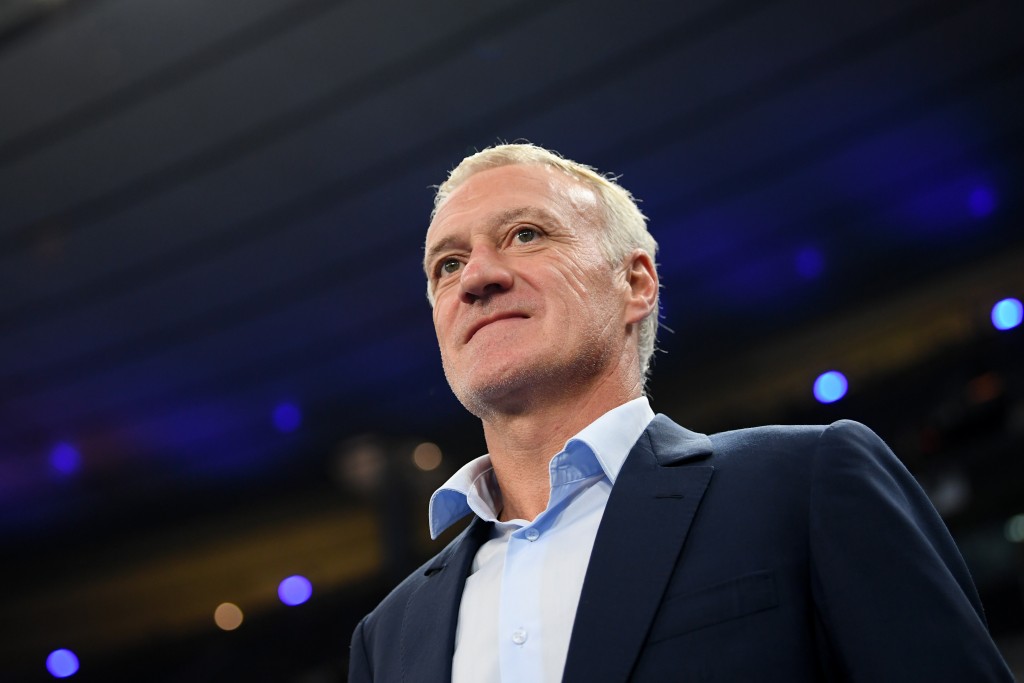
France and Spain will meet in Dallas on Tuesday for a place in the 2026 FIFA World Cup final, with two of international football’s most accomplished teams separated by just 90 minutes from another defining chapter in their history.
The stakes could hardly be higher as France are attempting to reach a third consecutive World Cup final, a feat previously achieved only by Brazil and Germany, while Spain are seeking their first appearance in the tournament’s showpiece since lifting the trophy in South Africa in 2010. The winners will face either England or Argentina in the final. But before either side can begin thinking about the trophy, they must negotiate a semi-final between two teams who have been among the most convincing performers in North America.
France arrive with a perfect record as Didier Deschamps’s side have won all six of their matches at the tournament, scoring 16 goals while navigating very different types of challenges. They controlled their group, overwhelmed Sweden in the Round of 32, survived a physical and disruptive Paraguay side, and then overcame Morocco in a demanding quarter-final.
That victory over the Atlas Lions again demonstrated the range of France’s qualities. Les Bleus were not at their clinical best and Kylian Mbappe missed a first-half penalty, but they never lost control of the contest. Their captain recovered to score a superb opening goal before creating the second for Ousmane Dembele, allowing France to close out another high-pressure knockout match.
Deschamps has traditionally been associated with pragmatic tournament football, but his final competition in charge has revealed a more adventurous version of France. Les Bleus still defend with discipline, but they are now committing more players into attacking positions and creating chances at a far greater volume. That shift has been possible because of the protection offered by the midfield and defence.
Deschamps is also preparing to create another piece of World Cup history. This will be his 26th match as a manager at the competition, moving him beyond Helmut Schon’s long-standing record. Having already won the World Cup as France captain in 1998 and as head coach in 2018, he now has the opportunity to end his 14-year tenure by reaching a third straight final.
France’s record at this stage offers further encouragement. They have progressed from each of their last four World Cup semi-finals and have won the previous three without conceding. Their only prior World Cup meeting with Spain also ended in victory, with the team recovering from behind to win 3-1 in the Round of 16 in 2006.
Spain, however, will not be intimidated by either France’s history or their current form. La Roja have developed into one of the most complete international teams under Luis de la Fuente and have repeatedly shown an ability to perform in major knockout matches.
The European champions topped Group H before sweeping Austria aside in the Round of 32. They then survived a fiercely contested meeting with Portugal and followed it by eliminating Belgium in the quarter-finals, with Mikel Merino once again emerging from the bench to score a late winner.
Spain’s strength is built around control and their passing is not simply designed to dominate possession; it is used to move opponents out of position before accelerating into the final third. Their recent record against France is a significant source of belief. They have won seven of the last ten meetings between the countries, including the Euro 2024 semi-final and the 2025 Nations League final. Yamal scored twice in the latter, while Mikel Merino also found the net in a remarkable 5-4 victory.
Those results give Spain psychological confidence, but France are a different proposition at a World Cup. Deschamps’s side understand how to manage tournament pressure, absorb difficult moments and punish errors with ruthless efficiency.
The tactical contest is likely to revolve around space behind Spain’s defensive line. La Roja will want to push high, dominate possession and compress the pitch, but that approach could leave them vulnerable to Mbappe’s pace. France will not need long periods on the ball to create danger; one turnover in midfield could immediately place Spain’s defenders in a foot race they would prefer to avoid.
Spain, by contrast, will try to prevent the game becoming stretched. Rodri and the two midfielders ahead of him must circulate possession quickly while maintaining enough security to stop France countering through Mbappe and Dembele.
At the opposite end, Spain must decide how aggressively to press France’s build-up. Pushing too many players forward could open space behind the midfield, where Olise is capable of turning and releasing Mbappe. Sitting too deep, however, would allow France to sustain pressure around the penalty area.
Set pieces may also prove decisive as Spain possess several high-quality delivery options, including Yamal, Alex Baena and Dani Olmo, while France carry significant aerial power through Saliba, Upamecano, Rabiot and Kone. In a semi-final likely to be decided by small margins, one dead-ball situation could shape the outcome.
This is a genuine meeting of equals. Spain may control more of the ball, but France possess the more devastating transition threat. La Roja have the midfield structure to frustrate Les Bleus, yet Mbappe’s pace and France’s experience in World Cup semi-finals may ultimately make the difference.
Expect a tense, high-quality contest in which Spain dominate spells of possession and France remain dangerous whenever the game opens up. One moment from Mbappe, Olise or Yamal could decide which European giant reaches the final. The Hard Tackle takes a look at how both sides could line up and what tactics they might employ on the day.
Team News & Tactics
France
France head into the World Cup semi-final with only a handful of fitness concerns, and Didier Deschamps is expected to name a side close to full strength for one of the biggest matches of his managerial career. Les Bleus have won all six of their matches at the tournament and are unlikely to stray from the settled system that has combined defensive discipline with attacking freedom.
Skipper Kylian Mbappe is expected to be available despite suffering a minor ankle sprain during the quarter-final victory over Morocco. The France captain was substituted as a precaution and should be fit to lead the line against Spain. Manu Kone was also withdrawn with a knee issue in the previous round, but the problem is not considered serious and the AS Roma midfielder is expected to be available.
Aurelien Tchouameni has resumed training after recovering from a thigh injury and is back in contention, although Manu Kone is tipped to retain his place. France have no suspension concerns ahead of the semi-final.
Deschamps is expected to continue with his preferred 4-2-3-1 formation, which has been the cornerstone of France’s impressive run to the last four. The system is designed to remain compact without possession before exploding into quick transitions through its dynamic front four. Michael Olise has become the creative heartbeat of the attack, frequently drifting across the final third to link play and create space for Kylian Mbappe and Ousmane Dembele.
With five assists already at the tournament, Olise has consistently unlocked deep defensive blocks, while Mbappe and Dembele have developed one of the competition’s most dangerous attacking partnerships, creating 19 chances for one another during France’s World Cup campaign. Desire Doue is expected to get the nod on the left after another impressive display, although Bradley Barcola remains a strong alternative from the bench.
The key tactical battle for France will revolve around Olise’s movement against Rodri. Spain will attempt to dominate possession through their midfield anchor, but Olise’s freedom to drift between the lines could disrupt Spain’s defensive shape and create opportunities for Mbappe to attack the space behind the high defensive line. France will also look to exploit transitions whenever Spain commit numbers forward, with Mbappe’s pace remaining their greatest weapon on the counterattack.
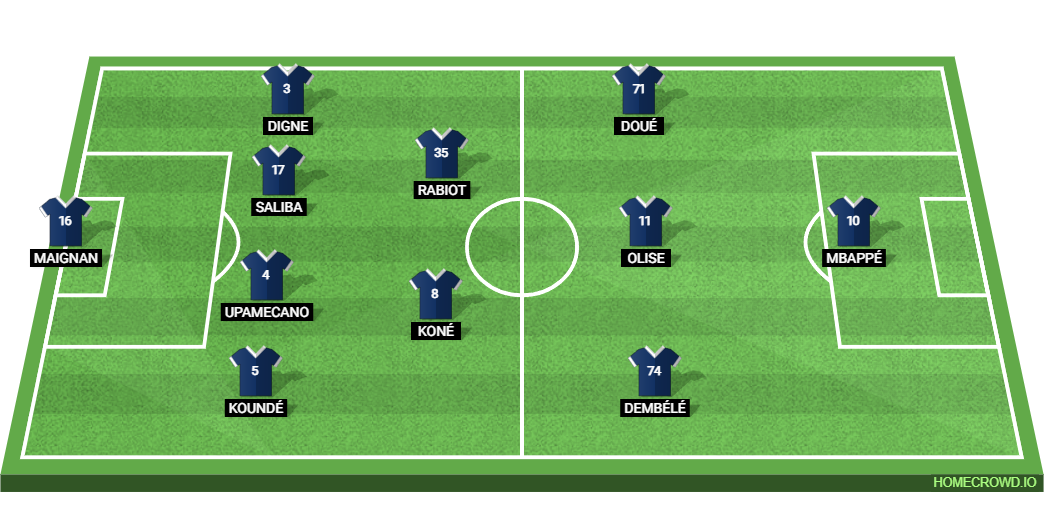
Mike Maignan will start in goal as a reliable last line of defence, while Jules Kounde should continue at right-back. Dayot Upamecano and William Saliba are expected to form the central defensive partnership while Lucas Digne is likely to start at left-back.
In midfield, Manu Kone and Adrien Rabiot should operate as the double pivot, combining physicality with intelligent distribution while protecting the defence against Spain’s possession-based approach. Ousmane Dembele is expected to start on the right wing, Michael Olise will occupy the central attacking midfield role as France’s chief creator, and Desire Doue should feature from the left. Mbappe will once again captain the side from the centre-forward position, using his pace, movement and clinical finishing to spearhead France’s pursuit of a third consecutive World Cup final.
Probable Lineup (4-2-3-1): Maignan; Kounde, Upamecano, Saliba, Digne; Kone, Rabiot; Dembele, Olise, Doue; Mbappe

Spain
Spain head into the semi-final with an almost fully fit squad, giving Luis de la Fuente several selection dilemmas after another impressive knockout performance, this time against Belgium. La Roja have shown outstanding consistency throughout the tournament, and while changes are possible in midfield and attack, the Spain boss is expected to maintain the core of the side that has guided them into the last four.
Spain have no major injury concerns ahead of their meeting with France. Nico Williams has resumed full fitness and is available for selection, while Yeremy Pino is also back in contention after recovering from injury. Mikel Merino and Pedri are both pushing for recalls to the starting lineup following influential displays from the bench in recent matches, leaving Fabian Ruiz and Dani Olmo facing stiff competition for places. Spain also have no suspension concerns, allowing De la Fuente to choose from a full-strength squad.
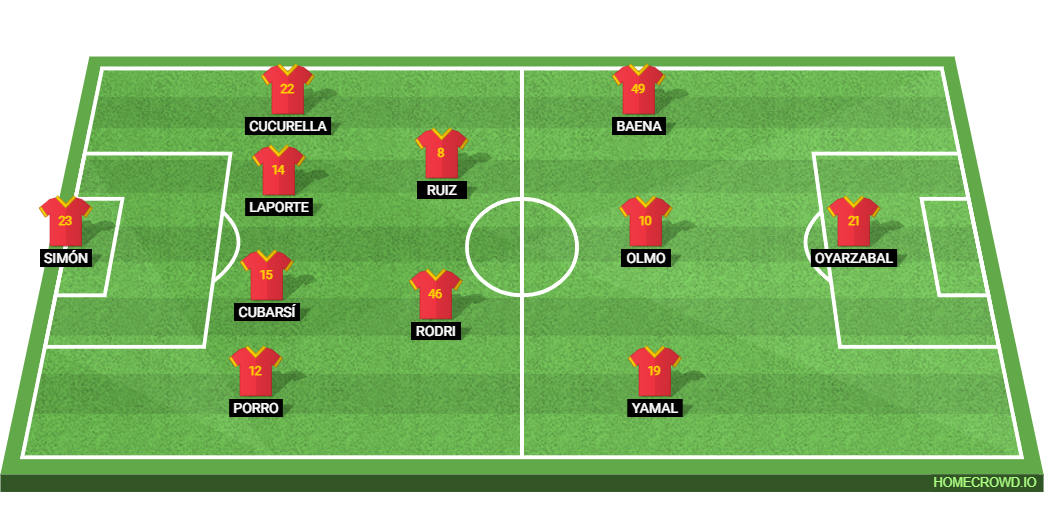
The European champions are expected to continue with their possession-based 4-2-3-1 system, although the shape frequently evolves into a 4-3-3 when Rodri drops deeper to dictate play. Unai Simon should start in goal, Pedro Porro should continue at right-back, while Pau Cubarsi and Aymeric Laporte are expected to form the central defensive partnership. Marc Cucurella is likely to retain his place at left-back, providing energy and attacking support down the flank.
In midfield, Rodri and Fabian Ruiz should operate as the double pivot, combining defensive stability with intelligent ball progression. Lamine Yamal is expected to start on the right wing, Dani Olmo will occupy the central attacking midfield role, and Alex Baena should feature from the left. Mikel Oyarzabal is set to lead the line.
Rodri remains the foundation of La Roja’s approach, controlling the tempo with his exceptional passing range while shielding the defence and orchestrating Spain’s high press. Ahead of him, Dani Olmo operates between the lines as the chief creator, while Lamine Yamal and Alex Baena provide width and creativity from the flanks. Mikel Oyarzabal is expected to continue as the central striker after scoring four goals at this World Cup, though Ferran Torres, Nico Williams, and Yeremy Pino all offer quality alternatives from the bench.
The tactical battle will centre on Spain’s midfield against France’s devastating transition game. Rodri’s ability to resist pressure and recycle possession will be crucial in limiting France’s counter-attacking opportunities, while the movement of Dani Olmo between the lines will test the positioning of Manu Kone and Adrien Rabiot.
Spain’s high defensive line and aggressive counter-press have been central to their success throughout the tournament, but they must remain alert to the pace of Kylian Mbappe and Ousmane Dembele whenever possession is lost. Lamine Yamal will also have a key role on the right flank, where his one-on-one ability and link-up play with Pedro Porro could provide Spain’s most dangerous attacking outlet.
Probable Lineup (4-2-3-1): Simon; Porro, Cubarsi, Laporte, Cucurella; Rodri, Ruiz; Yamal, Olmo, Baena; Oyarzabal
Key Stats
- France have won all six of their matches at the 2026 FIFA World Cup, scoring 16 goals on their way to the semi-finals.
- Spain are unbeaten in their last 14 major tournament matches and have kept nine clean sheets during that run.
- Spain have won each of their last two competitive meetings with France, including the UEFA Euro 2024 semi-final and the 2025 UEFA Nations League final.
- France have progressed from each of their last four World Cup semi-finals and have won their previous three at this stage without conceding a goal.
Player to Watch
Kylian Mbappe
The Real Madrid ace has once again established himself as the standout player of the 2026 FIFA World Cup. The France captain leads the Golden Boot race with eight goals and has been the driving force behind Les Bleus’ run to the semi-finals, combining devastating pace with clinical finishing and intelligent movement in the final third.
Against a Spain side that is expected to dominate possession and play with a high defensive line, Mbappe’s ability to exploit space in transition could prove decisive. Whether making runs behind the defence or linking up with Ousmane Dembele and Michael Olise, the Real Madrid superstar has the quality to produce the defining moment in one of the biggest matches of the tournament and fire France into a third consecutive World Cup final.
Prediction
France 2-1 Spain
This promises to be the closest contest of the tournament so far. Spain have the midfield quality to control possession through Rodri, Dani Olmo and Fabian Ruiz, while Lamine Yamal’s ability to stretch defences gives La Roja a genuine match-winning threat. Their recent record against France, including victories at UEFA Euro 2024 and the 2025 Nations League Finals, will also provide plenty of belief.
However, France have repeatedly shown why they are the benchmark in World Cup knockout football. Didier Deschamps’s side have won six consecutive matches at the tournament, possess the competition’s most dangerous player in Kylian Mbappe, and continue to find decisive moments through Michael Olise’s creativity and Ousmane Dembele’s movement. Their ability to absorb pressure before attacking with devastating pace makes them exceptionally difficult to stop.
The tactical battle should be fascinating. Spain’s high defensive line and aggressive counter-press will seek to suffocate France’s transitions, but that approach also creates space for Mbappe to exploit behind the defence. At the other end, La Roja’s varied set-piece routines and midfield control could test a French side that has occasionally been forced to defend for long spells.
Expect a tightly contested semi-final with periods of dominance for both teams. Spain should enjoy more of the ball, but France’s clinical edge in the final third and unrivalled experience in World Cup knockout matches could ultimately prove decisive.