
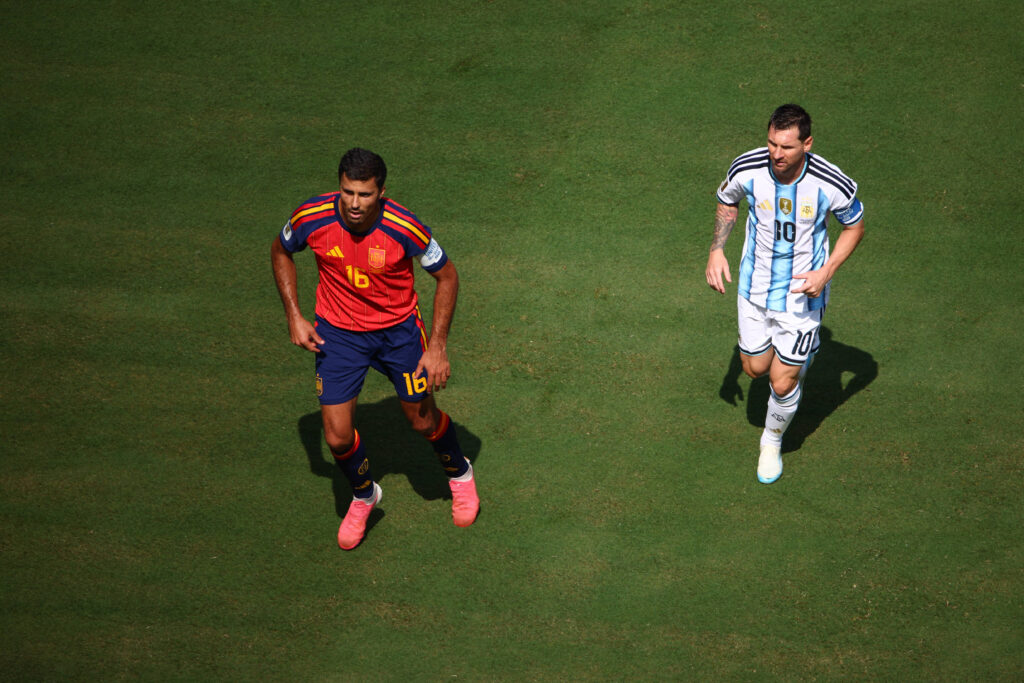
With the 2026 FIFA World Cup in the rearview mirror, it is time to take a look at The Hard Tackle’s Team of the Tournament.
The 2026 FIFA World Cup delivered a historic tournament across North America, culminating in tactical masterclasses, defensive records, and individual brilliance. Deploying a fluid and dominant 4-1-4-1 formation, this Team of the Tournament balances defensive solidity, deep midfield orchestration, and an unstoppable attacking frontline.
The Starting XI (4-1-4-1)
GK: Yassine Bounou
Morocco’s heroic deep block relied entirely on Bono’s elite shot-stopping. Facing an immense volume of shots, Bounou prevented 4.8 Expected Goals on Target (xGOT), the highest individual metric among all goalkeepers in the tournament. He maintained a 79% save percentage and single-handedly won a penalty shootout against the Netherlands, proving to be the ultimate tournament goalkeeper.
RB: Pedro Porro
Porro has revolutionised the modern full-back role this summer. Beyond his two crucial goals, he recorded 37 total defensive contributions (tackles, interceptions, and clearances). Out of possession, he choked his flank; in possession, his 3.2 progressive carries per 90 minutes constantly transitioned Spain from defense to devastating attack.
CB: Pau Cubarsi
At just 19 years old, the Best Young Player award recipient showed maturity far beyond his years. Cubarsi completed 94.5% of his short passes under high pressure, anchoring a historic Spanish backline. His positional discipline was flawless, logging a tournament-high 42 recoveries without committing a single yellow-card offence.
CB: Aymeric Laporte
The veteran general alongside Cubarsi, Laporte was the aerial and vocal leader of a backline that conceded just one goal all tournament. He won 82% of his aerial duels and averaged 5.1 clearances per match. His long-range passing accuracy (78% completion on balls over 30 yards) consistently bypassed opposing midfields.
LB: Marc Cucurella
Cucurella was a relentless force on the left flank. He ranked first among all full-backs for expected assists (2.4 xA), providing elite width and final-third delivery. Defensively, he led the tournament in successful defensive duels in the opposition half (14), perfectly embodying Spain’s aggressive counter-pressing philosophy.
DM: Rodri
The tournament’s Golden Ball winner was the undisputed heartbeat of the world champions. Rodri led all players globally with 612 total passes completed and a staggering 92% accuracy rate in the opponent’s half. He ranked in the 99th percentile for progressive passes and recoveries, acting as an unbreakable shield and master conductor.
RM: Michael Olise
Olise was France’s primary creative engine, operating with lethal precision on the right wing. He became the first player on modern record to register 6 assists entirely from open play in a single World Cup, having also surpassed Pele’s record in 1970 for the most assists in a single edition. He averaged 3.4 key passes per 90 minutes and created 8 big chances, consistently unlocking low blocks.
AM: Lionel Messi
At 39 years old, the Silver Ball winner defied time by dragging Argentina to the final. Messi produced 8 goals and 4 assists, operating in a free-roaming central role. His underlying metrics remain staggering. The veteran attacker registered a tournament-high 4.1 shot-creating actions per 90, proving his enduring, unmatched world-class efficiency.
AM: Jude Bellingham
Bellingham drove England to a third-placed finish with sheer physical and technical dominance. He netted 7 goals, the most by an Englishman in a single World Cup campaign. His 2.8 box entries per match highlighted his elite late-running ability, while his defensive work rate yielded 22 successful tackles. Those performances justify why a glut of high-profile clubs, including Chelsea and Manchester United, are showing interest in him.
LM: Kylian Mbappe
The Golden Boot winner achieved football immortality by hammering home 10 goals in 8 matches. Mbappe was completely unplayable on the left wing, leading the tournament in successful dribbles (28) and non-penalty expected goals (6.4 npxG). His explosive pace and clinical finishing terrorised every defensive line he faced.
ST: Erling Haaland
Haaland translated his club dominance to the ultimate international stage. Functioning as the focal point of this XI, he converted 31% of his total shots into goals, finishing with an incredible expected goals (xG) overperformance of +2.3. His physical presence drew multiple defenders, creating space for the elite midfield behind him.
The Bench
GK: Unai Simon
The Golden Glove winner kept a record-tying 7 clean sheets. While his backline shielded him immensely, Simon’s 100% claim rate on crosses and pinpoint distribution kept Spain entirely in control of every match tempo.
RB: Daniel Munoz
Munoz was a defensive warrior for Colombia. He won more ground duels (34) than any other right-back in the tournament and scored 2 goals, offering an aggressive, high-energy alternative on the right flank.
CB: Dayot Upamecano
Upamecano was an absolute powerhouse for France. He ranked in the 95th percentile for progressive passes by a central defender and used his recovery pace to stop 9 separate counter-attacks as the last defender.
LB: Nuno Mendes
Mendes offered electric pace and directness. He completed 4.2 progressive carries per 90 minutes, providing a highly vertical, attacking alternative to Cucurella’s possession-oriented style.
CM: Azzedine Ounahi
Replicating his previous tournament magic, Ounahi was a press-resistance maestro. He completed 89% of his dribbles in his own half and ranked third overall in distance covered, driving Morocco’s transition play.
CM: Johan Manzambi
The tournament’s breakout engine room player. Manzambi disrupted opposition play effortlessly, averaging 4.3 tackles and interceptions per game while anchoring Switzerland’s surprising knockout stage run.
CM: Mikel Merino
Merino was the ultimate chaotic super-sub. He stretched tired defences to breaking point, and scoring two goals off the bench to make his mark on Spain’s World Cup triumph.
RW: Ousmane Dembele
Dembele was sensational at the 2026 FIFA World Cup for large stretches, averaging an astonishing 5.1 progressive carries into the penalty box per 90 minutes over his tournament appearances. He also scored 6 goals and provided 2 assists during a memorable campaign.
AM: Ismael Saibari
Saibari provided crucial technical quality in the final third for Morocco. His underlying metrics showed elite efficiency, generating 0.55 expected goals assisted (xA) per 90 minutes, netting 3 goals in 5 games before injury prematurely ended his campaign.
ST: Harry Kane
The consummate professional, Kane will provide elite depth to this team. Dropping deep to link play, he recorded 6 goals and 1 assist in 7 games, maintaining an excellent 84% pass completion rate in the final third.