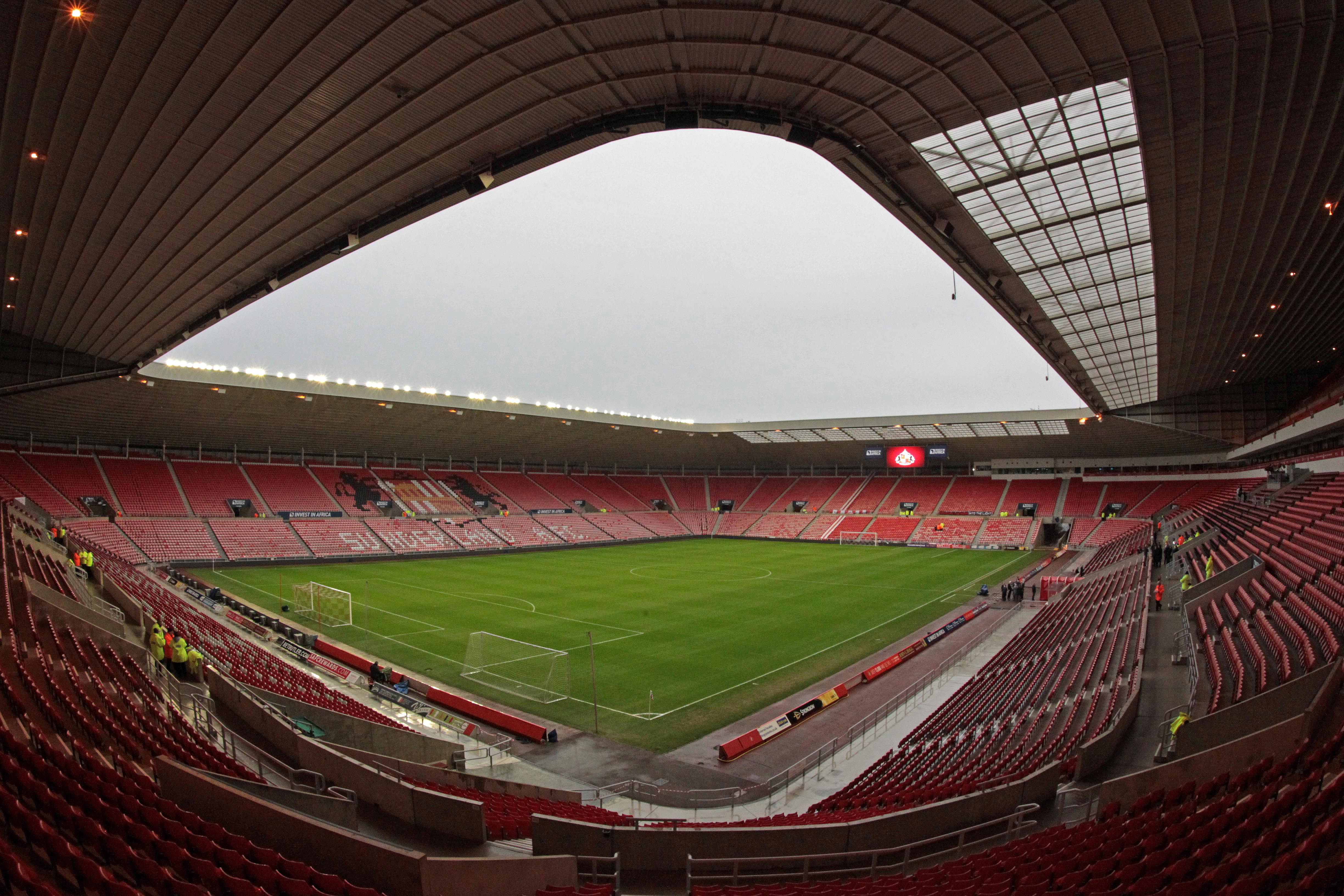
Sunderland vs Tottenham at the Stadium of Light on Sunday will feature two teams eager to recover from slow starts to the season and build momentum going into the festive period.
Tottenham’s commanding 2-0 victory over Ipswich Town sharpened the contrast before this meeting. Roberto De Zerbi;s men are recovering quickly, while Sunderland’s season has stabilised without escaping danger. Sunderland drew 0-0 at Aston Villa and then 1-1 at home against Jagiellonia Bialystok, leaving this Stadium of Light fixture as a test of whether Spurs’ momentum can survive a difficult selection picture.
The result matters to both clubs, but neither side is operating under a decisive early-season verdict. For Sunderland, the priority is to turn home resistance into a platform rather than allow another draw to keep them in trouble. Their recent defensive improvement gives them something to protect, but another dropped two points would leave the relegation pressure intact.
The Black Cats have looked more settled lately, with two draws following a mixed run, and their regular 4-2-3-1 system gives them a familiar base. The challenge is that several absences affect the spine. So, the team may need to be more pragmatic than ambitious when the game becomes stretched.
Tottenham arrive with a different calculation. Their recovery has given them a chance to climb towards the European places, while a draw would still keep that target alive. Their latest win, the fourth in five league matches, suggests a side carrying greater confidence and a clearer attacking threat.
The Lilywhites should therefore be more willing to control the match away from home, although the squad disruption means De Zerbi may have to manage the supporting cast carefully rather than rely on the same depth throughout the afternoon.
Team News: Similar shapes, but very different selection problems
Sunderland are without Granit Xhaka (calf), Brian Brobbey (thigh), Dan Ballard (hamstring), Romaine Mundle (knee), and Habib Diarra (thigh). Additionally, Kevin Danso is ineligible to face his parent club due to the terms of his loan agreement.
Xhaka’s absence removes an experienced option from the double pivot, while Brobbey’s muscle problem takes away a competing central-forward profile. That leaves the structure dependent on the selected midfield pairing and on Wilson Isidor giving the attack a usable first ball.
Robin Roefs should continue in goal behind Reinildo Mandava, Luke O’Nien, Nordi Mukiele, and Trai Hume. Mukiele has started nine matches and has two shots on target from nine attempts, while his 7.06 average rating reflects why Sunderland are expected to trust him on the right side of the central defence.
As for the midfield unit, Noah Sadiki and Jules Ahoka should form the holding pair, with Enzo Le Fee ahead of them. The Frenchman is the main creative reference; he has three goals and 17 key passes from 11 starts, and his penalties add another responsibility to a side that may spend long periods defending.
Malick Fofana and Nilson Angulo should occupy the wide attacking positions around Isidor. Isidor is expected to lead the line, with the 4-2-3-1 unchanged in principle despite the missing options.
Probable Sunderland Starting Lineup (4-2-3-1): Roefs; Hume, Mukiele, O’Nien, Reinildo; Ahoka, Sadiki; Angulo, Le Fee, Fofana; Isidor
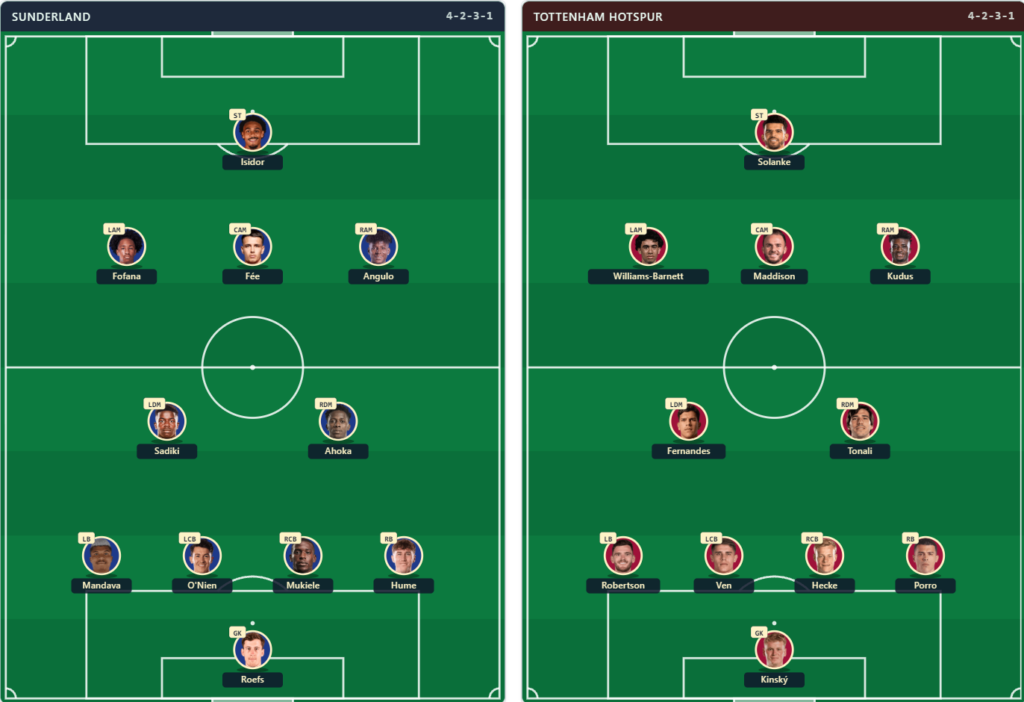
Probable Tottenham Hotspur Starting Lineup (4-2-3-1): Kinsky; Porro, van Hecke, van de Ven, Robertson; Tonali, Fernandes; Kudus, Maddison, Williams-Barnett; Solanke
Tottenham have a longer list of absentees. Xavi Simons, Mathys Tel, Wilson Odobert, Savio, and Mykhaylo Mudryk are out, while Lucas Bergvall is doubtful with illness. The volume of unavailable attacking options makes the choice of the supporting line especially important, and it reduces the room to change the match from the bench.
James Maddison is expected to start in the central creator role, but that call remains less secure than Tottenham’s other major selections. Antonin Kinsky should play behind Andrew Robertson, Micky van de Ven, Jan Paul van Hecke, and Pedro Porro.
As for the midfield unit, Mateus Fernandes and Sandro Tonali should sit behind Maddison, with Mohammed Kudus on the right and Luca Williams-Barnett on the left. Kudus has three assists and 12 key passes, giving Tottenham a productive wide-to-central outlet.
Dominic Solanke is likely to spearhead the Tottenham attack vs Sunderland, though Omar Marmoush is the close alternative. Solanke has two goals, one assist, and nine shots on target from 21 attempts. Tottenham’s expected shape is therefore another 4-2-3-1, but the absences make it a more carefully balanced selection than the formation alone suggests.
Tactics: Sunderland’s long route vs Tottenham’s control
Sunderland’s 4-2-3-1 setup is designed to keep two midfielders behind Enzo Le Fee while giving him a clear lane to connect the striker with the wide players. They do not usually insist on building through the middle. The hosts play 59 long balls per match, compared with 35 for Tottenham and a league typical figure of 50.
The contrast points to the central problem. Sunderland can reach the forward line quickly, but Wilson Isidor and Le Fee must make those attacks stick or the team will spend too much time defending the next phase. On the other hand, Tottenham’s version of the same formation protects Maddison between the lines and gives Mohammed Kudus a defined right-sided attacking position.
Spurs average 62% possession, against 45% for Sunderland and a league typical 48%. So, they are likely to occupy the central platform for much of the match. Their recent possession control should allow them to move the home side’s block from side to side, while Sandro Tonali and Mateus Fernandes provide cover behind James Maddison rather than forcing the game into an open exchange.
Both teams are set up to pursue the win while still accepting a draw if the match becomes dangerous. Sunderland need enough forward threat to avoid being pinned back, but they should not abandon the protection provided by the double pivot. Tottenham can take more territory and still reduce the risk once ahead.
That difference in control is important. Sunderland’s plan depends on a few successful connections, whereas Tottenham’s plan can keep producing phases even when one attack breaks down. The home side’s best alternative is through dead balls. The Wearside outfit’s recent set-play output produced 1.07 xG against Chelsea, 1.14 against Dinamo Zagreb, and 0.66 against Jagiellonia Bialystok.
That route gives them a way to threaten without winning the entire possession battle, and it also gives Le Fee’s delivery and penalty responsibility greater importance. If those situations do not arrive, Tottenham’s ability to keep the ball should gradually push Sunderland towards their more direct fallback. The central creator duel is the clearest meeting point.
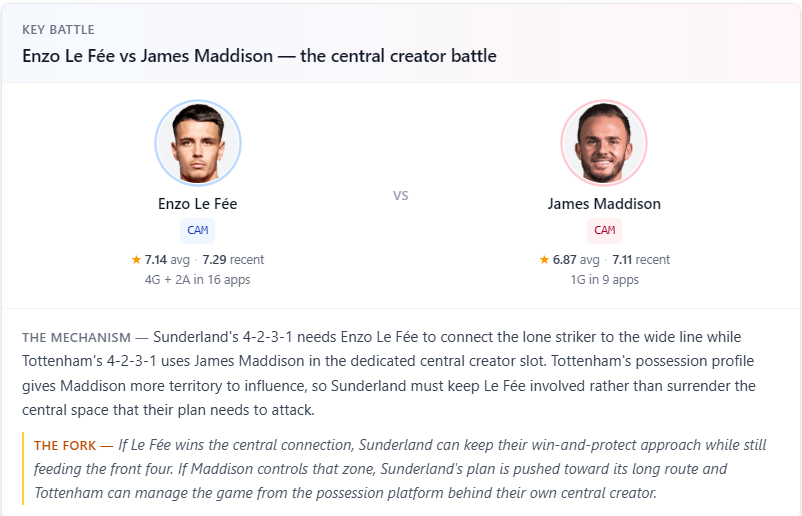
Le Fee is in strong current form and must keep appearing between Tottenham’s midfield and defence, while Maddison’s positioning should benefit from the territory Tottenham normally control. If the Sunderland playmaker wins that connection, the Black Cats can retain their cautious attacking posture and still bring Nilson Angulo, Wesley Fofana, and Isidor into the game.
If Maddison controls the zone, Sunderland are likely to become increasingly dependent on long passes, while Tottenham can manage the match from behind their creator. The second layer is the contest between Isidor and Jan Paul van Hecke. Isidor must offer more than a target for clearances; he needs to hold the first pass long enough for Sunderland’s wide line to advance.
Meanwhile, van Hecke, whose form has earned him a spot in our FPL recommendations, has the settled role in the centre of Tottenham’s back four and should try to remove that outlet early. If Isidor makes the ball playable, Sunderland can stay connected without opening the game. If the Dutch defender wins the exchange, Spurs can recover possession higher and keep the home side trapped in its own half.
Prediction: Why the away side has the firmer route to victory
Tottenham are out, albeit with medium confidence. The main reason is not simply their recent run; it is the difference between how each side is likely to create repeatable attacks. Spurs have averaged 1.92 xGA and 0.83 xGA across their last five matches. Sunderland’s corresponding figures are 1.74 for and 0.98 against. That gives the visitors the stronger recent attacking and defensive balance before the match even reaches the specific creator battle.
The strongest case against Tottenham is Sunderland’s ability to make the game awkward without needing sustained possession. A successful dead-ball sequence, an early long pass that Wilson Isidor can hold, or a strong performance from Enzo Le Fee could force Spurs to defend more often than expected.
Lean: Tottenham win
Range: 0-1/1-2/0-2
Tottenham’s absent attacking options also matter if the match becomes a test of fresh legs and creative alternatives. Sunderland do not need to dominate to win; they need to turn a small number of advanced moments into a goal and then preserve their shape.
The prediction settles in the 0-1, 1-2 or 0-2 range. Tottenham should have enough control to create the better volume of opportunities, but Sunderland’s defensive posture and home setting make a narrow away victory more likely than a wide-margin result.
The change Tottenham can make if Sunderland close the middle
Tottenham have the clearest in-game structural adjustment. If Sunderland’s double pivot begins to block James Maddison’s influence or if the home side’s long route starts producing second balls, Roberto De Zerbi can move to a 4-3-3 and add another central midfielder. That would remove the dedicated number-ten slot, but it would give Spurs an extra body around the second ball and help them secure the match without asking their attacking line to force every opening.