Crystal Palace vs Hull City at Selhurst Park on Sunday will be a match between a team struggling in the shadows of recent success and another pre-season defying expectations.
Crystal Palace’s comeback win over Real Sociedad showed the attacking intent Thomas Frank is trying to establish, but Hull City arrive with a very different way of making matches uncomfortable. The Eagles overturned a 1-0 deficit to win 2-1 on Thursday, while Hull’s disciplined, direct approach has helped them avoid the relegation fight many expected after promotion.
This is a meaningful game for both team. Palace need a league response, while Hull can protect their early-season security and keep a European target within reach. For the home side, the result is about repairing a turbulent start rather than making a season-defining gamble. They sit at the wrong end of the table, and another dropped result would leave the rebuild under immediate pressure even if a win would not transform their position overnight.
Their latest performance offered encouragement, but it also came in Europe only four days before this fixture. The home side carry one league victory in their last five and have scored six while conceding ten across their recent five-match run. The attacking absences reduce Frank’s room for manoeuvre, particularly in the central striker and wide attacking roles. So, the available players must give the new shape enough threat without leaving the defence exposed.
On the other hand, Hull’s situation is less urgent. A win would move them into the European spots, while a draw would keep that target alive. So, Sergej Jakirovic does not need to turn this into an open contest. Their latest result, a 2-0 victory over Brighton & Hove Albion, strengthened the sense that the promoted side’s direct model is working.
The Tigers have also won once in their last five, but they have conceded only four goals in their recent four-match aggregate and arrive with a clearer defensive identity. Their priority is to make Crystal Palace attack around a compact structure, then use direct service to keep the home side from settling high up the pitch.
Team News: Palace replace firepower while Hull keep their back five
Thomas Frank is bereft of the services of five first-team players this weekend. Jean-Philippe Mateta is suspended after a red card against Tottenham last month, with Yeremy Pino serving a one-match ban after picking up his fifth booking of the 2026/27 Premier League season against Coventry City. Meanwhile, Chadi Riad is out with a knee injury, Ismaila Sarr is unavailable because of a groin problem, and Takehiro Tomiyasu is yet to recover from a calf problem.
Mateta’s absence is the most important football change. Jorgen Strand Larsen thus becomes the main central striker, while Dario Osorio is required on the left of the attacking line because there is no natural remaining option for that slot.
Crystal Palace will line up in a 4-2-3-1 formation vs Hull City, a move away from the 3-4-2-1 that had been their arrangement under Pierre Sage. Dean Henderson is an automatic pick between teh sticks, with Tyrick Mitchell, Jaydee Canvot, Chris Richards, and Anan Khalaili forming the backline.
As for the midfield unit, Quinten Timber and Adam Wharton form the double pivot, with Daichi Kamada ahead of them and Dwight McNeil and Osorio supporting Strand Larsen. Kamada has three assists and 12 key passes from eleven starts, making him the clearest player to connect Palace’s midfield to a lone forward.
Wharton has also started all eleven of his appearances and supplied 12 key passes, though his current form has been less convincing. Strand Larsen offers a more direct reference point; he has scored twice and put eight of 14 attempts on target in nine appearances. This is a side designed to stretch Hull rather than simply replace Mateta with an identical role.
Probable Crystal Palace Starting Lineup (4-2-3-1): Henderson; Khalaili, Richards, Canvot, Mitchell; Wharton, Timber; McNeil, Kamada, Osorio; Strand Larsen
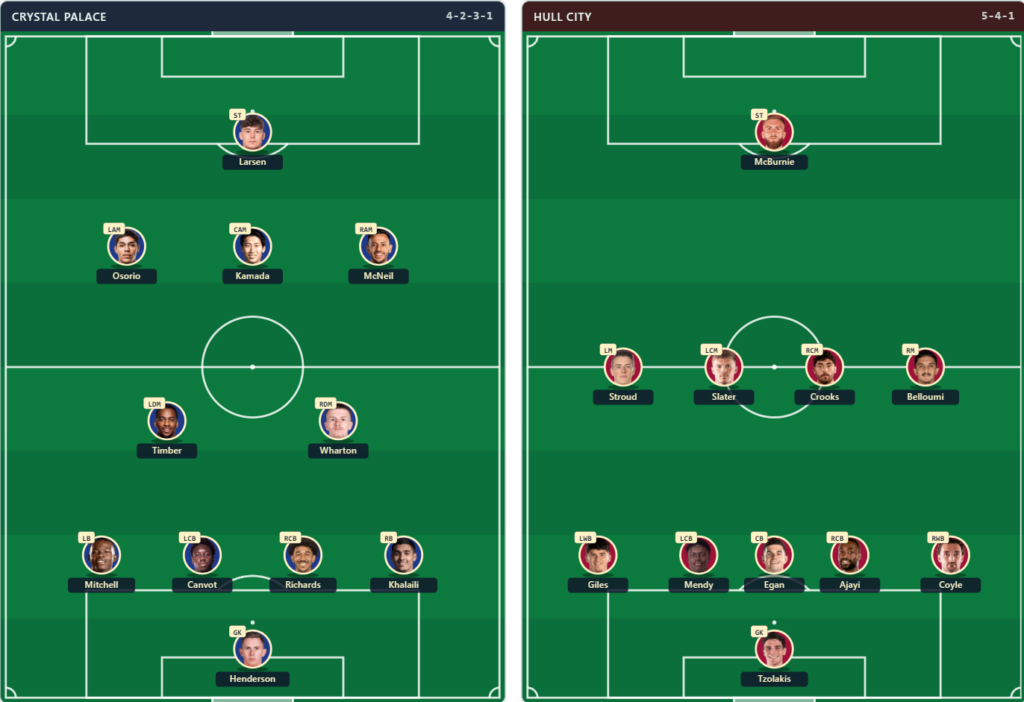
Probable Hull City Starting Lineup (5-4-1): Tzolakis; Coyle, Ajayi, Egan, Mendy, Giles; Belloumi, Crooks, Slater, Stroud; McBurnie
The visitors also have several absentees. Charlie Hughes faces a late fitness test to determine his availability. Meanwhile, Hidemasa Morita (muscle), Ilyas Ansah (back), Joe Gelhardt (thigh), Matt Targett (ankle), Eliot Matazo (knee), and Tim Iroegbunam (thigh) are in the treatment room. Matazo’s absence helps explain why the midfield selection matters, with Matt Crooks starting in his place.
Hull City will line up in a 5-4-1 formation vs Crystal Palace. Konstantinos Tzolakis starts behind a back five of Ryan Giles, Nobel Mendy, John Egan, Semi Ajayi, and Lewie Coyle. As for the midfield unit, Regan Slater and Matt Crooks pair up in the double pivot, with Elliot Stroud and Mohamed Belloumi supplying the width around Oli McBurnie.
Belloumi is Hull’s most productive wide outlet, with three goals, three assists, and ten key passes from ten appearances. McBurnie leads the line after four goals and two assists in 11 starts, and his penalty duty adds another route to a goal in a match likely to be decided by small margins.
Tactics: The first ball decides whether Palace can sustain pressure
Crystal Palace’s 4-2-3-1 setup is built to put two midfielders behind Daichi Kamada, give the wide players room around Hull City’s spare centre-back and preserve some protection against direct counterattacks. Thomas Frank’s side should take the game to the away side, but their recent attacking output has not yet been matched by defensive control.
The away side’s five-man shape, meanwhile, gives them an extra defender against the lone striker and allows the wide players to drop without abandoning Oli McBurnie. The away side’s habits are clear. They play 64 long balls per match against a league typical figure of 50, and their ball share is 32 per match against the league’s 48.
The Tigers are not trying to win this fixture through prolonged construction in midfield. Their crossing sits close to the league norm. So, the more important feature is the decision to bypass pressure and attack the next contest rather than pass through Palace’s first line. That direct approach meets a Palace side that has to press higher and keep the second ball in Hull’s half.
The key question is not whether the hosts can have more of the ball, but whether their double pivot can prevent Hull’s first clearance from becoming an organised attack. Sergej Jakirovic’s men have the option to sit in, accept the draw if necessary and still threaten when the game breaks forward. Palace must take more initiative, yet the European turnaround makes the demand for repeated pressure more difficult. The main duel is Chris Richards against Oli McBurnie.
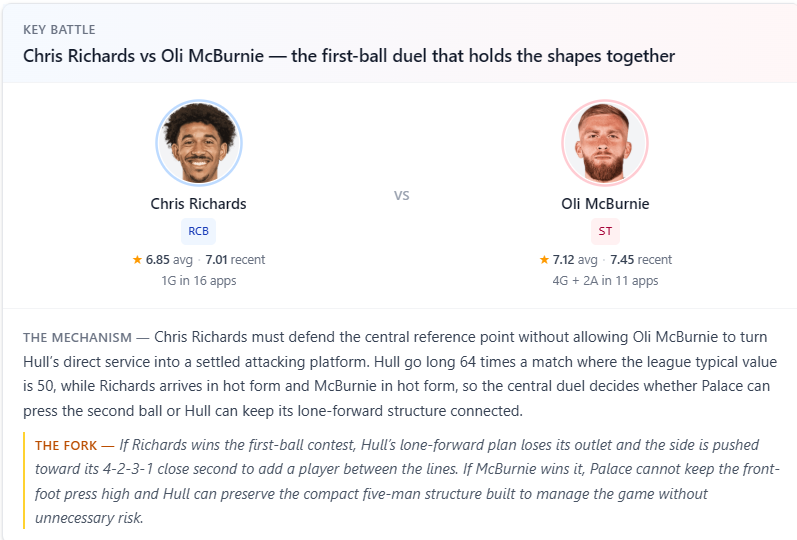
Richards has the form to defend the first ball aggressively, while McBurnie has become the forward around whom Hull’s direct game is organised. If the American defender wins that contest, McBurnie cannot turn long service into a settled platform and Palace can attack the loose ball with their midfield already advanced. If the Hull striker wins it, the home side’s press is forced backwards and Hull can preserve the compact five-man structure that protects a point.
This is also where the cover behind the duel matters. Richards is not merely defending a striker; he is deciding whether Palace’s whole defensive line can stay high. If McBurnie brings the ball down, Hull’s midfielders can join the second phase and the home side’s two holders are suddenly defending a forward-facing attack.
If Richards dominates, Hull may need to change shape and add a player between the lines, sacrificing some of the central protection that the 5-4-1 shape provides. The wide contest gives the Eagles their best alternative. Anan Khalaili must hold Palace’s right side high enough to pin Ryan Giles and stretch the back five, while the Hull full-back has to release the visitors down that flank without allowing the block to lose its width.
Palace’s attacking structure can force Hull’s wing-back deeper, but an unsuccessful attack leaves the home side’s full-back exposed when the Tigers go long again. The match therefore has two linked battles. The home side need width to create space, but Richards must win the central first ball so that the width is not constantly followed by defensive retreat.
Prediction: A draw remains the likeliest outcome
We are leaning towards a draw, but only with low confidence. Crystal Palace have the clearer reason to attack and should be able to create pressure through Daichi Kamada, Dwight McNeil, and their wide outlets. Yet Hull City’s direct release gives them a reliable way to bypass that pressure, and the hosts have not shown enough defensive security to make a controlled home win the default expectation.
The strongest case against the draw is that Palace’s 4-2-3-1 setup may finally give their attack enough width to pull Hull’s back five apart. Kamada’s position behind Jorgen Strand Larsen can then become decisive, especially if the wing-backs are pinned and the away side’s midfield cannot protect the spaces around him.
Lean: Draw
Range: 1-1/0-0/2-2
Palace’s recent attack has produced 2.03 xG per match, but they have allowed 2.39 and kept no clean sheets in that same five-match window. That combination makes a home victory possible, while also explaining why it is difficult to trust the South London outfit to manage the match once Hull find their route forward.
Hull’s recent four-match run is more restrained, with 1.30 xG and 1.71 xGA. However, that does not make them a natural winner here. Their best route is to keep the game compact, win enough first contacts around Oli McBurnie and wait for Palace’s attacking structure to leave space. The likeliest scoreline range is 1-1, 0-0 or 2-2.
Hull have the clearer mid-match switch
The selection that could still alter the contest is Hull City’s ability to move from the five-man structure into a 4-2-3-1 if Crystal Palace deny Oli McBurnie the first ball. That would put an extra player between the lines and give Hull a way to attack without relying entirely on long service.
The hosts can also move to two forwards, but doing so would remove a central creator and weaken the protection behind the attack. That makes Hull’s adjustment the cleaner lever if the opening plan stops connecting.