Brighton & Hove Albion vs Newcastle United at the Amex Stadium on Sunday will feature two teams eager to return to winning ways in the Premier League and continue to push for their objectives.
Brighton & Hove Albion’s 2-0 defeat to Hull City looked particularly damaging because both goals arrived in stoppage time and stopped them from taking advantage of Arsenal’s slip against Newcastle United, though the response was emphatic. Fabian Hurzeler rotated eight players for Thursday’s 4-0 win over Universitatea Craiova, with Ibrahim Osman scoring twice.
Newcastle also arrive with renewed belief after turning a difficult first half against Arsenal into a 2-2 draw at St. James’ Park. The meeting therefore tests Brighton’s established home authority against a Newcastle side beginning to show greater tactical coherence away from its usual surroundings.
The result matters to Brighton because they are second with 22 points and are already operating inside the Champions League places. A win strengthens that position, while another defeat would make their consistency the immediate question. Their recent league run is still strong despite that setback, and the wider home record remains a serious advantage.
The Seagulls have not lost any of their nine Premier League home meetings with Newcastle and have conceded only once at the Amex across all competitions this season. They carry the sharper attacking momentum too, having scored 26 league goals, while their last five matches brought eight goals and only two conceded.
Newcastle need points more urgently, though the stakes are meaningful rather than desperate. They sit 13th on 13 points, and a draw keeps their target alive; a win would move them to 16 points, but defeat would leave the recent improvement looking more cosmetic than structural. The Arsenal draw steadied a mixed sequence, yet their away record against the division’s best remains a major concern.
The Magpies have gone 39 Premier League away matches against top-two teams without winning. Their immediate attacking burden is also clear, with no first-half league goal in their last six matches, even as William Osula has been involved in eight goals across his last 12 Premier League starts.
Team News: Brighton keep the settled shape, Newcastle patch the screen
The home side’s missing players affect the defensive options. Jaouen Hadjam and Malick Yalcouye are out with knee injuries, while Olivier Boscagli is a doubt because of illness. Joao Costinha will serve a suspension after being sent off against Hull City last week, while Kaoru Mitoma (hamstring), Zadok Yohana (muscular), Evan Ferguson (ankle), and Stefanos Tzimas (knee) remain in the treatment room.
That leaves Ferdi Kadioglu as the expected left-back, and it makes the back four less settled than the headline home record suggests. Brighton & Hove Albion should still line up in their familiar 4-2-3-1 vs Newcastle United, the formation they have used in three of their last five matches.
Bart Verbruggen remains in goal, with Lewis Dunk and Luka Vuskovic expected to form the central pairing and Mats Wieffer at right-back. As for the midfield unit, Pascall Gross and Chema Andres should sit behind the attacking line. Gross is the main organiser of that platform, contributing four goals, four assists, and 31 key passes in 11 appearances; his ten big chances created are also the highest-impact part of that midfield record.
Brighton’s attacking unit should feature Maxim De Cuyper, Yasin Ayari, and Diego Gomez behind Charalampos Kostoulas. De Cuyper has started all 11 games, producing two goals, three assists, 26 key passes, and six big chances created. Ayari gives the central role greater weight after three goals and seven key passes in 10 starts, while Kostoulas brings three goals and two assists from nine starts. Gomez’s two goals, two assists and 15 key passes make him the more connective right-sided option rather than a pure wide runner.
Probable Brighton & Hove Albion Starting Lineup (4-2-3-1): Verbruggen; Wieffer, Vuskovic, Dunk, Kadioglu; Gross, Andres; Gomez, Ayari, De Cuyper; Kostoulas
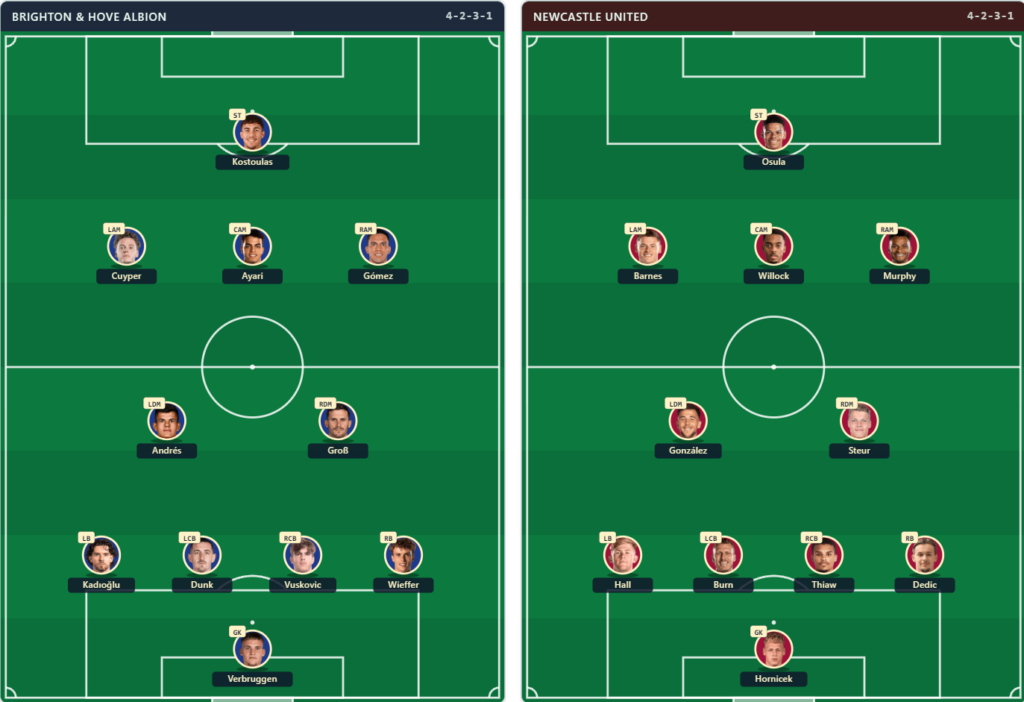
Probable Newcastle United Starting Lineup (4-2-3-1): Hornicek; Dedic, Thiaw, Burn, Hall; Steur, Gonzalez; Murphy, Willock, Barnes; Osula
Newcastle United have only Ewen Jaouen and Joelinton unavailable, with their hamstring injuries expected to keep them out until December. They will line up in a 4-2-3-1 formation, with Lukas Hornicek lining up between the sticks. with Lewis Hall, Dan Burn, Malick Thiaw, and Amar Dedic will form the backline.
As for the midfield unit, Nico Gonzalez and Sean Steur should form the double pivot, although Steur’s place is the one to watch because he is only expected rather than definite, with Lewis Miley a possible alternative. Finally, Harvey Barnes and Jacob Murphy should play either side of Joe Willock, with William Osula leading the line.
Barnes has three goals, two assists, and 14 key passes in 11 starts; Murphy has 12 key passes and three big chances created despite starting six times. Osula’s return is one goal, two assists, and three big chances created from five starts, giving Newcastle a runner to occupy the centre-backs.
Tactics: Brighton’s pressure vs Newcastle United’s connected retreat
Both sides should use the 4-2-3-1 formation, but the shapes serve different purposes. Brighton & Hove Albion’s version is built to place two midfielders behind three attacking players and carry the game forward without abandoning cover. They are likely to take the initiative at home, accepting the risks that come with sustained pressure but not treating the fixture as a win-at-any-cost contest.
Newcastle United’s setup is more conservative in its intent. Two holding midfielders protect the centre, three players support William Osula, and the team can pursue the win while still accepting a draw. The contrast is substantial.
Brighton average 67% possession per match against the Premier League’s 48% norm, while Newcastle average 49% against the same mark. The Seagulls also cross 23 times per match compared with the away side’s 14, either side of the league typical 16. The hosts’ attacks should therefore stretch the game from wide areas before trying to connect through Yasin Ayari and Pascal Gross.
Meanwhile, Newcastle will need Harvey Barnes, Jacob Murphy, and the full-backs to keep those channels linked to the double pivot rather than allowing the back four to defend repeated deliveries alone. Brighton’s recent five-match possession share is 64%, compared with Newcastle’s 44.8%, and that difference explains the first system question, can Newcastle escape the first wave of pressure often enough to make their away plan more than a long defensive spell?
Brighton’s opponents have also passed substantially worse against them than their own normal level, whereas Newcastle’s effect in that area is less severe. If Fabian Hurzeler’s team pin Nico Gonzalez and Sean Steur near their own box, Gross can keep finding the attackers; if the visitors play through the first pressure, Osula can attack the space behind Brighton’s advancing full-backs. That makes the key duel Maxim De Cuyper against Amar Dedic.
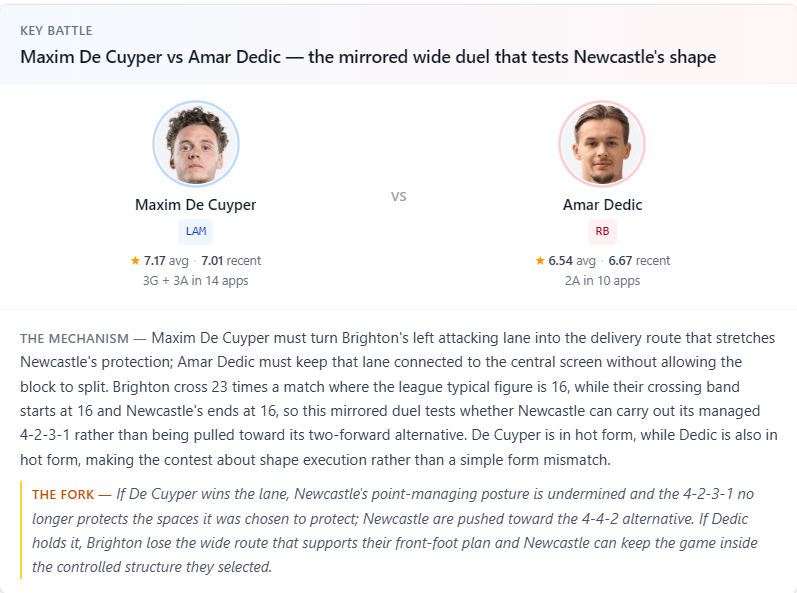
De Cuyper has been in impressive form and should try to turn Brighton’s left side into the main delivery route, while Dedic must prevent that lane from disconnecting Newcastle’s central screen from its wide protection. The contest is not simply about which player beats the other, but it determines whether the away side’s chosen structure remains compact.
If De Cuyper wins the lane, Brighton can pull the Newcastle block apart and force the Magpies toward the late two-forward option. If Dedic holds it, the hosts lose an important route around the block and Newcastle can continue managing the game inside their 4-2-3-1. Behind that wide duel sits Pascal Gross against Joe Willock.
Gross links Brighton’s right-sided build to the attacking line, while Willock has to deny him the time to turn and release the forwards. Brighton’s initiative depends on that connection surviving; Newcastle’s plan depends on closing it without leaving Osula isolated. Gross has the more influential creative record, but Willock’s positioning can make the difference between the home side circulating around a set defence and playing into it.
Prediction: Brighton have the stronger route to the result
We are leaning towards a Brighton win, but only with medium confidence. Their home record, stronger recent attacking output and ability to disrupt Newcastle United’s passing structure give them the clearest route to controlling the match. Brighton & Hove Albion have averaged 1.97 xG across their last five matches, and that attacking baseline should test a Newcastle defence that has conceded five times in the same period.
Lean: Brighton & Hove Albion win
Range: 2-1/2-0/1-1
The strongest case against the home win is Newcastle’s ability to keep the game close rather than chase it recklessly. Their 4-2-3-1 setup can place enough bodies around the centre-backs, and William Osula’s running may punish Brighton if the home full-backs advance together.
The resilience shown against Arsenal showed that Matthias Jaissle’s half-time adjustments can improve the side’s attacking conviction. So, an early period of resistance could turn this into a patient, low-margin contest rather than a sustained Brighton siege. The likely scoreline range is 2-1, 2-0 or 1-1.
Newcastle’s late shape change is the clearest escape route
Newcastle United have one meaningful in-game adjustment available if William Osula is being isolated and Brighton & Hove Albion continue to control the wide areas. Moving to the 4-4-2 formation would add a second forward against Lewis Dunk and Luka Vuskovic and attack the centre-backs more directly.
Brighton’s own late option is more conservative, with a third central midfielder available through a shift to 4-3-3 if they need to protect a lead. That gives the visitors the more aggressive change, but it also removes the central attacking-midfield slot that currently helps connect their build.