Hull City vs Brighton & Hove Albion at the MKM Stadium on Sunday will be a match between two teams that have defied expectations in the first third of the 2026/27 Premier League season and harbouring lofty ambitions.
Brighton’s 2-0 win over Brentford extended a run that has made them the clear force in this fixture, but their next task is less straightforward than the table suggests. Hull City have built a defensive, direct identity under Sergej Jakirovic, and this first top-flight meeting between the clubs should test whether the Seagulls can turn sustained control into clear chances against a packed back line.
Pascal Gross is also set for a milestone appearance and has signed a new contract, giving the away side another notable subplot in a match where patience may matter as much as ambition. The result matters to both clubs, though not in a win-or-collapse sense.
Hull are 13th with 11 points and still have a meaningful route toward the Europa League places, while Brighton sit second, five points behind Arsenal. A win would give the Tigers the lift their season has lacked; a draw would preserve their defensive progress, but another defeat would extend a difficult league sequence. Brighton can keep their title-chasing momentum with victory, while a stalemate would still leave their wider position intact.
Hull’s opening two league wins have been followed by eight matches without another victory, including five draws and three defeats. Their latest run has been competitive without being productive enough, and they arrive having scored five times across their last five league games.
Their chance creation has remained limited, so the value of a result here is less about confirming their current level than proving that their organised resistance can finally produce a complete performance. The potential return of Mohamed Belloumi gives them another direct option on the right, but the home side will still be asked to make long defensive phases work without losing its outlet.
Brighton & Hove Albion, on the other hand, have won six of their last seven league matches and followed their Brentford result with the confidence of a side comfortable in front. They have kept a clean sheet in each of those six victories, and their latest five-match sequence has brought three consecutive league wins.
Securing second place heading into the international break makes this a test rather than a crisis. Brighton want the points, but they can approach the game without abandoning the control that has carried them into the top two. Their patience will be especially important against Hull’s deep structure, where forcing the issue too early could offer the home side the kind of broken game it wants.
Team News: The returning winger and the settled Brighton core
Hull City’s likely XI should retain the 5-4-1 shape that has become their regular recent choice. Konstantinos Tzolakis remains behind John Egan, Nobel Mendy, and Semi Ajayi, with Mendy the left-sided defender and Ajayi the right-sided one. The continuity at the back gives Hull a recognisable defensive base rather than a makeshift block.
Ryan Giles and Lewie Coyle should provide the width from the wing-back positions, with Giles contributing nine key passes and four big chances created. In midfield, Regan Slater is expected to keep his place, while Matt Crooks should operate on the right side of the central pair. Crooks will be asked to screen the space in front of the back three. His recent form has been uneven, but the job is structural as much as creative.
Sorba Thomas should continue on the left wing, while Mohamed Belloumi is expected to take the right-sided midfield role as he returns from a hamstring problem. The Algerian winger’s inclusion would give Hull a more aggressive escape route than a purely defensive selection. Oli McBurnie leads the line and remains the first target for the direct ball; he has two goals, two assists, and 11 key passes from ten starts, with penalties among his set-piece duties.
Hull’s absentees make that defensive arrangement more important. Matt Targett, Hidemasa Morita, Eliot Matazo, Darko Gyabi, Charlie Hughes, and Ilyas Ansah are unavailable, while Belloumi’s return is the relevant selection development. The missing midfield options reduce the scope for reshaping the central unit, which helps explain why the five-man defence and four-man midfield remain the safer starting point.
Probable Hull City Starting Lineup (5-4-1): Tzolakis; Coyle, Ajayi, Egan, Mendy, Giles; Belloumi, Crooks, Slater, Thomas; McBurnie
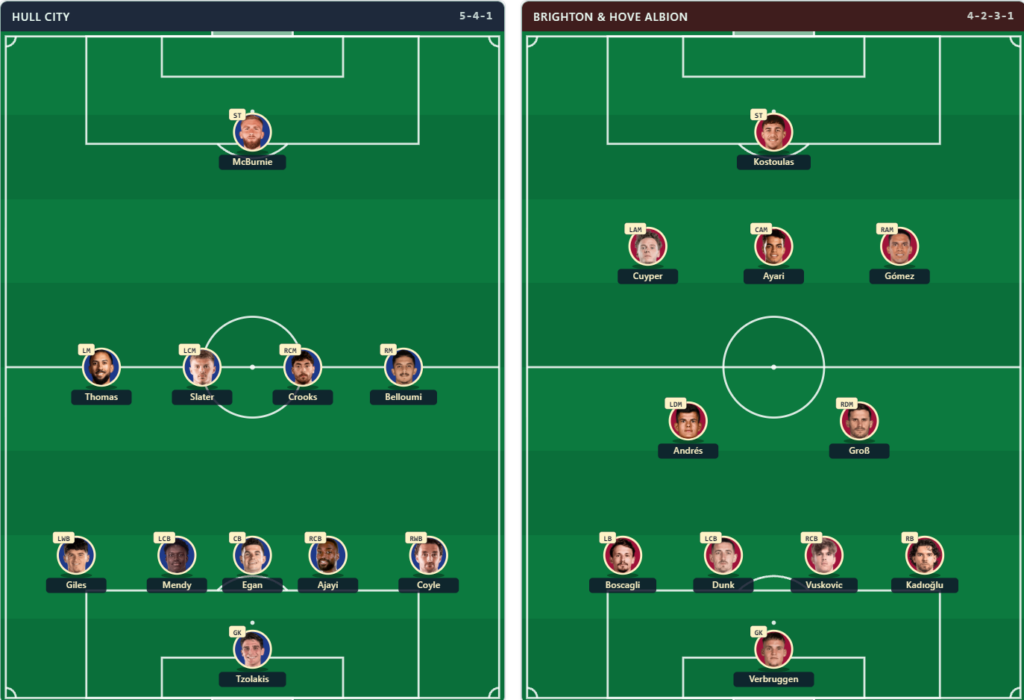
Probable Brighton & Hove Albion Starting Lineup (4-2-3-1): Verbruggen; Kadioglu, Vuskovic, Dunk, Boscagli; Gross, Chema Andres; Gomez, Ayari, De Cuyper; Kostoulas
Brighton should answer with their familiar 4-2-3-1 setup. Bart Verbruggen starts behind Olivier Boscagli, Lewis Dunk, Luka Vuskovic, and Ferdi Kadioglu. Dunk has eight starts and a 7.05 rating, while Boscagli has created 15 key passes and three big chances from ten appearances. Vuskovic’s selection gives Brighton a central defender specifically suited to dealing with Oli McBurnie’s aerial reference.
Chema Andres and Pascal Gross form the double pivot, with the latter the main distributor and dead-ball taker. His four goals, six assists, 29 key passes, and eight big chances created make him the clearest creative hub in the match. Yasin Ayari plays centrally ahead of them, while Diego Gomez and Maxim De Cuyper occupy the attacking channels.
Charalampos Kostoulas should lead the line, having started nine times and produced three goals and three assists. Kaoru Mitoma, Evan Ferguson, and Zadok Yohanna are out, while Femi Azeez remains a fitness doubt and Stefanos Tzimas is not yet ready to return. Pascal Struijk is returning, but the expected back four gives Brighton the balance they have used most often.
Tactics: Hull’s long release vs Brighton’s central control
Hull City’s 5-4-1 setup is designed to preserve an extra centre-back, keep the midfield line connected, and leave Oli McBurnie as a clear outlet. It is not a possession structure. Hull average 32.5% ball dominance against a league typical 48.5%, while Brighton average 65.5% against that same reference. That is the central territorial divide.
Brighton should have the ball, and Hull’s plan is to make possession difficult to convert rather than to compete for it directly. The home side’s directness is equally clear. They play 62 long balls per match against a league typical 49.75, while Brighton play 58 against that mark. The difference is not that Brighton never go long; it is that Hull make the direct pass their main route out of pressure.
Oli McBurnie must make the first ball playable, and Sorba Thomas, Mohamed Belloumi, Ryan Giles, and Lewie Coyle then have to bring the second phase away from their own defensive third. Meanwhile, Brighton’s 4-2-3-1 system keeps Pascal Gross and Yasin Ayari connected to the two holding midfielders, allowing the visitors to circulate the ball without exposing the centre immediately.
They average 17 shots per match compared with Hull’s nine, both either side of a league typical 12.5. So, Brighton are more likely to keep asking questions after an initial attack is blocked. They also force opponents’ passing below their usual level far more often than Hull do. The away side’s disruption figure is 6.21956 per match against a league typical 0.0613688, while Hull’s is -5.39072 against the same reference.
Brighton’s control therefore has a defensive side as well as an attacking one. That creates a tension in the match. Both sides can live with a draw, but they will pursue it differently. Hull are likely to protect the game first and attack through direct releases, accepting limited possession without opening the centre.
The visitors should carry the game forward while retaining enough cover to avoid turning one lost attack into a counter. Their latest defensive record supports that patience, while Hull must decide how long a lone striker can keep the block connected. The first major meeting is Matt Crooks against Gross.
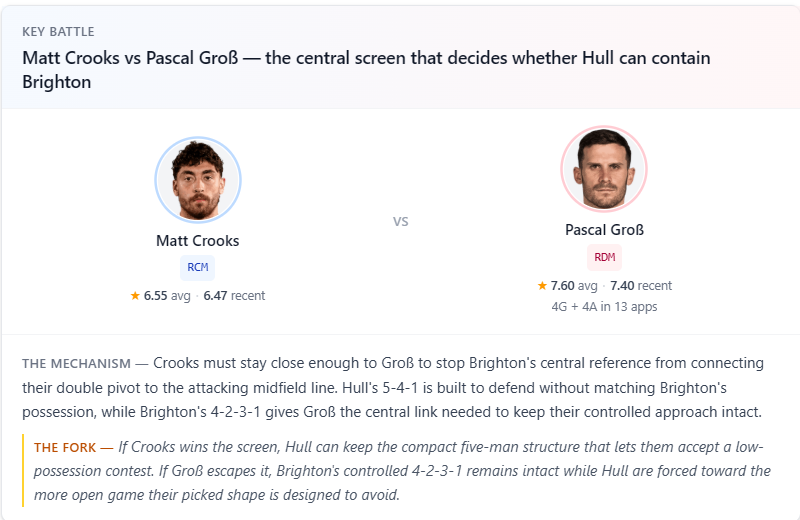
Crooks has to stay close enough to prevent Gross from linking Brighton’s holding pair with Ayari between the lines. If Crooks wins that screen, Hull can preserve the compact five-man structure and make the away side play around the block. If Gross escapes it, the Seagulls’ shape remains connected and Hull may be forced into the more open game their starting formation is intended to avoid.
The second duel is the first ball between Oli McBurnie and Luka Vuskovic. If the Hull City striker makes the long pass playable, the hosts can move their midfield up and keep the attack attached to the defence. If the Croat wins the contest cleanly, Brighton can pin Hull back and make the home side defend wave after wave without an immediate release. That battle does not replace the central screen; it determines whether the screen gets relief.
Prediction: Brighton have the stronger route to a narrow win
We predict a Brighton victory, but it is held with medium confidence rather than treated as a risk-free away selection. Brighton have the cleaner route to controlling the match. Their central defenders can deal with enough of Oli McBurnie’s first-ball threat, while Pascal Gross, Yasin Ayari, and the two attacking midfielders should keep finding positions around Hull City’s midfield line.
The home side’s direct outlet is real, but territory after a long pass is not the same as sustained attacking pressure. The strongest case against Brighton is that Hull’s defensive structure could make the visitors work without creating clear openings.
Lean: Brighton & Hove Albion win
Range: 0-1/1-2/0-2
If McBurnie wins enough first contacts and Mohamed Belloumi or Sorba Thomas can carry the second ball into the channels, Brighton may spend long periods facing a set block rather than an exposed defence. A dead-ball moment or a rare early home goal would also change the match, because the away side’s controlled approach would then have to take more risks against a side comfortable defending its lead.
The likely scoreline band is 0-1, 1-2 or 0-2. Brighton’s recent defensive floor points toward a restrained away win rather than a high-scoring match, while Hull’s low attacking output makes it difficult to build a strong case for multiple home goals.
The second striker is Hull’s clearest adjustment
Hull City’s key in-game lever is the move from the 5-4-1 setup to a 5-3-2 formation if the lone outlet is being isolated after the interval. That change would put another forward closer to Oli McBurnie and give the home side a better chance of turning clearances into attacks, though it would remove a wide midfielder and leave more space for Brighton’s attacking midfielders. The visitors’ answer would be to keep the double pivot connected and make Hull defend the wider channels rather than chasing the game through the middle.