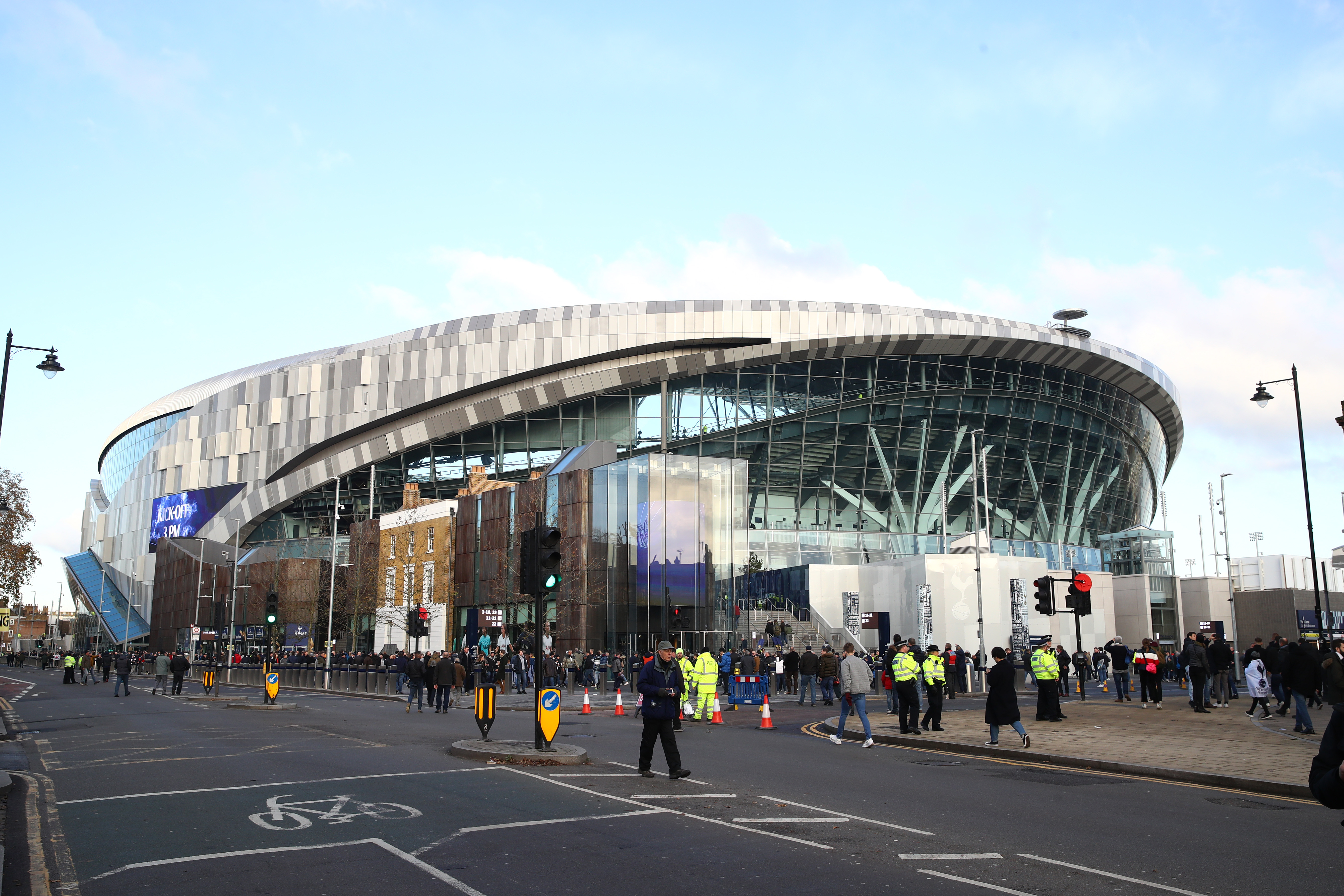
Tottenham Hotspur vs Ipswich Town at the Tottenham Hotspur Stadium on Saturday will feature two teams looking for a response after narrow defeats priort to the international break.
Tottenham’s response to the defeat to Leeds United is the first question at this meeting. Before that 1-0 loss at Elland Road, Roberto De Zerbi’s side had put together three consecutive Premier League victories, capped by a 2-0 win over 10-man Crystal Palace at the Tottenham Hotspur Stadium.
Ipswich Town, on the other hand, were beaten 2–1 by Bournemouth after Christian Walton’s early error, although Jack Clarke’s penalty gave them a route back into the contest. This is a meaningful mid-table game rather than a decisive one. Tottenham need a win to keep their European ambitions moving, while Ipswich want progress without turning a competitive start into a defensive crisis.
For Spurs, the fixture is about restoring control after momentum was interrupted. A victory would keep the Champions League target live and ease some of the pressure around De Zerbi; a second straight defeat would make the Leeds performance look less like an isolated lapse. Their outings in October had included a 1-1 draw at Manchester United and wins over Coventry, Chelsea, and Crystal Palace, earning De Zerbi his first Premier League Manager of the Month award.
The concern is that Leeds exposed a side which suffered in the second half and failed to win its individual contests. That makes this less about changing direction than proving the established approach can survive a setback. The absence of several attacking and midfield options means the selected front four may have to carry more of the creative burden.
Meanwhile, Ipswich arrive with a different calculation. Gary O’Neil’s men can improve their position with a win, but the season is too early for one result to settle their broader objective; a draw would still fit the cautious progress they have made, while another defeat would deepen the frustration around a defence that keeps giving opponents openings.
Their recent run includes one win, two draws, and two losses, and the Bournemouth match captured both sides of the team: a damaging mistake inside five minutes, followed by enough resilience to reduce the deficit. O’Neil’s charges are not required to chase recklessly here. Their challenge is to remain competitive while making Tottenham work for the wide spaces they normally seek.
Team News: Tottenham’s reshaped attack meets an unchanged Ipswich core
Tottenham have several absentees. Xavi Simons and Wilson Odobert are out with cruciate ligament injuries, while Lucas Bergvall is likely to miss out with a knee problem and Savio is listed with a muscle injury. Mathys Tel is also unavailable after suffering an ankle injury at Leeds. That removes depth across the attacking and midfield lines.
So, Dominic Solanke becomes the clearest central reference and James Maddison has greater responsibility for finding connections behind him. The home selection should be a 4-2-3-1 system, the shape Tottenham have used most often recently. Antonin Kinsky is an automatic pick between the sticks and is expected to build from the back, while Jan Paul van Hecke and Micky van de Ven form the centre-back pairing.
The two Dutchman give the high defensive line recovery pace behind Andrew Robertson. Robertson’s established left-back role is important to the plan. He has supplied 14 key passes and created four big chances in nine appearances.
Sandro Tonali should sit on the left of the double pivot, with Mateus Fernandes alongside him. James Maddison takes the central attacking-midfield slot, although his campaign has been interrupted. The Englishman has played 195 minutes across six appearances, with one goal.
Omar Marmoush and Mohammed Kudus should occupy the wide attacking positions, with Kudus the more established recent outlet after recording three assists and 10 key passes in nine appearances. Solanke leads the line after five starts, one goal, one assist and five shots on target from 16 attempts.
Probable Tottenham Hotspur Starting Lineup (4-2-3-1): Kinsky; Porro, van Hecke, van de Ven, Robertson; Fernandes, Tonali; Kudus, Maddison, Marmoush; Solanke
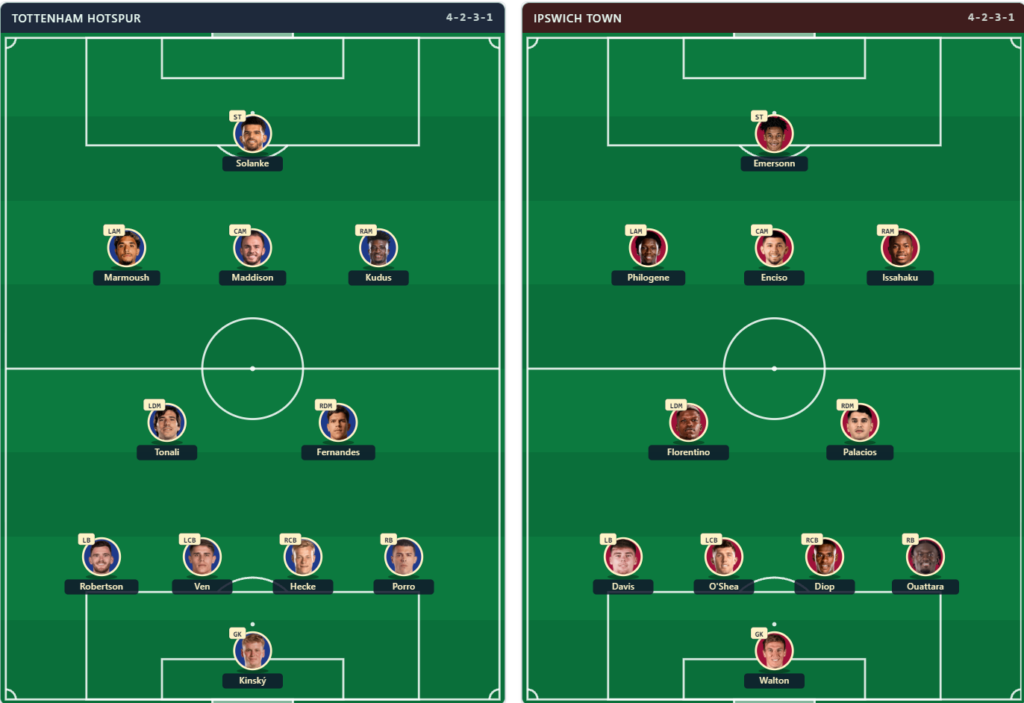
Probable Ipswich Town Starting Lineup (4-2-3-1): Walton; Ouattara, Diop, O’Shea, Davis; Palacios, Florentino Luis; Issahaku, Enciso, Philogene; Emersonn
Gary O’Neil has a full-strength squad for the visit to the capital. Their expected shape is also 4-2-3-1, which has been their regular recent choice. Christian Walton remains in goal, with Leif Davis and Abdoul Ouattara at full-back and Dara O’Shea alongside Issa Diop in the central defensive unit.
Florentino Luis is expected to start in the holding role, with Exequiel Palacios likely to join him in the double pivot. Julio Enciso is the central attacking threat; he has started in each match, contributing two goals, two assists, 15 key passes and four big chances created.
Jaden Philogene should start on the left after four starts in six appearances, while Abdul Fatawu Issahaku is likely to keep the right-sided attacking slot after creating five big chances and providing nine key passes. Emersonn is expected to lead the line, having started all 10 matches and returned two goals, one assist and eight key passes.
Tactics: Robertson’s delivery tests the cover behind Ouattara
Tottenham’s 4-2-3-1 setup is designed to keep the attacking three high while Sandro Tonali and Mateus Fernandes provide cover behind them. At home, they should carry the match forward without abandoning the two-man protection in midfield. Ipswich Town’s matching shape offers a way to contest the game without opening the centre, with Julio Enciso operating behind Emersonn and the two deeper midfielders screening the back four.
The difference is in the risk each side accepts. Tottenham are likely to pursue the win inside their structure, while Ipswich can take attacking opportunities without treating every phase as a race to force the issue. The profiles show a clear difference in how the match may be played.
Spurs have averaged 61.5% of the ball against a league typical figure of 48.5%, while Ipswich have averaged 48% against the same mark; Roberto De Zerbi’s charges are therefore far more likely to establish territory and dictate the starting point of attacks. Tottenham also average 23.5 crosses per match compared with Ipswich’s 13.5, with the league typical figure at 16.5.
The away side’s route is more direct. They play 50.5 long balls per match against Tottenham’s 34, with the league average at 49.75. That makes the wide battle the first structural test. Andrew Robertson is expected to receive early and supply Tottenham’s left side, while Abdoul Ouattara must defend that lane without losing the outlet Ipswich need when they escape pressure.
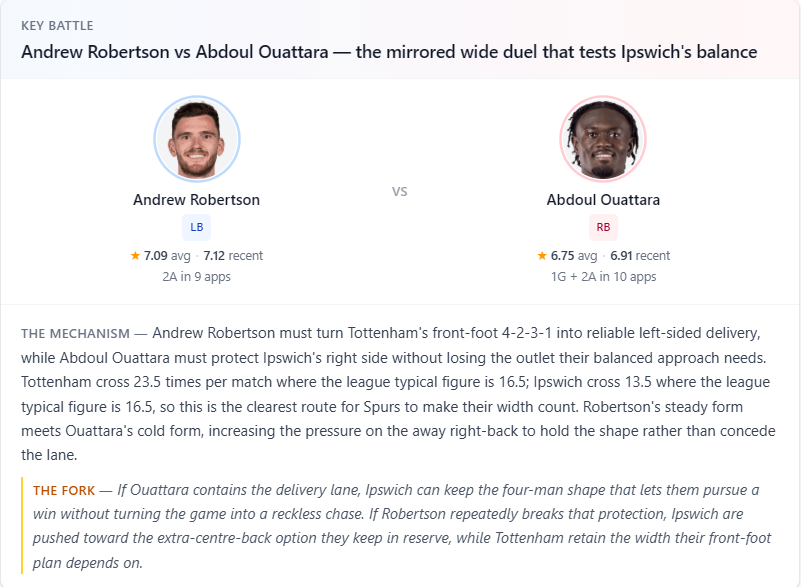
Robertson’s steady contribution meets Ouattara, who has not been at his best recently. So, the danger for Ipswich is not merely the delivery itself. If their right side is repeatedly dragged toward Robertson, Julio Enciso and Jaden Philogene may be forced to defend deeper rather than attack the spaces around Tottenham’s midfield.
The system pattern behind that duel matters as much as the individual contest. Tottenham’s ability to pin Ipswich back should determine whether the away side can keep its two-man midfield screen connected to the defence. If Spurs establish sustained possession, Gary O’Neil’s side may have to choose between protecting the centre and stopping the next wide delivery.
Their defensive record makes that decision costly. Across the recent five-match aggregate, Ipswich have conceded more xG than Tottenham have allowed, while Spurs have created the stronger attacking baseline. The Tractor Boys can still make the game uncomfortable if Enciso receives between the lines before Tonali and Fernandes settle, but the longer Tottenham keep the ball in advanced areas, the more often the visitors will be defending their own shape.
The central duel is the other important pressure point. Tonali’s job is to keep Enciso away from the pocket in front of the centre-backs while still supporting Tottenham’s forward movement. Enciso arrives in better attacking form and has the creative record to punish a disconnected double pivot.
If Tonali controls that space, Tottenham can maintain pressure with two midfielders behind their attacking four. If Enciso escapes it, Spurs may have to reduce their aggression or leave the space behind their pressure exposed, allowing Ipswich to threaten without abandoning their balanced approach.
Prediction: Tottenham retain the edge, but the margin should remain narrow
Our prediction leans toward a Tottenham win with medium confidence. Their home structure should create more sustained pressure, and the strongest separator is the way their left side can repeatedly ask questions of Ipswich Town’s defensive balance. That is more concrete than simply saying Tottenham will have more of the ball.
Andrew Robertson’s delivery gives their possession a recognisable route into the penalty area, while Abdoul Ouattara may have to defend facing his own goal for long periods. The recent attacking numbers support our lean.
Tottenham have averaged 1.57 xG across their last five matches, while Ipswich have 1.86 xGA over the same window. The Tractor Boys have also recorded no clean sheets in that run. That points to Spurs creating enough chances to win, particularly if the home side can turn territorial control into repeated deliveries rather than sterile circulation.
Lean: Tottenham Hotspur win
Range: 2-1/2-0/1-1
The strongest case against a home victory is Julio Enciso finding room before Tottenham’s double pivot becomes properly connected. Ipswich do not need to dominate possession to hurt Spurs. if Enciso receives behind Sandro Tonali and Mateus Fernandes, Emersonn can become a useful target and the visitors can attack the spaces left by Tottenham’s full-backs.
That is the route to the 1-1 outcome in the forecast range, while a more efficient Tottenham performance points to 2-0. The most likely settlement is therefore a Tottenham win in a match that could also finish 2-1 if Ipswich exploit the central pocket.
The late shape change that could protect Tottenham’s lead
The important in-game lever sits with Tottenham if they establish control but need to protect the result. Roberto De Zerbi can move from the 4-2-3-1 formation into a 3-1-4-2 setup, adding a central defender and allowing the wide players to remain higher while a lone midfielder shields the centre.
That would reduce the space Ipswich Town can attack during a late push, although it would also remove one established attacking-midfield role. The visitors have their own defensive switch available, but it asks them to retreat into a shape that concedes one central midfielder. So, Tottenham’s ability to change the balance after taking the lead may be the cleaner route to finishing the match on their terms.