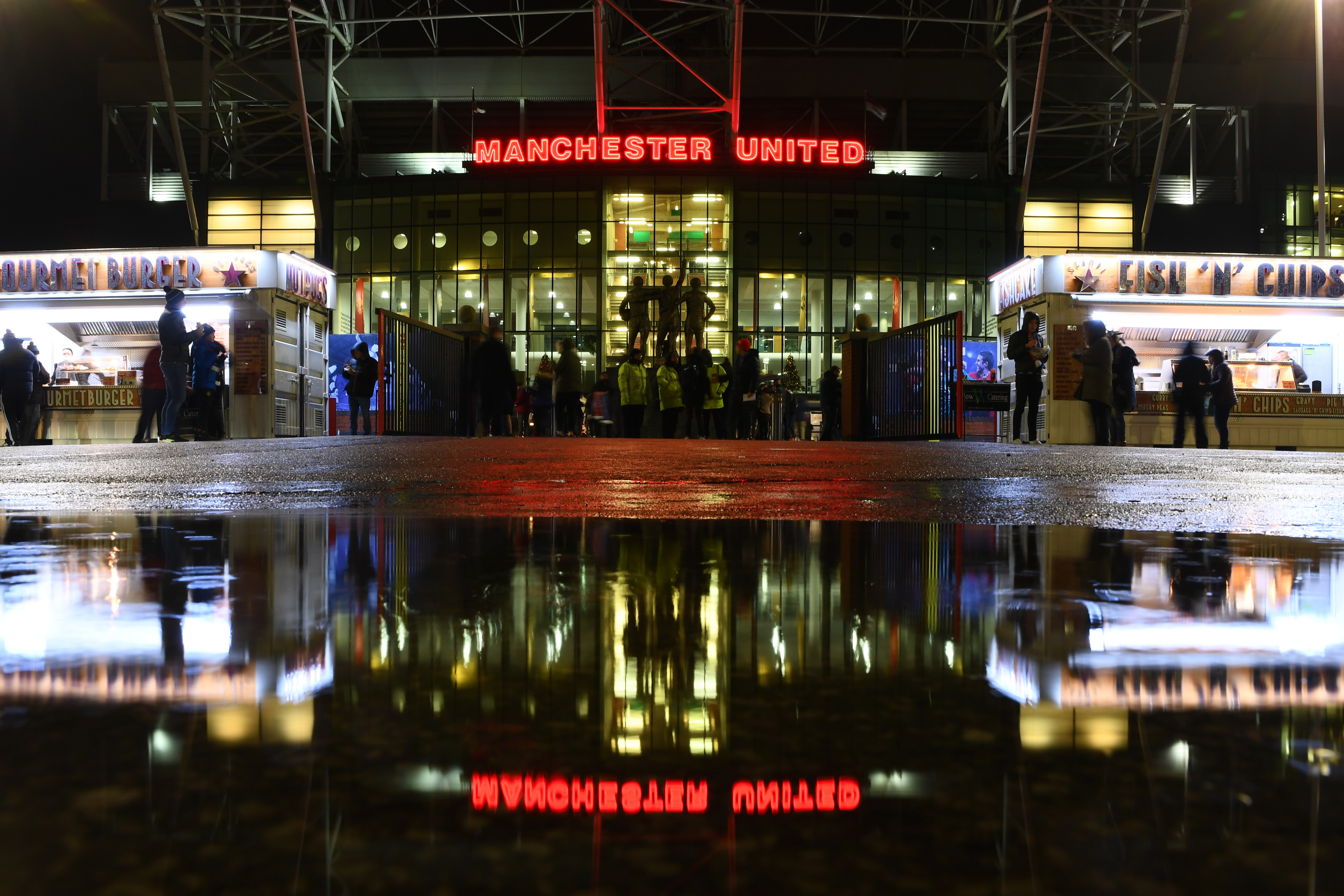
Manchester United vs AS Roma at Old Trafford on Tuesday will be a battle of two teams eager to build momentum in the UEFA Champions League despite coming into this game in contrasting runs of form.
Manchester United’s crisis deepened with a 2-0 defeat to Chelsea at Stamford Bridge this past weekend. On the other hand, AS Roma continued their unbeaten start to the 2026/27 Serie A season with a 5-2 win at Udinese. In the UEFA Champions League Matchday 3, the Giallorossi beat Slovan Bratislava 4-0 to secure their first European victory of the season, while United fell to an embarrassing 4-1 defeat to Como.
Those contrasting arrivals shape this meeting. The hosts need a response before pressure around Michael Carrick becomes even harder to contain amid suggestions that he has until the international break to turn things around. Meanwhile, Roma can pursue another win without having to turn the match into a reckless contest.
For Manchester United, a result matters because their season has unravelled after a run of nine games without a victory. A win would provide the response their campaign needs; a draw would stop the immediate slide but leave the wider problem unresolved, while another defeat would deepen the pressure on Carrick and make the home advantage feel like another missed opportunity.
The home side’s recent sequence has been four defeats and a draw, and the side has carried little attacking momentum into this fixture. Roma, on the other hand, arrive with a different kind of pressure. Their recent run is five matches without defeat, including the strong results in Udine and against Slovan Bratislava. So, they can approach this as a chance to reinforce their momentum rather than a desperate rescue mission.
A draw would still leave the Giallorossi with something from a difficult away game, but their recent attacking output means they will believe Manchester United can be exposed. The main uncertainty is not whether Roma can attack, but how much control they retain once United are forced to open up.
Team News: The predicted teams and the absences behind them
Michael Carrick is bereft of the services of Luke Shaw (muscular), Manuel Ugarte (ACL), Benjamin Sesko (shin), and Marcus Rashford (hip). However, there is some good news, as Patrick Dorgu has resumed training and may be available to take on AS Roma on Tuesday. Additionally, Leny Yoro is available after serving a suspension on Matchday 3 against Como.
Manchester United will line up in a 4-2-3-1 formation vs AS Roma with a fixed striker and a double pivot rather than a more experimental structure. Senne Lammens is an automatic pick between the sticks, with Noussair Mazraoui, Lisandro Martinez, Harry Maguire, and Diogo Dalot forming the backine.
As for the midfield unit, Carlos Baleba and Kobbie Mainoo should form the double pivot behind Youri Tielemans, with Matheus Cunha and Bruno Fernandes supporting Bryan Mbeumo. Tielemans is the important selection in that line; he has made three starts, created seven key passes and produced two big chances, giving Manchester United a link from the deeper midfielders into the attacking line.
Cunha is expected to begin on the left, where United will need his ability to carry the attack when the first pass forward is not available. Fernandes should operate from the right-sided attacking role, while Mbeumo provides the fixed reference point up front; he has started three times and supplied one assist.
Probable Manchester United Starting Lineup (4-2-3-1): Lammens; Dalot, Maguire, Martinez; Mazraoui; Mainoo, Baleba; Bruno Fernandes, Tielemans, Cunha; Mbeumo
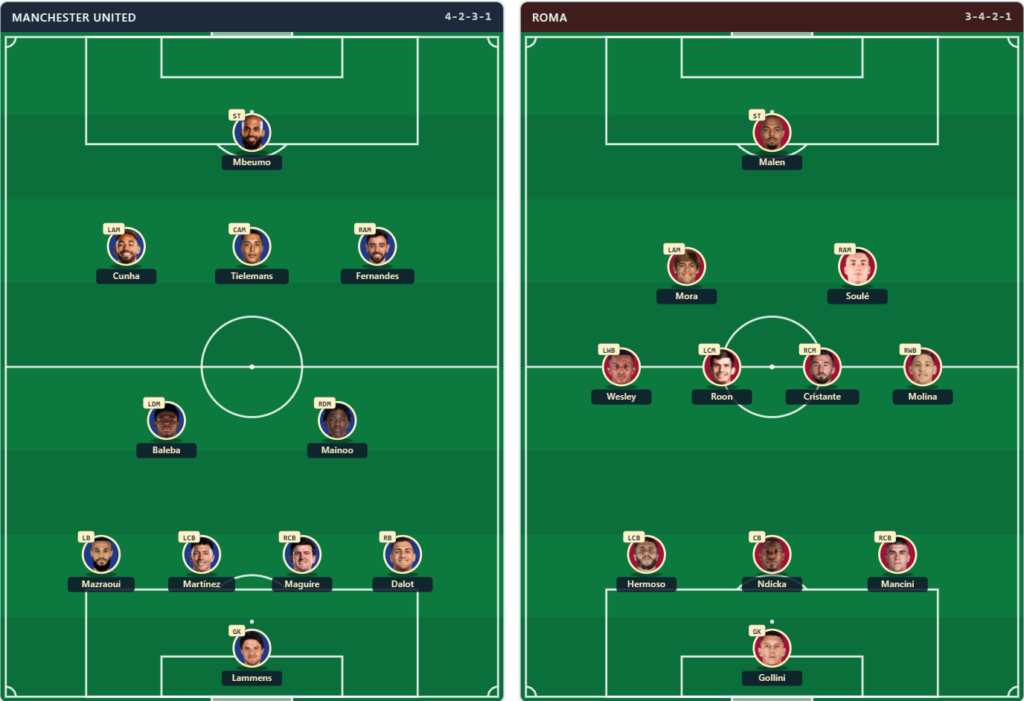
Probable AS Roma Starting Lineup (3-4-2-1): Gollini; Mancini, Ndicka, Hermoso; Molina, Cristante, de Roon, Wesley; Soule, Mora; Malen
AS Roma are missing Mile Svilar (finger), Manu Kone (hamstring), Lorenzo Pellegrini (thigh), and Paulo Dybala (calf). The absences reduce their goalkeeping depth and remove three options from the attacking and central-midfield rotation. However, the visitors can still field their preferred 3-4-2-1.
Pierluigi Gollini should start behind Mario Hermoso, Evan Ndicka, and Gianluca Mancini. Wesley and Nahuel Molina should provide the width, with Marten de Roon and Bryan Cristante pairing up in the central areas. Rodrigo Mora and Matias Soule are expected to play behind Donyell Malen, who is Roma’s central attacking reference and their penalty taker.
The Dutchman has three goals and three assists in three UEFA Champions League outings this term, with six of his 13 shots on target. Soule has created six key passes and two assists in three appearances, while Cristante has scored once in his only start. This is a front line built to keep Manchester United’s back four turning, even with the missing attacking options.
Tactics: Roma’s width vs Manchester United’s need for cover
Manchester United’s 4-2-3-1 setup is designed to keep two midfielders behind the attacking three, allowing Bruno Fernandes and Matheus Cunha to support Mbeumo without completely abandoning protection in front of the centre-backs. It is also the structure United have used throughout this season. So, the selection offers continuity at a time when the team needs a response rather than another major alteration.
On the other hand, AS Roma’s 3-4-2-1 system places two attacking midfielders behind Donyell Malen and gives the wing-backs room to stretch the opposing full-back line. Their profile points to a side more comfortable controlling the match. The visitors have had 58% of the ball per match against United’s 45%, with both figures set against a league typical 53%.
These figures come from three matches, so they describe the current tendency rather than a complete season identity. Nevertheless, the contrast is useful here. Roma should have more of the ball, while Manchester United will need their double pivot to make each forward release count. The same comparison appears in their use of width.
Roma produce 16 crosses per match against the league’s typical 15, while United produce 13 against that same mark. That gives the visitors a broader route into the final third, especially with Wesley and Nahuel Molina able to advance from the wing-back positions. The home side’s full-backs cannot simply follow the wide players and leave the inside channels open, because Rodrigo Mora and Matias Soule are positioned to receive behind them.
Both teams are set up to seek the win while still accepting a draw if the match does not open cleanly. Manchester United therefore need to attack without losing the cover that makes their shape viable; Roma can carry the game forward but are not required to overcommit from the start. The system contest is clear.
The Red Devils want to release Matheus Cunha, Bruno Fernandes, and Bryan Mbeumo from a protected base. On the other hand, Roma want to draw that base apart with wing-backs outside and two attackers inside. The first decisive duel is Diogo Dalot against Rodrigo Mora.
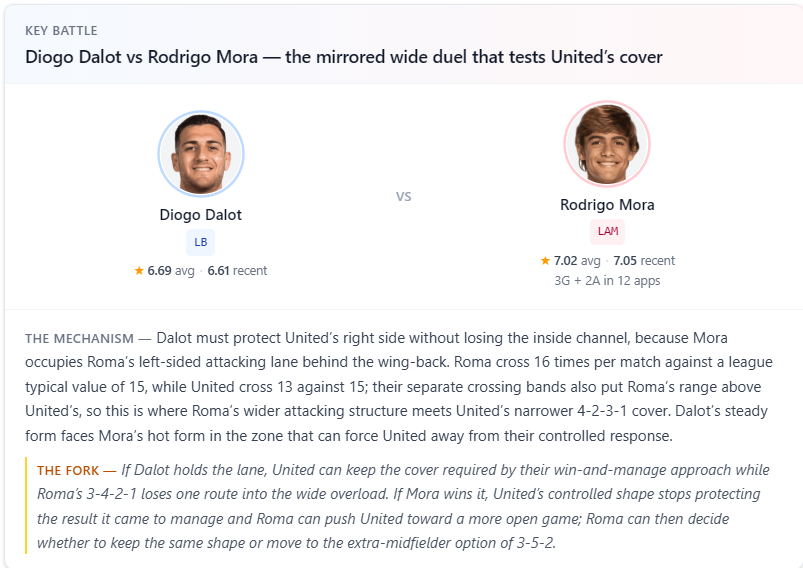
Dalot has to protect Manchester United’s right-hand side while also watching the inside route, because Mora is not merely holding the flank; he is looking to receive behind the wing-back and connect with Donyell Malen. The Portuguese attacking sensation arrives in hot form, whereas Dalot has offered a steadier presence.
So, the question is whether the home side’s right side can delay Roma without pulling the double pivot too far across. If Dalot holds the lane, United can preserve the cover their controlled approach requires and Roma lose one route into the wide overload. If Mora wins it, United’s structure can be dragged into a more open match, after which Roma may either continue with the same shape or add a central midfielder through a 3-5-2.
Behind that duel sits the wider system problem. Roma’s wing-backs stretch the pitch while their two attacking midfielders stay close enough to support the next pass. Manchester United’s full-backs must remain connected to Carlos Baleba and Kobbie Mainoo. Otherwise, the home side will be forced to defend repeated deliveries and cut-backs rather than launch the attacks their formation promises.
The centre also matters. Youri Tielemans must connect the double pivot to the front three, while Bryan Cristante’s running and vertical support can make that connection uncomfortable. If Tielemans keeps the link alive, the hosts can remain compact and still threaten. If Cristante controls the central ground, United may be left defending without a clean route out.
Prediction: Roma have the clearer route to the result
We pick a win for AS Roma, held with medium confidence rather than treated as a certainty. The visitors have the stronger attacking baseline, having averaged 2.63 xG across their last five matches, while Manchester United have allowed 1.51 xGA in that same recent window.
That gap gives Roma more ways to win, particularly if their wide structure forces United to defend deeper than planned. The strongest case against the lean is the Red Devils’ ability to turn the match into a compact home response.
Lean: AS Roma win
Range: 1-2/1-3/1-1
If Diogo Dalot and the opposite flank maintain their distances from the double pivot, Matheus Cunha and Bruno Fernandes can receive earlier and attack the space beside Roma’s back three. The home side’s best route is not to dominate possession but to make their forward attacks more direct once Roma’s wing-backs have advanced.
A goal from that pattern could force Roma to take more risks than their preferred approach demands. The expected scoreline range is 1-2, 1-1 or 1-3. The away win is the sharper result-side angle, but the overall outcome still carries enough uncertainty to avoid presenting it as a strong certainty.
The switch AS Roma can make if Manchester United overload the centre
AS Roma have a clear in-game alteration available. They can move from the 3-4-2-1 into a 3-5-2 if the extra central midfielder becomes more valuable than keeping two attacking midfielders behind Donyell Malen.
That change would give them another body around Manchester United’s double pivot and help them protect the result without abandoning the back-three platform. Michael Carrick’s charges have less obvious structural room to alter their plan, which leaves the visitors better placed to respond if the opening shape does not settle the match.