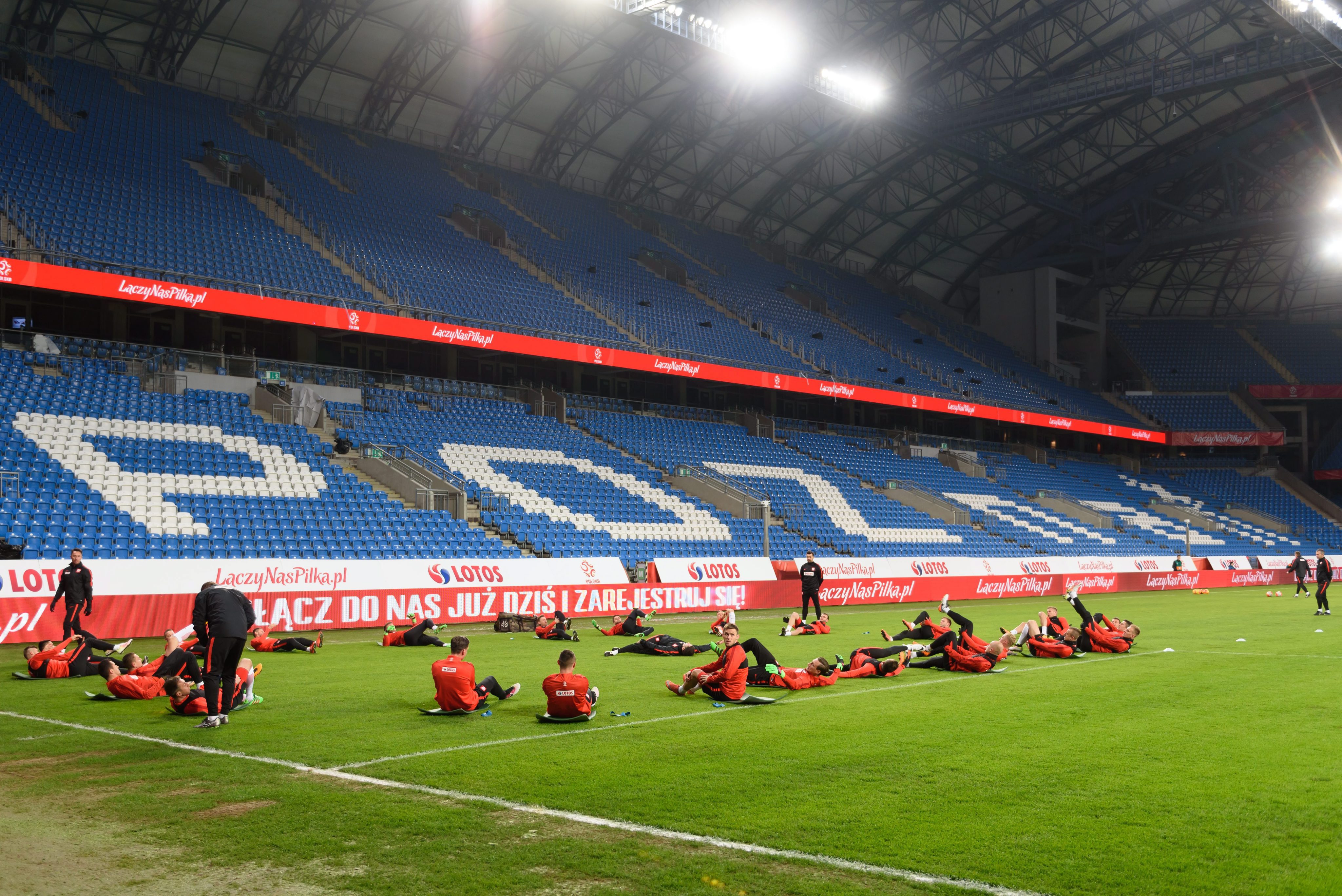
Lech Poznan vs Sunderland at Eneo Stadion on Thursday will feature two teams on the opposite end of the form spectrum in their campaigns.
Sunderland have won both of their opening Europa League league-phase matches, beating AZ Alkmaar 1-0 and Torreense 2-1. The Black Cats now face a Lech Poznan side still searching for a first response. The meeting at Enea Stadion is therefore less about a quantified qualification equation than direction.
Regis Le Bris and his charges want to carry their European momentum into another demanding fixture, particularly amid dreadful form in the Premier League that has dropped them into the relegation zone. On the other hand, Lech need to stop their campaign sliding further away from them, hoping to carry their impressive domestic form into European football.
For the home side, another poor result would deepen the damage caused by their opening two European defeats. They lost 4-0 to Crystal Palace and 4-0 to Bayer Leverkusen, conceding eight goals without scoring. So, even a draw would at least halt the immediate collapse.
Niels Frederiksen’s men should approach this as a controlled recovery attempt rather than abandon their structure from the first whistle. The unsettled central attacking-midfield slot could still affect how cleanly that recovery plan functions.
Sunderland arrive with the more positive European story, though their domestic run makes this a test rather than a free hit. The Black Cats have lost four consecutive Premier League matches, and the latest defeat came after a European win, meaning the team must show that the continental performances can survive another difficult week.
A draw would keep the European momentum intact, while a win would strengthen the contrast between their two campaigns. Their settled shape gives them a clearer platform, but the domestic pressure may encourage them to protect the point if the match remains level.
Team News: The teams and the missing pieces
Lech Poznan are without Ali Gholizadeh (knee), Allahyar Sayyadmanesh (groin), and Joao Moutinho (foot), while Alex Douglas is struggling with an ankle complaint. Those absences reduce the available attacking and midfield options, leaving the expected eleven dependent on a less established central link behind Mikael Ishak.
Mateusz Lis should feature in goal behind a back four of Michal Gurgul, Terry Yegbe, Mateusz Skrzypczak, and Joel Pereira. Meanwhile, Radoslaw Murawski should return as one half of the double pivot after serving a suspension. Pablo Rodríguez is likely to partner Murawski.
Meanwhile, Patrik Wålemark should start from the right. Leo Bengtsson is expected to take the left-sided role, with Filip Jagiello likely to reprise the no. 10 role. Ishak should lead the line for Lech Poznan vs Sunderland, offering the most settled focal point despite having no goal yet and only two shots on target from five attempts.
Probable Lech Poznan Starting Lineup (4-2-3-1): Lis; Pereira, Skrzypczak, Yegbe, Gurgul; Murawski, Rodriguez; Walemark, Jagiello, Bengtsson; Ishak
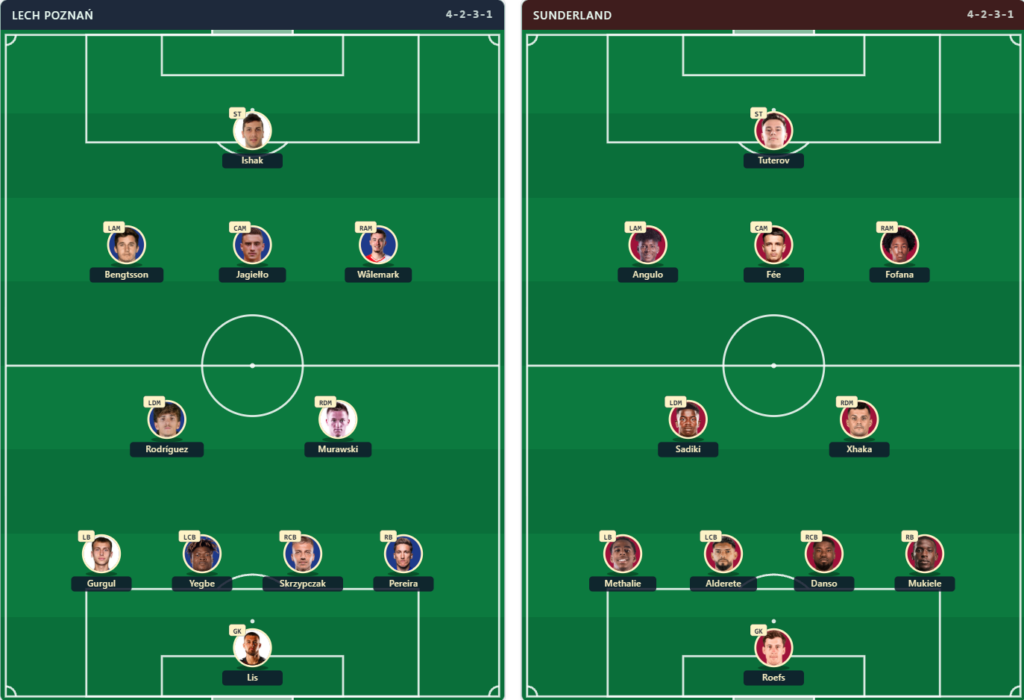
Probable Sunderland Starting Lineup (4-2-3-1): Roefs; Mukiele, Danso, Alderete, Methalie; Xhaka, Sadiki; Fofana, Le Fee, Angulo; Tuterov
Sunderland are without Brian Brobbey (hamstring), Romaine Mundle (knee), Dan Ballard (thigh), and Thomas Meunier (hamstring), while Wilson Isidor remains a doubt with a muscular injury. Brobbey’s hamstring problem removes a forward option, Ballard’s injury affects the defensive pool, while Mundle and Meunier are longer-term losses.
Robin Roefs starts behind Nordi Mukiele, Kevin Danso, Omar Alderete, and Dayann Methalie. As for the midfield unit, Granit Xhaka and Noah Sadiki form the double pivot. Further ahead, Enzo Le Fée should play centrally behind Timur Tuterov, with Nilson Angulo on the left and Malick Fofana on the right.
Le Fee is Sunderland’s most productive attacking midfielder so far in the UEFA Europa League, with one goal, four key passes and a 7.5 average rating. Tuterov is the expected centre-forward, particularly with Regis Le Bris unlikely to take a chance with Wilson Isidor.
Tactics: Why Sunderland’s wide delivery meets Lech Poznan’s central problem
Both teams should use a 4-2-3-1 formation, but the similarity ends there. Lech Poznan’s double pivot is intended to give the side protection while placing an attacking midfielder between Sunderland’s midfield and defence. The shape offers a calmer route back into the match than an early switch to two strikers, although it places considerable responsibility on the central link and Mikael Ishak’s ability to connect play.
Sunderland’s 4-2-3-1 setup is more settled and gives them two holding midfielders behind three advanced players. They can seek the win while keeping enough protection to accept a draw, rather than forcing an open game. Their profile points to a wide route. The Black Cats have produced 32 crosses per match against a league-typical figure of 17.
Those numbers come from only two matches, so they describe what has happened recently rather than establish a permanent identity. However, the route is clear enough for Lech to have to defend it. The same applies to Sunderland’s dead-ball threat. Regis Le Bris’s men have 1.188 xG from set pieces per match compared with a league-typical 0.342, again over two matches.
That makes every avoidable foul and every corner more important for Lech, particularly after conceding heavily in their opening European games. The home side’s controlled approach will be tested if Sunderland can repeatedly move the ball wide, deliver into the area and force the double pivot to defend closer to its own box.
The main system question is whether Niels Frederiksen’s men can connect Radoslaw Murawski and Pablo Rodriguez with Filip Jagiello’s position and Ishak’s movement. If that link works, Sunderland’s cautious balance can be stretched because Lech will have a way to keep attacks alive rather than simply return the ball.
If it fails, Sunderland can defend the first pass, protect the space in front of their centre-backs and wait for the home side to become more direct. Enzo Le Fee then becomes important between the lines, while Granit Xhaka and Noah Sadiki can decide whether Sunderland keep control or are pulled into repeated defensive phases. The leading duel is Mikael Ishak against Kevin Danso.
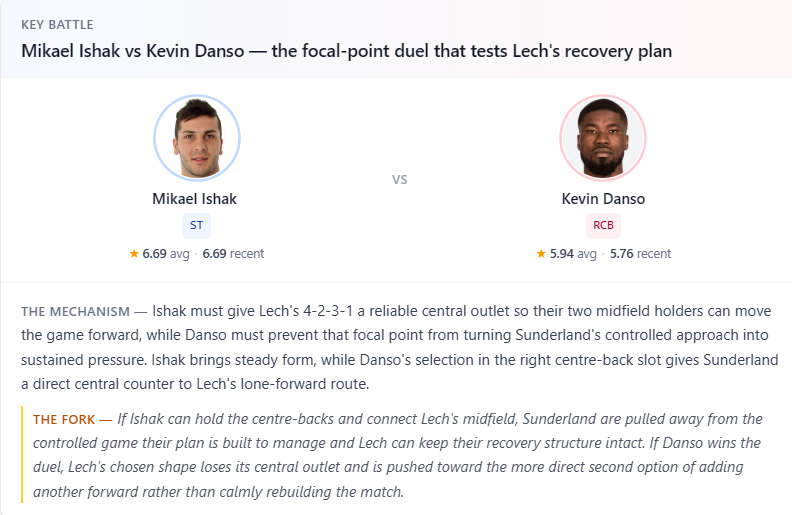
Ishak must give Lech Poznan a reliable central outlet, hold the ball long enough for the midfield to advance and prevent the home attack from becoming disconnected. Danso, selected in the right centre-back position and coming off the stronger current showing, has to stop that focal point from turning the home side’s controlled recovery into sustained pressure.
If Ishak can hold Danso and draw the centre-backs into uncomfortable decisions, Lech’s two midfielders can move the game forward and keep Sunderland from settling into their preferred controlled pattern. If Danso wins the contest, the hosts lose their central release point, and Sunderland can squeeze the attacking midfielder out of the match.
There is little cover behind the duel/ Ishak is the lone forward in the projected shape, while Danso’s success allows the rest of Sunderland’s defensive line to stay compact rather than step out. The secondary collision is Patrik Walemark against Dayann Methalie.
Walemark’s four key passes show why Lech need his right-sided role to create more than isolated possession, while Methalie must protect Sunderland’s left defensive width without being pinned too deep. If the Lech Poznan winger keeps that side active, Sunderland’s wish to control the game without overcommitting becomes harder to maintain. If Methalie holds the lane, Lech may struggle to generate enough pressure through the current shape.
Prediction: A low-confidence draw with room for goals
We predict a draw, albeit only with low confidence. Sunderland have the clearer attacking route. The Wearside club’s recent attacking baseline is 1.72 xG per match, while Lech Poznan have 3.77 xGA per match across their opening Europa League outings. That is a meaningful structural concern for the home side, but both figures come from limited windows and do not settle the match on their own.
The home side’s strongest answer is that their wider season scoring output has run 9.264 goals above expected. Their European matches have been goalless, but that wider attacking signal argues against treating those two defeats as a complete description of the team.
Lean: Draw
Range: 1-1/0-1/2-2
Mikael Ishak holding the ball, Patrik Walemark creating from the right and the double pivot finding the attacking midfielder could produce the response Sunderland’s controlled approach is designed to prevent. The strongest case against the draw is Sunderland turning their wide and set-piece pressure into an early lead.
That would force Lech to leave the measured recovery plan, expose the spaces behind the midfield and make the away side’s cautious approach much easier to execute. The match settles in the 1-1, 0-1 or 2-2 range.
The switch Lech can make if the central route stalls
Lech Poznan’s clearest in-game adjustment is to move into a 4-4-2 with a second central forward if the current shape cannot give Mikael Ishak enough support. That would sacrifice the separate attacking-midfield link but place another player against Sunderland’s centre-backs and change the terms of the focal-point duel.
The Black Cats have no equivalent shape change identified here. So, the home side’s decision over when to add that second forward could be the selection and tactical lever that changes a level match.