Como vs Manchester United at Stadio Giuseppe Sinigaglia on Wednesday will feature two teams eager to recover from Matchday 2 defeats in the UEFA Champions League.
Como’s impressive home win over RB Leipzig was followed by the defeat to Feyenoord last week. Meanwhile, Manchester United’s 2-0 defeat to Atletico Madrid on Matchday 2, where Leny Yoro was dismissed in the second half, has been a part of a terrible run for Michael Carrick’s team. The match means something different to each club.
Como are trying to establish themselves in Europe after arriving as newcomers, while Manchester United need to stop the winless run and ease the pressure around Michael Carrick. Both sides have a meaningful result to chase, but only one comes into the game with the manager being settled.
Como’s 3-1 win at Fiorentina this past weekend gives them a recent away success to carry into this contest, and their home victory over Leipzig on Matchday 1 has already shown that their European arrival is not simply ceremonial. A draw would keep their progress moving, but a home defeat would weaken the force of that promising start.
The Lariani have scored seven and conceded seven across their last five matches, so the improvement is not built on defensive control alone. The attacking confidence is real, though the loss of a major wide option could affect how aggressively they approach the right side.
On the other hand, Manchester United’s 1-1 draw at Leeds came after the defeat to Atletico Madrid and extended a run that has brought three draws and three losses in their last six matches. The Red Devils need a result to change the mood around the team, but the formal qualification consequences are not established here. So, this is pressure for a response rather than a claim that defeat ends their campaign.
Their recent six-match record contains only five goals, while nine have gone in at the other end. That lack of attacking production makes their away approach especially important. Carrick’s men cannot simply wait for the game to rescue them.
Team News: The absences reshape both shapes
Como have three players unavailable. Jayden Addai and Adrian Lahdo through eligibility restrictions, and Assane Diao because of a thigh injury. Additionally, there are concerns about Trevoh Chalobah’s availability due to a muscular problem. Diao’s absence has the clearest effect on the XI, removing a high-output option from the right-sided attacking role.
Mattia Liberali therefore occupies that position, deputising for Diao on the right flank. Como otherwise keep the 4-2-3-1 they have used in all five recent matches, with Nico Paz central behind Anastasios Douvikas and Lucas Da Cunha and Maximo Perrone forming the double pivot.
Nico Paz is the central selection around which the home attack is built. Martin Baturina should give the left side more movement inside; he has one goal, one assist, three shots on target from two appearances and four key passes in the Champions League. Douvikas leads the line with two goals and one assist in 95 minutes, so Como’s front three still contain a clear route to goal despite the missing Diao.
The back four should consist of Yan Couto, Jacobo Ramon, Marc Oliver Kempf, and Alex Valle Gómez in front of Jean Butez. In midfield, Da Cunha’s role is more important than his recent 6.64 rating suggests: he is the deeper player who helps Como build with two central midfielders, and he has put three of four shots on target. Perrone offers the other side of that platform after scoring once from his only shot on target.
Probable Como Starting Lineup (4-2-3-1): Butez; Couto, Ramon, Kempf Valle; Perrone, Da Cunha; Liberali, Paz, Baturina; Douvikas
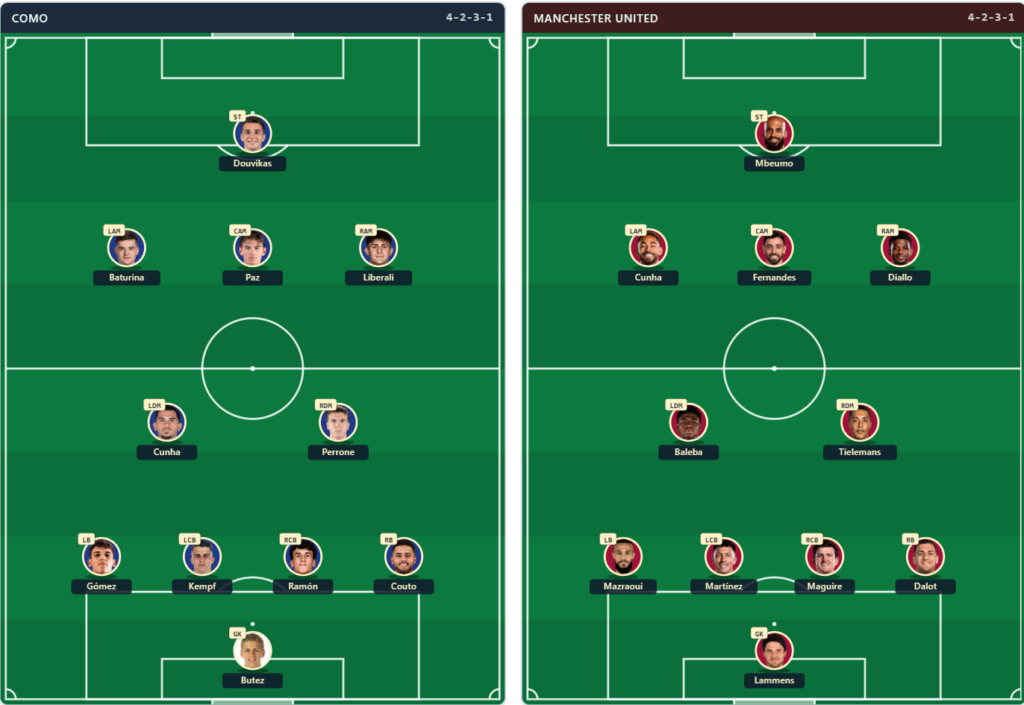
Probable Manchester United Starting Lineup (4-2-3-1): Lammens; Dalot, Maguire, Martinez, Mazraoui; Tielemans, Baleba; Amad, Bruno Fernandes, Cunha; Mbeumo
Manchester United are without Manuel Ugarte (ACL), Patrick Dorgu (hamstring), Luke Shaw (unspecified), and Benjamin Sesko (shin), while Leny Yoro is suspended after his dismissal last week. The absences remove a holding-midfield option, a centre-back, both established left-back choices and a centre-forward.
That leaves the away side relying on Carlos Baleba alongside Youri Tielemans, while Noussair Mazraoui fills in at left-back and Harry Maguire comes into the right-sided centre-back position. Bryan Mbeumo remains the forward reference, with Matheus Cunha and Amad Diallo expected to play either side of Bruno Fernandes in the same 4-2-3-1.
Fernandes is Manchester United’s main creative outlet, having produced five key passes and two big chances created in his two starts in the UEFA Champions League. Tielemans carries a significant part of the progression burden too: he has one assist, five key passes and three big chances created across his two appearances, even though his recent form has dipped.
Cunha brings the sharper recent attacking numbers, with one goal and four shots on target from five attempts. Mbeumo has one assist and two key passes, and his presence gives United an established focal point despite the centre-forward absence.
Lisandro Martinez and Diogo Dalot should complete the defensive unit with Maguire and Mazraoui, while Senne Lammens starts behind them. However, Martinez’s recent early withdrawal makes his selection a slightly more delicate one than the rest of the backline. Lammens has also played every minute in the current window. The shape is familiar, but the personnel inside it is not entirely secure.
Tactics: Nico Paz and Bruno Fernandes decide who controls the central space
Both teams should use a 4-2-3-1 formation, but they will not ask it to do the same job. Como are expected to carry the game forward within their structure, keeping Nico Paz between the lines and using the double pivot to support sustained possession. Manchester United are more likely to pursue the win without abandoning their shape: they need to respond.
However, opening the game too quickly would expose a defence already altered by suspension and injury. The recent five-match aggregates point to a territorial advantage for Como, who have averaged 60.2% possession compared with Manchester United’s 48.6%. That has also been reflected in attacking production, with the Italian outfit averaging 1.76 xG against United’s 1.08.
The profile complicates that picture. Across two UEFA Champions League matches, Como’s ball dominance is 51 per match and United’s is 50, both below the 54.75 typical figure in the competition. The difference suggests that Como’s recent control is stronger than their shorter measured habit, while neither side has established a clear separation on that particular axis.
Manchester United make 14.5 attempts per match, compared with Como’s 12.5, while the league-typical figure is 16. That does not guarantee greater danger from the visitors, but it does explain why the Red Devils may seek width and early deliveries rather than depend entirely on patient central combinations.
Their crossing figure of 14.5 per match sits close to the league typical 14, whereas Como’s profile is less reliant on that route. Manchester United need those wide attacks to produce access around Douvikas rather than simply possession in harmless areas. The most important meeting is Nico Paz against Bruno Fernandes.
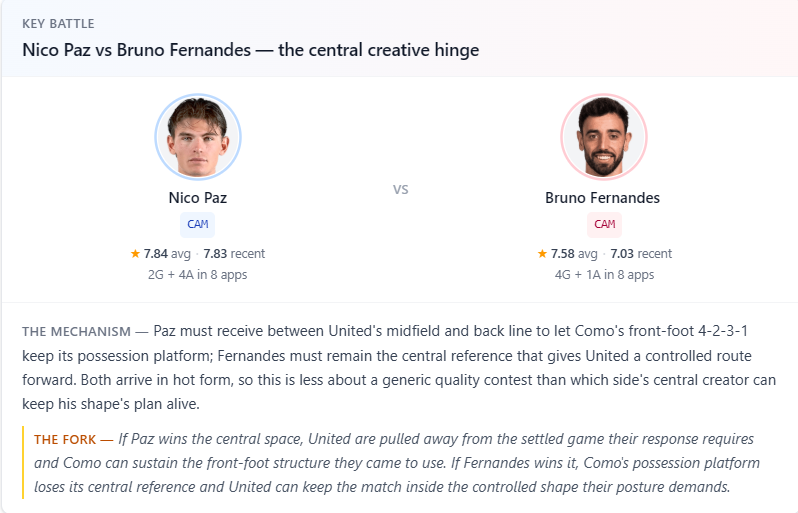
Nico Paz must receive in the gap between Manchester United’s midfield and defence so Como can keep their front-foot structure high; Fernandes must remain available as the central reference that lets United play forward without losing their shape. The contest is structural as much as individual.
Behind Nico Paz are Lucas Da Cunha and Maximo Perrone, while Fernandes has Carlos Baleba and Youri Tielemans covering the central lanes. The player who loses the duel will not be isolated, but his team’s entire route through the middle becomes less reliable. If Paz wins that space, Manchester United are likely to be pulled away from the controlled game they want, allowing Como to sustain pressure and keep their midfield platform advanced.
If Fernandes wins it, the home side’s possession structure loses its main link between midfield and attack, and Manchester United can keep the contest inside the shape that protects their weakened defence. That is why the duel carries more weight than a simple comparison of creative quality.
The secondary battle on Como’s right is Yan Couto against Matheus Cunha. The Como full-back has to protect the channel without abandoning the back four, while Cunha needs to attack it often enough to give United a route into the game.
If Couto holds his position, Como can continue to push without exposing the side behind him. If Cunha breaks that protection, the hosts may be forced into deeper defending and Manchester United may find the more open match they otherwise want to avoid.
Prediction: Como have the stronger case, but the draw remains live
We predict a Como win, held with medium confidence rather than certainty. Their recent attacking baseline is stronger, and Manchester United’s defensive record gives the home side a clearer route to creating the decisive chances. The visitors have 1.31 xGA per match in their latest five-game aggregate and have recorded no clean sheets across that stretch.
Como’s front-foot approach should therefore test the visitors’ ability to keep their response controlled, particularly if Nico Paz receives regularly behind the midfield. The strongest case against Cesc Fabregas’s men is that Manchester United’s wide attacking players can turn the match before the home side’s possession becomes decisive.
Cunha has already shown a willingness to shoot, while Bryan Mbeumo gives Manchester United a forward who can connect those attacks to the penalty area. If their deliveries and early runs force Como’s full-backs to retreat, Bruno Fernandes may receive the central space he needs and the visitors can make their depleted defence less relevant by attacking first.
The expected scoreline range is 2-1, 2-0 or 1-1. Como have the better platform, but Manchester United retain enough attacking quality for a narrow result or a draw to remain plausible.
The right-side replacement may decide how much Como can risk
Como’s biggest late-match adjustment is likely to come from the right-sided attacking role. Mattia Liberali gives them the nominal width needed to preserve the 4-2-3-1 shape, but the side may need to alter how often that player comes inside if United begin targeting the same channel through Matheus Cunha. That choice will determine whether the home side can keep their midfield pressure high or must protect the back four more conservatively.