Bournemouth vs Sunderland at the Vitality Stadium on Sunday will feature two teams that are under pressure after sluggish starts to their 2026/27 Premier League campaigns despite creating European momentum.
Bournemouth’s European start has been extraordinary, but their Premier League campaign has not followed it. They won 2-1 away at Real Sociedad and then beat Sturm Graz 3-0 at home earlier this week. Yet, the league brought consecutive defeats, including a 5-1 loss to Chelsea in which the damage was done almost immediately.
Similarly, Sunderland have also needed Europe to require a lift from a difficult domestic run. Their late 2-1 comeback at Torreense, settled by a 93rd-minute winner, came after a 2-0 home defeat to Brighton & Hove Albion. This meeting matters to both sides because a win would move either club clear of the immediate danger, while defeat would leave the pressure on.
For Bournemouth, the result is worth more than a routine home improvement. They are still searching for Marco Rose’s first Premier League victory, and three points would move them out of the drop zone while keeping their wider ambitions alive. Another failure would leave the European success looking disconnected from domestic progress.
Their latest league sequence has been poor, although the 3-0 European win over Sturm Graz showed a side capable of producing a strong performance when the attack and defensive structure work together. Bournemouth carry a home advantage in the tactical sense as well as the venue. However, a key absence in midfield means the double pivot has to be assembled carefully rather than taken for granted.
Sunderland’s stakes are meaningful but slightly different. A victory could lift them towards the lower mid-table spots, while a loss would drop them into the relegation zone and in a spot of bother. Their four league points have come amid defeats to Brighton, Arsenal, and Manchester City, and the Brighton match was especially frustrating because possession did not become enough threat in the final third.
The comeback against Torreense gives Regis Le Bris’s team a recent lift, but not yet a domestic solution. Their settled structure should help them avoid panic, and the Black Cats can accept a draw more comfortably than Bournemouth can, provided their direct attacks do not become wasteful.
Team News: The double pivot decides Bournemouth’s selection
Bournemouth are without Julian Araujo (hamstring), Alex Scott (thigh), Eli Junior Kroupi (foot), and Veljko Milosavljevic (knee). Scott’s absence matters most to the expected shape, as it removes a midfield option and makes a two-man screen behind the attack more important.
Bournemouth will line up in their familiar 4-2-3-1 setup vs Sunderland rather than the 4-4-2 alternative. Djordje Petrovic should retain his spot in goal behind Adam Smith, James Hill, Antonio Silva, and Adrien Truffert, with Hill and Silva providing continuity in the centre and Truffert retaining the left-back role despite a difficult recent spell.
As for the midfield unit, Tyler Adams is expected to start alongside the probable Ryan Christie in the double pivot. Adams has started four matches and played 372 minutes, while Christie has two starts and 176 minutes, so this is a functional pairing rather than an entirely settled one. Ahead of them, Rayan will start on the right wing, with Justin Kluivert reprising the no. 10 role, and Marcus Tavernier on the left.
Tavernier has scored three times, supplied ten key passes and created three big chances in six appearances, making him the talismanic attacker for the home side. Finally, Evanilson will spearhead the Bournemouth attack vs Sunderland. He has one goal, three assists, and six key passes from six starts, as well as three big chances created, and his recent performances have made him Bournemouth’s clearest outlet when they need to move up the pitch.
Sunderland’s defensive absences and changes make that reference point particularly important. Bournemouth’s starting eleven is thus built around the striker, the central creator and the two midfielders behind them, not as a team preparing to throw two attackers forward from the get-go.
Probable Bournemouth Starting Lineup (4-2-3-1): Petrovic; Smith, Hill, Silva, Truffert; Adams, Christie; Rayan, Kluivert, Tavernier; Evanilson
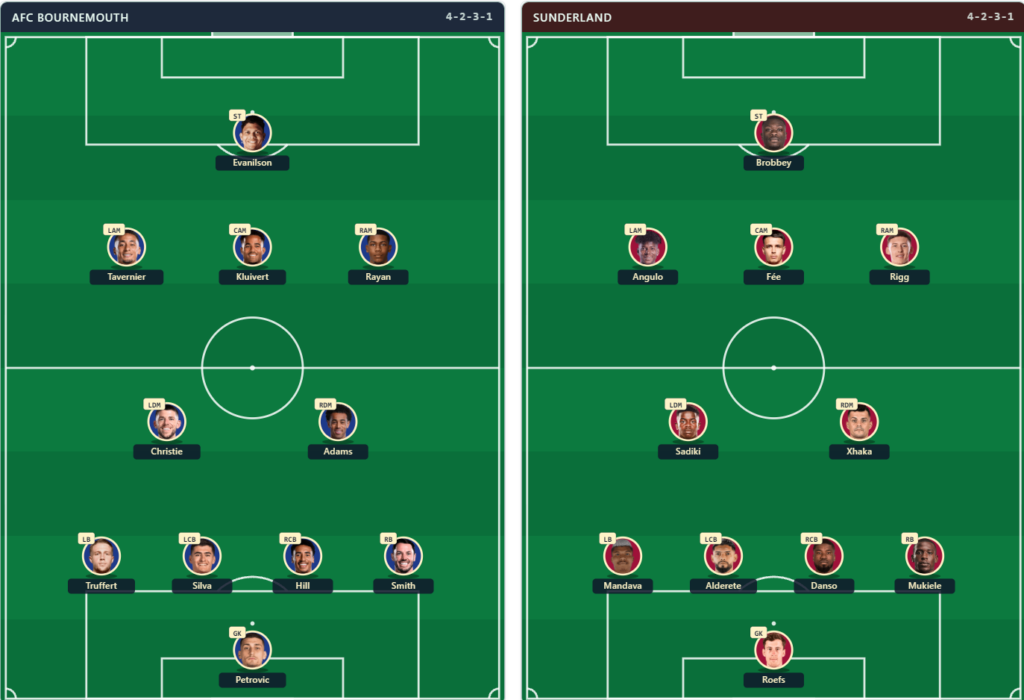
Probable Sunderland Starting Lineup (4-2-3-1): Roefs; Mukiele, Danso, Alderete, Reinildo; Xhaka, Sadiki; Rigg, Le Fee, Angulo; Brobbey
Sunderland have only Romaine Mundle unavailable through a knee injury, while Dan Ballard and Thomas Meunier miss out through hamstring issues. Brian Brobbey is returning from a hamstring problem and is expected to lead the line, restoring the key option that would otherwise have been missing from the plan.
The 4-2-3-1 has been Sunderland’s consistent choice and should remain so here vs Bournemouth. Robin Roefs starts behind a back four of Nordi Mukiele, Kevin Danso, Omar Alderete, and Reinildo Mandava.
Granit Xhaka and Noah Sadiki form the double pivot, with Xhaka the organiser after six starts and 14 key passes. Enzo Le Fee plays behind Brobbey after contributing one goal, one assist, 11 key passes and four big chances created. Nilson Angulo should occupy the left attacking-midfield slot, while Chris Rigg is the more experimental call on the right after only 17 minutes this season.
Tactics: Two similar shapes, but different ways of reaching the box
Both teams should line up in a 4-2-3-1 formation and both are prepared to pursue the win without turning the match into an uncontrolled chase. Bournemouth’s shape keeps two midfielders behind an attacking trio, allowing Evanilson to remain the central outlet while Justin Kluivert works between the lines.
Sunderland’s version gives Granit Xhaka and Noah Sadiki responsibility for the central platform and leaves Enzo Le Fee close to Brian Brobbey. The difference is in the route. Bournemouth want quick vertical attacks after winning the ball, while Sunderland prefer possession-based build-up, pressure and a more direct delivery when the central route is blocked.
The two profiles make the match more physical and direct than the possession numbers alone suggest. Bournemouth and Sunderland each average 48% of the ball, exactly alongside the league’s typical 48%. So, neither side has a clear habit of monopolising possession.
Sunderland play 57.5 long balls per match to Bournemouth’s 55.5, with both above the league’s 49.75, meaning the midfield battle will often be about second balls rather than long spells of uncontested circulation. The hosts shoot 13 times per match and Sunderland 12, compared with a league figure of 12.5; that is a small difference, but it points to the home side carrying a slightly greater appetite to finish attacks.
The physical contest is also close. Bournemouth average 101 combined ground and aerial duels per match, while Sunderland average 102.5, both above the league’s 95.75. This should not look like two sides calmly exchanging short passes for ninety minutes. Regis Le Bris’s men will try to gain territory with early deliveries and force the home side’s midfield screen to defend facing its own goal.
Bournemouth’s recent five-match attacking and defensive platform is stronger on the chance-quality side, with 1.67 xG and 0.93 xGA. However, that advantage only matters if they can prevent Sunderland from turning direct balls into repeated second phases. That is where the main duel sits.
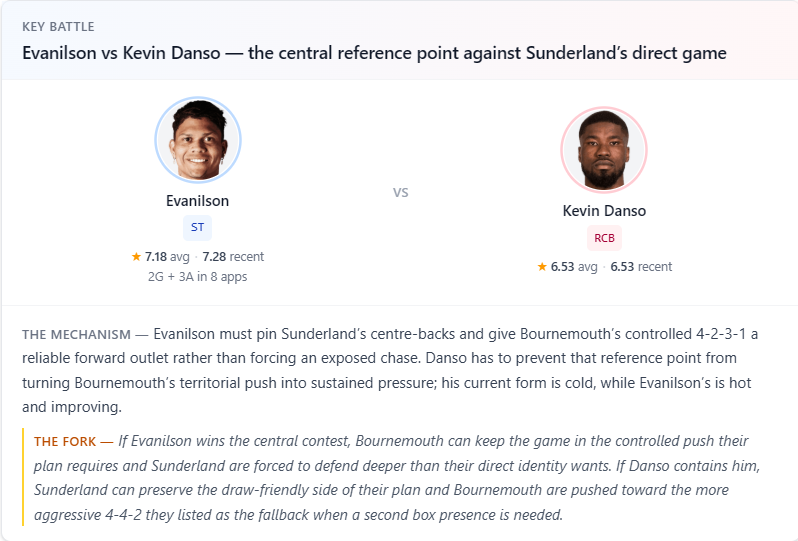
Evanilson needs to pin the centre-backs and give Bournemouth a forward target, while Kevin Danso has to stop that outlet from becoming sustained home pressure. The Brazilian striker’s current form is the sharper of the two, but Danso’s job is not simply to win every individual challenge. He must keep Sunderland’s shape connected behind him.
If Evanilson wins the contest, Bournemouth can maintain their controlled push and force Sunderland deeper than their direct approach prefers. If Danso contains him, Sunderland can protect the draw-friendly side of their plan and make the Cherries consider a switch to two forwards late on.
The wide battle offers a second route into the same problem. Marcus Tavernier attacks from Bournemouth’s left against Nordi Mukiele, and Tavernier’s recent output gives the home side a way to stretch the visitors without abandoning their midfield cover.
Mukiele must hold that side while still supporting the first pass forward. If he does, Bournemouth’s cleanest wide release becomes less reliable; if Tavernier gets free, Sunderland may be forced to defend closer to their own box and lose the territory their direct game needs.
Prediction: Bournemouth have the clearer route to a narrow win
We predict a Bournemouth win, but only with medium conviction. Their 4-2-3-1 shape has the better central reference point in Evanilson, and the home side’s recent defensive platform has allowed 0.93 xGA per match compared with Sunderland’s 1.44. That difference matters in a fixture where both sides are likely to have periods of possession, but neither has shown enough finishing security to make an open game comfortable.
Bournemouth also have the more convincing recent attacking potential through Evanilson;s current form and Marcus Tavernier’s production from the left. The strongest case against the home win is Sunderland’s ability to turn the match into a long sequence of territory, deliveries and second balls.
Lean: Bournemouth win
Range: 1-0/2-1/1-1
The Black Cats’ direct approach could pull Bournemouth’s double pivot away from the controlled build-up, especially if Brian Brobbey gives the visitors a stable target. That would make the hosts defend more often than Rose wants and could push them towards the 4-4-2 fallback before the match is settled.
Sunderland’s xG output has also been better than their actual return; they are 4.286 goals below expected, compared with Bournemouth’s 1.637-goal shortfall. So, a sharper finishing display could overturn the recent results. The most likely scoreline range is 1-0, 2-1 or 1-1. Bournemouth should have enough control to stand the greater chance of winning, but the defensive and directness profiles leave a draw very much in play.
Rose’s late switch is the clearest escape route
Bournemouth’s most useful in-game adjustment is already visible in the shape options. If the lone-striker plan is not producing enough presence in the penalty area, Marco Rose can move to a 4-4-2 and add a second body near the goal.
That change would increase the cost of Sunderland’s deep defending, but it would also ask Bournemouth to accept less protection in midfield. The timing of that switch may decide whether their controlled push becomes a home win or settles for the draw.