LASK vs Liverpool will feature a UEFA Champions League upstart trying to cause more trouble to a team coming off a damaging win on the weekend.
Liverpool’s Champions League campaign now turns on their response. They were beaten 3-0 at home by Manchester City this past wekeend after a competitive opening hour, while LASK also lost at home, going down 2-0 to SK Rapid Vienna.
The Austrian champions still arrive with the lift of an extraordinary European breakthrough. They overturned a 3-0 first-leg deficit against Celtic by winning the return 5-1, reaching the Champions League proper for the first time. This is therefore a meaningful test for both clubs, but the exact qualification demand is not established strongly enough to say that either must win.
For LASK, the occasion carries the weight of a landmark achievement, and a positive result would turn that achievement into a genuine start to their European campaign. A draw would still allow them to protect the night from becoming another setback, while defeat would leave the historic qualification followed immediately by two home losses.
Their recent match against Rapid was a poor result, and the short current run offers no firm basis for calling their form stable. What they do carry is the confidence of that Celtic comeback and the willingness to take the game forward in front of their own supporters.
On the other hand, Liverpool are seeking to restore their Champions League momentum after the damaging loss to Manchester City. However, their position is less absolute than the reaction to that defeat might suggest. A win would re-establish control; a draw would keep the campaign moving without forcing them into an unnecessarily open contest, while another defeat would deepen the concern around a new manager rebuilding the team.
Their recent run has otherwise been more solid than the latest scoreline. Andoni Iraola’s men have scored in most of their recent matches, conceded relatively little overall and kept several clean sheets. The personnel losses in attack make a measured response more likely, while Dominik Szoboszlai’s doubt could affect the supporting structure behind the lone striker.
Team News: LASK keep the back three; Liverpool rebuild around Wirtz
LASK should use a 3-1-4-2 setup vs Liverpool, with Lukas Jungwirth in goal behind Alemao, Andres Andrade, and Xavier Mbuyamba. The back three is the platform Dietmar Kuhbauer’s side are expected to trust, rather than moving to the alternative 3-5-2.
Melayro Bogarde should sit in front of that defence as the single holding midfielder, with Sascha Horvath and Robert Ljubicic ahead of him. The wide positions are less settled. Kasper Jorgensen is expected to start as the right wing-back, but Florian Flecker’s left-sided selection remains open after George Bello’s injury doubt.
Up front, Christoph Lang should start after recording one shot on target and one key pass in 74 minutes, while Sasa Kalajdzic is the probable partner. Kalajdzic gives the shape a second centre-forward presence, but the decision still carries more uncertainty than Lang’s place.
LASK have several absences beyond those two doubts. Ramiz Harakate is out with a knee injury, while Art Smakaj and Cheikne Kebe are unavailable because of eligibility issues. Moses Usor is also doubtful after a shoulder injury sustained against Rapid Vienna.
Those losses reduce the options around a shape that already asks its wide midfielders to provide width and recover into the defensive line. If Bello cannot play, Flecker inherits a demanding role rather than simply replacing a like-for-like attacking outlet.
Probable LASK Lineup (3-1-4-2): Jungwirth; Mbuyama, Alemao, Andrade; Bogarde; Jorgensen, Ljubicic, Horvath, Flecker; Lang, Kalajdzic
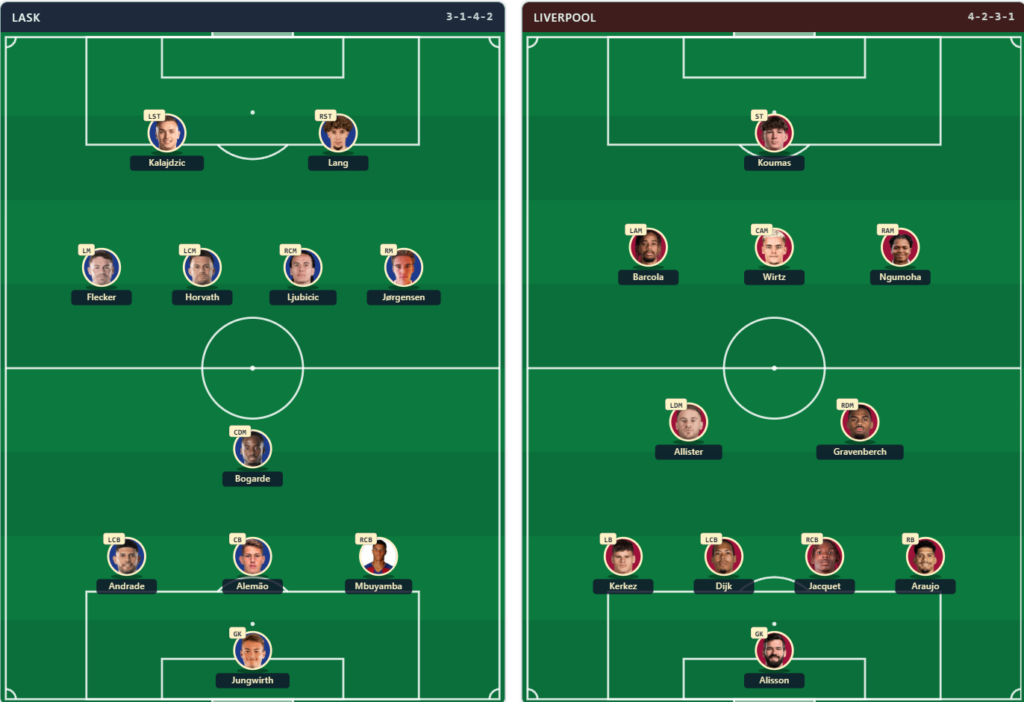
Probable Liverpool Lineup (4-2-3-1): Alisson; Araujo, Jacquet, van Dijk, Kerkez; Gravenberch, Mac Allister; Ngumoha, Wirtz, Barcola; Koumas
Liverpool should retain their established 4-2-3-1 system vs LASK. Alisson Becker starts behind Ronald Araujo, Jeremy Jacquet, Virgil van Dijk and Milos Kerkez, with Alexis Mac Allister and Ryan Gravenberch forming the double pivot in the middle of the park.
Florian Wirtz should operate behind Lewis Koumas, with Bradley Barcola on the left and Rio Ngumoha on the right. Wirtz has already created three key passes and one big chance, giving him the clearest central attacking reference in the predicted side. Koumas is a makeshift lone striker due to the absence of Cody Gakpo (ankle) and Alexander Isak (hamstring).
Beyond the duo, Conor Bradley (knee), Hugo Ekitike (achilles) and Giovanni Leoni (knee) are unavailable, while Federico Chiesa and Wataru Endo are not in the UEFA Champions League squad. Dominik Szoboszlai is doubtful with a thigh problem and hamstring tightness.
The absences remove established attacking and midfield options, so Liverpool’s familiar formation is being used to preserve structure while the individuals within it change. The predicted XI is therefore settled in outline, but not entirely settled in attacking function.
Tactics: Bogarde’s screen against Wirtz is the first control point
LASK’s shape is designed to push the game forward with two strikers, two wide midfielders and a midfield three supporting the back three. Melayro Bogarde’s position is crucial because the formation can become exposed if both central midfielders advance and the wing players remain high.
LASK are expected to carry the game rather than sit back. However, that approach still requires the single pivot to remain close enough to the defenders to prevent one pass from opening the centre. On the other hand, Liverpool’s 4-2-3-1 setup offers a more stable reference.
The Reds should seek the win without turning the fixture into an uncontrolled exchange, especially after the defeat to Manchester City and with an improvised attack. The double pivot gives them cover behind Florian Wirtz, while Bradley Barcola and Rio Ngumoha can stretch the outside centre-backs or force LASK’s wide players to retreat.
Liverpool’s challenge is to create enough threat without relying on a recognised central striker to occupy the back three for long periods. The two systems meet most clearly between Bogarde and Wirtz. Bogarde must screen the space in front of LASK’s defenders, while Wirtz will look to receive between the lines and turn toward the home back three.
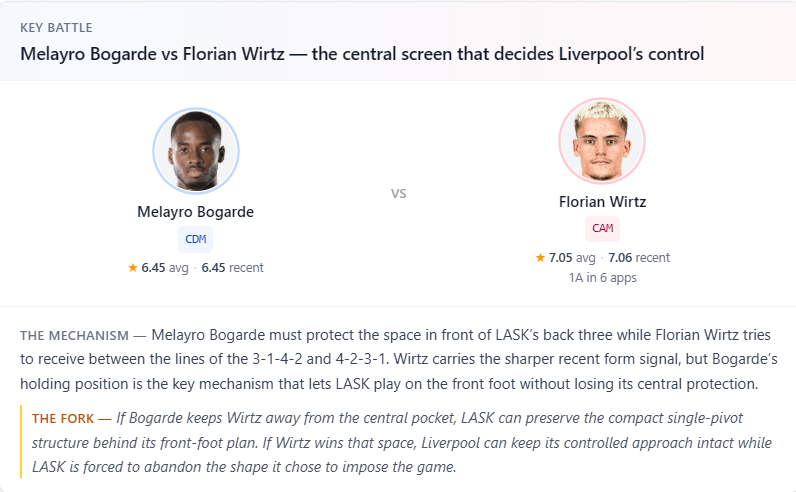
Wirtz has the sharper current attacking signal, having created three key passes and a big chance in his opening appearance. However, Bogarde’s job is not to outplay the German playmaker in possession. It is to deny him the receiving position that allows Liverpool to control the next pass.
If Bogarde keeps Wirtz away from that central pocket, LASK can preserve the compactness of the 3-1-4-2 while still sending its wide players forward. If the Liverpool playmaker wins the space, the Reds can keep their controlled approach intact, and LASK may have to abandon the structure it selected to impose the game.
The consequence is greater because there is no second holding midfielder behind Bogarde; once he is drawn out, the space in front of the back three is directly exposed. The other important question comes at the opposite end. Alemao is expected to hold the centre of LASK’s back three against Lewis Koumas, whose selection reflects Liverpool’s lack of an established available striker.
If Alemeo contains the youngster, LASK can keep their defensive platform and continue to push their outside players forward. If Koumas provides a usable outlet, the home defenders will have to retreat, and Liverpool can manage the match from their settled shape rather than defend repeated forward attacks.
The hosts also need their wide midfielders to turn territorial ambition into sustained pressure. If Jørgensen and whichever player starts on the left can recover quickly, the back three can remain connected to Bogarde and the front two can contest Liverpool’s first pass. If Liverpool bypass that pressure, LASK risk becoming stretched between the front line and the single pivot. That is the system-level route by which the visitors can make their measured game more comfortable.
Prediction: Liverpool have the clearer route to a narrow away win
We predict a Liverpool win, but only with medium confidence. Their settled 4-2-3-1 shape gives them the clearer platform against LASK’s more proactive 3-1-4-2 system, and the central battle should favour the side with the more established way of managing the game.
The best case against Liverpool is LASK disrupting the improvised central attack before the visitors settle. Melayro Bogarde can make Florian Wirtz receive deeper or wider, while Alemao can prevent Lewis Koumas from giving the 4-2-3-1 a reliable forward outlet.
Lean: Liverpool win
Range: 0-1/1-2/1-1
If that happens, LASK’s front-foot approach could pin Liverpool’s full-backs back and turn the home side’s historic occasion into sustained pressure. The visitors’ recent defeat also showed that their defensive structure can be disturbed when the match changes quickly, so Andoni Iraola’s men cannot assume that control will arrive automatically.
The likely scoreline range is narrow: 0-1, 1-2 or 1-1. Liverpool’s season output has also run 0.539 goals above expected, which supports their superior finishing threat, but the missing forwards and the uncertainty around the replacement striker limit the case for a high-margin victory.
LASK’s adjustment is easier to identify once the game changes
The key in-game lever belongs to Dietmar Kuhbauer. If Florian Wirtz repeatedly receives beyond Melayro Bogarde, LASK can move away from the single-pivot structure and add another central body, sacrificing one of the aggressive forward positions to protect the area Liverpool are targeting.
That would reduce the immediate pressure from the 3-1-4-2, but it would give the home side a way to remain competitive without leaving Bogarde isolated in front of the back three. Liverpool’s shape is more settled. Yet, the home side’s ability to make that specific change could decide whether the final phase remains close.