
Leeds United and Newcastle will be eager to return to winning ways in the Premier League when they clash at Elland Road on Monday.
Leeds United’s back-three switch began with a defeat at Manchester City on November 29 last season, yet it became the foundation of a sustained improvement. Newcastle United, by contrast, are still in the early phase of Matthias Jaissle’s reign. Both sides are unbeaten in the Premier League, and they now meet at Elland Road with the same record after three matches.
However, the hosts are leaning on a defensive revamp, while Newcastle are banking on direct attacks to carry a new manager’s ideas. A win would move either club into the European places; a draw would still preserve momentum, so neither side enters a season-defining match at this early stage of the season.
For Leeds, the opportunity is to turn a revived defensive identity into a stronger early position to fuel their lofty ambitions. They are in the mid-table spots, showing the potential for a top-half finish. Their recent league run stretches back beyond this opening phase. They have lost only once in their last 12 matches (W5 D6).
The new campaign has started with three goals scored and two conceded across the first three games, and that balance reflects a side that has become harder to break down without abandoning the route forward. The main question is whether the open left-sided defensive lane can cope if Newcastle’s runners attack it repeatedly.
Meanwhile, Newcastle arrive one place higher, and their result carries a similar reward without the same pressure. Their league form is also similar a one and two draws, although their games have produced a more productive scoring return: six goals for and four against.
That gives Jaissle’s side reason to keep attacking directly, but not to turn the match into an uncontrolled exchange. The selection is settled around his 4-2-3-1 setup, with the uncertainty over Amar Dedic potentially affecting the right-back position rather than the wider plan.
Team News: The absences that reshape both benches
Leeds United will be without Joe Rodon because of a hamstring injury and Mateo Joseph due to a cruciate ligament tear. Rodon’s absence removes a central-defensive option from a back-three system, which helps explain the expected use of Nico Elvedi alongside Tarik Muharemovic and Jaka Bijol. Joseph’s absence reduces the attacking alternatives behind Dominic Calvert-Lewin, making the central striker’s ability to hold the direct outlet especially important.
The expected shape for the home side is a 3-4-2-1, the formation they have used most often recently. James Trafford should retain his spot between the sticks, with Muharemovic, Elvedi, and Bijol forming the central defensive unit. James Justin and Jayden Bogle should provide the width, with Justin expected to keep the left wing-back role and Bogle the right; Bogle has started three times and has also scored once.
The unsettled calls come higher up. Ao Tanaka is expected to fill the left central-midfield position, while Brenden Aaronson should play on the right of the two supporting attackers ahead of Harry Wilson. Noah Okafor will occupy the left-sided attacking slot, though that is is a less secure call.
Calvert-Lewin leads the line as the first-choice starter, with one goal, three shots on target from six attempts and 1.17 expected goals. Trafford, meanwhile, has started every match and owns a 7.26 average rating, giving Leeds a reliable final line behind the settled defence.
Probable Leeds United Lineup (3-4-2-1): Trafford; Bijol, Elvedi, Muharemovic; Bogle, Stach, Tanaka, Justin; Aaronson, Okafor; Calvert-Lewin
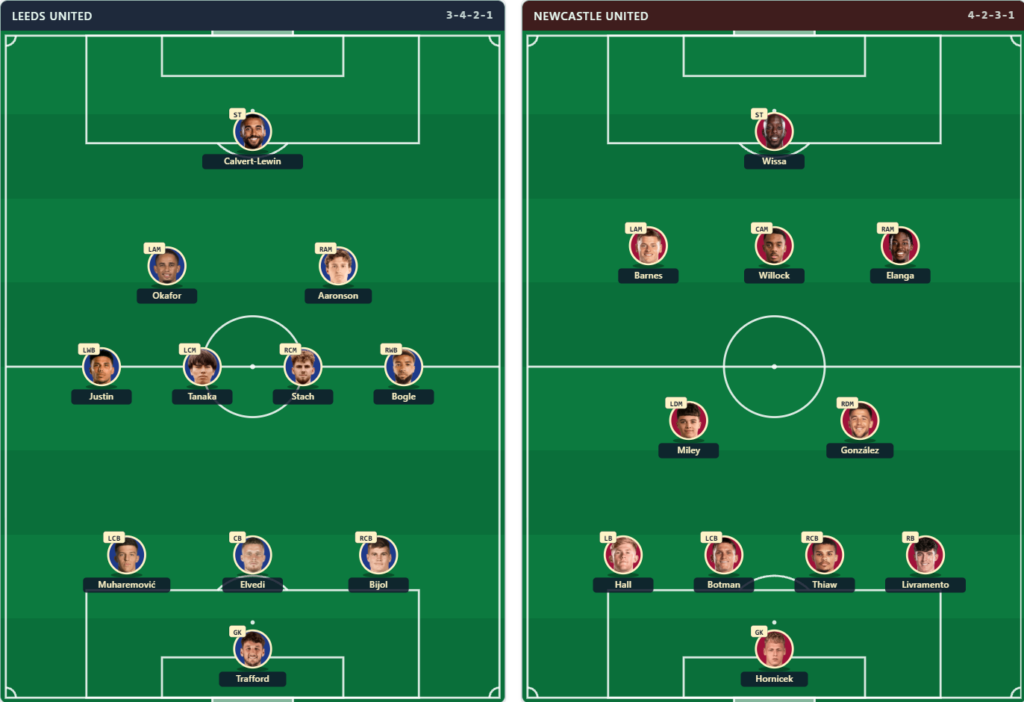
Probable Newcastle United Lineup (4-2-3-1): Hornicek; Livramento, Thiaw, Botman, Hall; Gonzalez, Miley; Elanga, Willock, Barnes; Wissa
Newcastle United have three confirmed absences. Dan Burn is out with an ankle injury, Joelinton is unavailable due to a thigh injury, and William Osula misses out because of a foot injury. Amar Dedic is doubtful after suffering a hamstring problem against Millwall earlier this week. If Dedic cannot play, Valentino Livramento is expected to step into the right-back position.
Livramento has played only 34 minutes without a start this season, so this would be a change in seasonal experience rather than a change to Newcastle’s formation. Lukas Hornicek should start behind a back four of Lewis Hall, Sven Botman, Malick Thiaw, and Livramento. Hall is one of the important progressors from the left wing for the away side; he has started three games, supplied one assist and made four key passes.
Meanwhile, Lewis Miley and Nico Gonzalez should form the two-man base in the middle of the park. Joe Willock is expected to connect the midfield with the attack, and Harvey Barnes and Anthony Elanga should support Yoane Wissa from the flanks. Elanga has scored twice and registered four key passes in his three starts, while Wissa has contributed one goal and one assist.
Tactics: The wide lanes decide whether the shapes hold
Leeds United’s 3-4-2-1 setup is designed to keep three defenders behind the ball while giving Dominic Calvert-Lewin a clear route out of pressure that Newcastle United build. Their measured profile supports that direct approach. The Whites play 57 long balls per match against a league-typical figure of 50.75. Newcastle are also above that benchmark at 52, so neither side has a meaningful advantage in choosing the aerial route.
The difference is what follows the first pass. Leeds want the two attacking midfielders and Stach to gather second balls around Calvert-Lewin, while Newcastle prefer their wide runners moving beyond the first defensive line. The possession figures point in the same direction.
Leeds have had 45% of the ball and Newcastle 42%, either side of the league’s 46% typical figure. Despite the early phase of the season, the figures still describe a fixture unlikely to be controlled through long spells of patient circulation. The home side can use the three centre-backs to protect the space behind advancing wing-backs; Newcastle can accept less of the ball and attack the next space quickly.
Daniel Farke’s men also carry the more notable dead-ball route. They generate 0.43 expected goals from set pieces per match against a league-typical 0.28 figure. Meanwhile, Newcastle’s figure is 0.181 against the same benchmark. That gives the home side a way to threaten without repeatedly passing through Newcastle’s two holding midfielders.
It also creates a problem for the visitors’ controlled approach. Repeated fouls, corners or wide free-kicks could force them into defending the very phase Leeds are best placed to exploit. The first major contest is James Justin against Anthony Elanga.
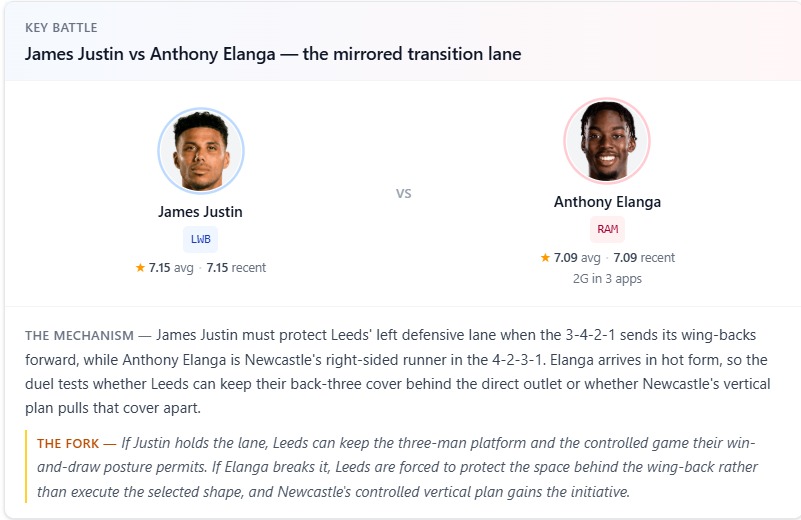
Justin has to defend the left lane when Leeds push the wing-back forward, while Elanga is Newcastle’s most dangerous runner from the matching right-sided channel. The Swede has been in productive form, and his three starts have brought two goals, so Justin’s task is not simply to stop a cross.
He must prevent Elanga from turning the space behind him into the first forward pass of Newcastle’s attack. If Justin holds that lane, Leeds can keep three defenders behind the ball and continue with the controlled game their shape allows. If the Swedish winger breaks it, the hosts will have to protect the area behind the wing-back instead of advancing both sides as planned.
The opposite lane matters just as much to the overall structure. Jayden Bogle meets Harvey Barnes on Leeds United’s right-hand side, and Barnes’s positioning can pin Bogle deep enough to remove one of the home side’s forward outlets.
If Bogle keeps Barnes from fixing the right side of Leeds United’s defence, the home side can retain the extra attacking support of the 3-4-2-1. If Barnes wins the lane, the Whites may need to leave one wing-back back or introduce the extra midfielder offered by the 3-5-2 alternative.
The wider system question sits behind those duels. Newcastle’s direct passes are intended to draw the Leeds wing-backs away before Willock, Barnes, or Elanga attack the spaces around the back three. Leeds, meanwhile, need Calvert-Lewin to make those longer passes stick long enough for Aaronson and Okafor to arrive.
The side that controls the second ball will decide whether this is a measured contest between two stable shapes or a match in which one back three or full-back line is repeatedly dragged out of position.
Prediction: A draw is the narrowest but clearest betting lean
We are leaning towards a draw, albeit with low confidence rather than conviction. Leeds have the stronger recent attacking output, averaging 1.28 expected goals for per match compared with Newcastle’s 0.97.
However, the finishing picture cuts against treating that difference as decisive. The home side’s season expected-goals difference so far is -0.885, while Newcastle’s is 3.033. That split suggests the recent scorelines have not followed the same direction as the underlying chance creation, making a firm home or away call difficult.
Lean: Draw
Range: 1-1/2-2/0-0
The strongest case against the draw is Newcastle’s ability to win the left-to-right transition through Anthony Elanga and Harvey Barnes. If one of those runners forces a Leeds wing-back to retreat, the home side’s three-man defensive platform becomes less useful and Calvert-Lewin can become isolated.
Newcastle’s six-goal recent return also gives them a credible route to winning a match in which they may not dominate possession. The Whites’ answer is set-piece pressure and second-ball control, but if the visitors defend those situations cleanly, the visitors can make their direct plan count. The scoreline range is 1-1, 2-2 or 0-0.
Leeds United have one shape change left if the midfield is lost to Newcastle United
The selection call that could still alter the match is Leeds United’s decision to move from the 3-4-2-1 into a 3-5-2 if Newcastle United’s two-man midfield begins controlling the second ball. That adjustment would add a central midfielder without removing the back-three cover, but it would also reduce the number of advanced connectors around Dominic Calvert-Lewin. It is a practical response available to Farke during the game, whereas the away side’s settled 4-2-3-1 is more naturally equipped to keep its attacking lanes in place.