Four quarter-finals, four very different routes to the FIFA World Cup 2026 semi-finals, with Spain, Argentina, England, and France finding their own way through.
The FIFA World Cup 2026 quarter-finals did not simply decide the final four; they revealed the different ways serious contenders survive when the stakes harden and the margin for error shrinks. Spain found their answer in patience, Argentina in endurance, England in individual force and France in the cold authority of a superstar who bent a brave contest to his will.
There was no single pattern to the weekend, and that was precisely what made it so compelling. Spain controlled and prodded before striking late against Belgium, Argentina stumbled through another uncomfortable knockout evening before eventually seeing off Switzerland in extra time, England leaned again on Jude Bellingham to escape Norway, and France ended Morocco’s run with the sort of ruthless efficiency that marks out a genuine favourite.
That variety matters because tournaments are rarely won with a single idea alone. Sometimes the best side must keep believing in its structure, sometimes it must ride a storm, and sometimes it must accept that an elite player will pull the game towards him and refuse to let it go. Now the semi-finals offer two grand pairings: Spain against France, artistry against power; Argentina against England, a tie weighted with history and star names.
Mikel Merino’s clutch again to down Belgium
Spain went into their clash with Belgium as favourites, and for long spells they looked every inch the side expected to reach the last four. Fabian Ruiz gave them the lead after 30 minutes, Belgium hit back through Charles De Ketelaere before the break, and yet the larger rhythm of play belonged to Luis de la Fuente’s team, who kept creating situations even when the second goal would not come.
Mikel Merino is becoming the decisive figure in Spain’s run, a midfielder who has now decided two knockout rounds. He had already decided the previous knockout match against Portugal, and in their clash with Belgium he came on in the 86th minute before scoring on his second touch two minutes later, punishing Senne Lammens after the substitute goalkeeper spilled Pau Cubarsi’s shot.
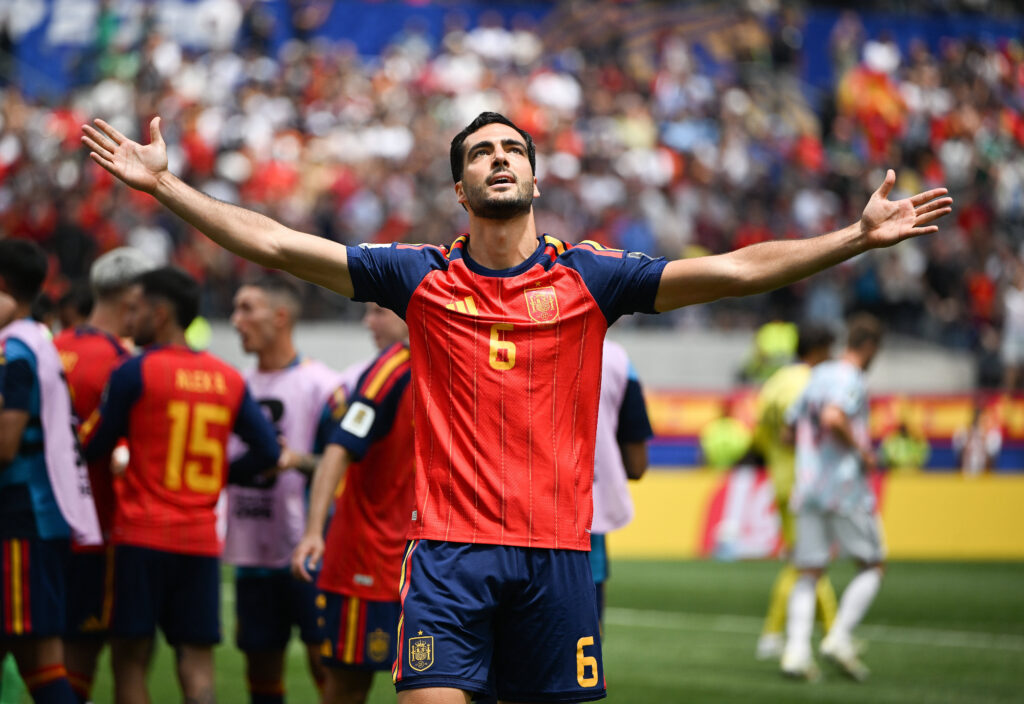
It is unusual for a midfielder to repeatedly arrive as Spain’s answer in their biggest moments, but Merino’s contribution no longer feels accidental. He is turning into the player who senses the loose ball, the broken phase and the unguarded second that matters more than all the earlier beauty, which is why he feels like the unicorn in this polished collective: a player who adds chaos, instinct and finality to a team built largely on control.
That matters for Spain because their clash with Belgium also exposed a small truth beneath the praise. They can dominate, they can move opponents around, and they can still end up needing an elite player to strike in the final minutes, which means Merino is no longer merely a useful option from the bench but a central part of their identity in this competition.
France await next, and Spain will need all of their structure, but they will also need that same timely edge. Merino has effectively dragged them through two knockout rounds with late interventions, and that makes him impossible to ignore as this tournament narrows towards its defining week.
Argentina escape a tricky Swiss test
Argentina have reached the semi-finals, but they have not done so in the serene manner normally associated with champions. Their 3-1 extra-time win over Switzerland looks convincing on paper, yet the match itself was far messier, far tighter, and far more revealing than the final score suggests. The Swiss mounted a genuine threat from which Argentina had to salvage their progress.
They began well enough, scoring through Alexis Mac Allister in the 10th minute from a Lionel Messi corner, but the control did not last. Switzerland stayed patient, stayed organised and were rewarded when Dan Ndoye equalised in the 67th minute, at a stage when the Swiss increasingly looked the team more likely to land the next telling blow.
The contest then turned on an extraordinary moment. Breel Embolo was sent off in the 72nd minute after a VAR review judged that he had simulated contact, with the initial booking shown to Leandro Paredes transferred to the Swiss forward under the mistaken identity protocol, and that dismissal altered both the flow of the match and the emotional temperature around it.
From there, Argentina regained a grip they had seemed in danger of losing. The Swiss resisted until Julian Alvarez’s long-range strike at 112 minutes ended the tie; Lautaro Martinez added a late third that flattered the final scoreline more than the match deserved.
This is the central tension of Argentina’s semi-final run: dangerous and experienced enough to find decisive moments, yet vulnerable for stretches that should have undone them. Credit must go to Murat Yakin’s men, as they nearly pulled off an upset. Yet tournament football is not a beauty contest. Argentina are through, and there is something ominous in a side that can underwhelm, survive controversy, absorb discomfort and still arrive in the last four with their most feared forwards producing when it matters most.
Jude Bellingham shaping his legacy for England
England’s quarter-final against Norway felt like a match waiting for a single dominant personality. Norway had already shown their quality by reaching this stage, Andreas Schjelderup put the Vikings ahead in the 36th minute, and the contest remained balanced enough to suggest that England might be heading for one of those nights when structure and possession count for little unless somebody takes the game by the collar.
That somebody was Jude Bellingham, again. He equalised in first-half stoppage time and then scored the winner in the third minute of extra time, carrying England into the semi-finals with a brace that once more underlined how often their biggest moments are beginning to flow through him.
The scale of that achievement is historic as well as dramatic. Bellingham became the first player since Diego Maradona in 1986 to score two or more goals in consecutive knockout-stage appearances at the same World Cup, following his brace against Mexico with another against Norway.
Credit must go to Norway’s midfield control and Martin Odegaard’s composure. The game was cagey, intelligent and often shaped by Norway’s midfield control, with the skipper central to their belief and calm, but Bellingham supplied the one commodity that England possessed in greater supply than their opponents: game-breaking individuality.
That is why England remain both encouraging and slightly uncertain at the same time. Their route has not always been smooth and their football has not always been complete, but in knockout football an all-round midfielder with timing, power and nerve can cover many flaws, and Bellingham is doing exactly that.
Argentina next should test England in a very different way, yet this quarter-final confirmed the essential truth of their tournament. When the game becomes cramped and nervous, England trust Bellingham to find the decisive action, and so far he has justified every bit of that faith.
France break Moroccan hearts
Of the four quarter-finals, France against Morocco may have carried the clearest emotional divide. The Atlas Lions came in with belief, poise and the burden of fitness concerns around important players, and that gave the evening a sense of possibility as much as jeopardy, but they were also facing their sternest examination of the tournament against one of the strongest squads left in the field.
For an hour they held the line. Then the Kylian Mbappe problem took over, and once it did the mood shifted quickly and completely. The skipper broke the deadlock in the 60th minute for his eighth goal of the tournament, moving level with Lionel Messi in the Golden Boot race, and six minutes later he created the second goal for Ousmane Dembele to settle the contest at 2-0.
That sequence explained France in miniature. They do not always need long spells of flourish; they need an elite forward to disturb the geometry of a defence, and once Mbappe does that, the rest of the side can strike with brutal speed.
There is room, too, to feel for Morocco. Their run had been built on courage and composure, and even in defeat there was no collapse of spirit, only the recognition that they had met a team with more top-end firepower and a player capable of turning a proud tie into a clinical French victory.
France’s reward is a semi-final against Spain, and on the evidence of this quarter-final they will enter it with every reason to believe they can go all the way. Morocco brought heart and resistance, but France brought the sharper truth of tournament football: when the biggest names play like the biggest names, even the bravest story can come to an end.