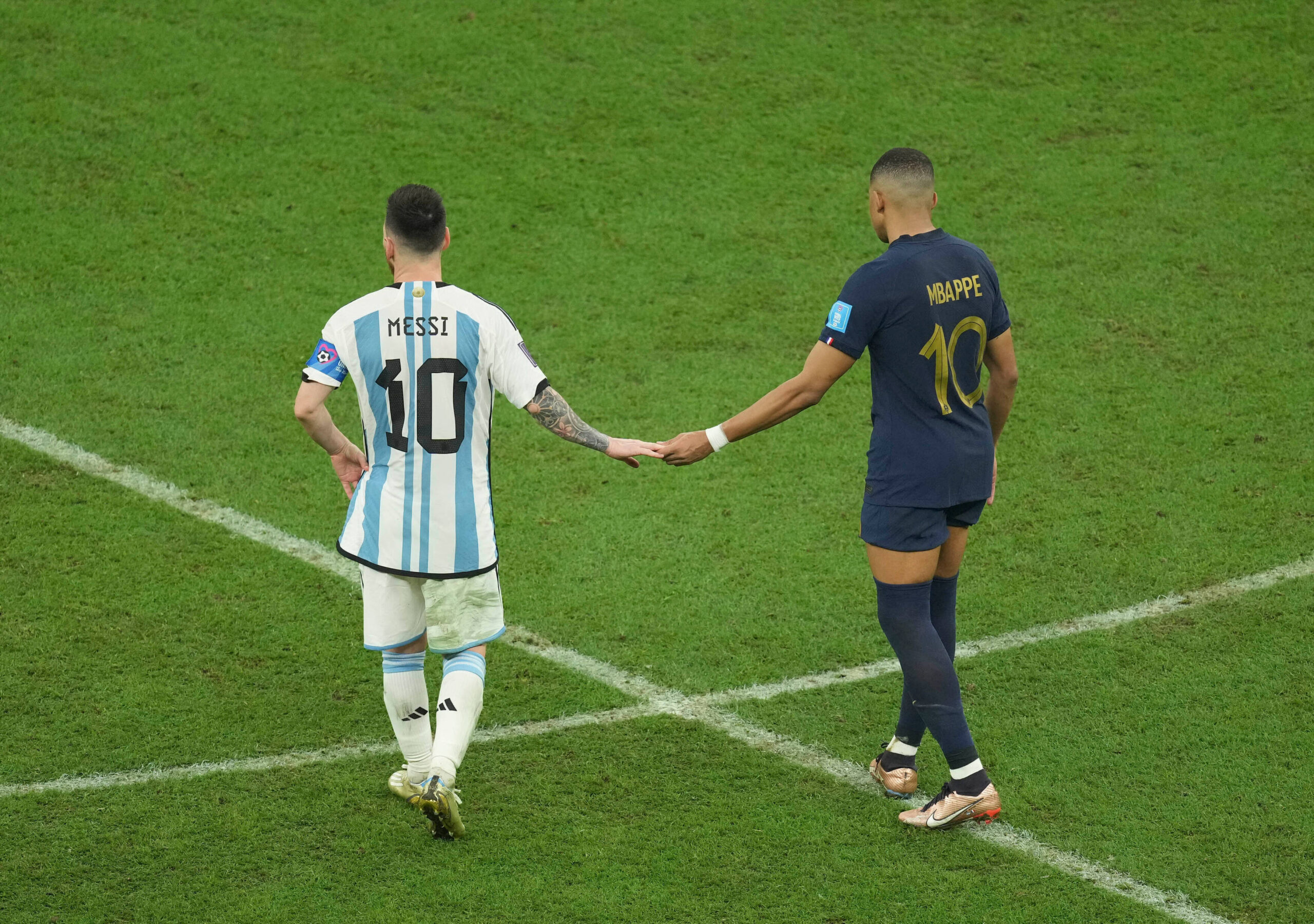
Lionel Messi, Kylian Mbappe, Erling Haaland, and Harry Kane have been part of a FIFA World Cup Golden Boot race for the ages.
Lionel Messi, Kylian Mbappe, and Erling Haaland have turned the 2026 FIFA World Cup Golden Boot race into something the competition has never seen before: three different players locked on seven goals each, all still alive in the tournament and all rewriting records as they go.
Harry Kane has now joined them as a very real fourth contender, with six goals and an assist and a knockout route that keeps him firmly in the conversation.
A Golden Boot race like no other
The World Cup has witnessed great individual scoring feats before, from Just Fontaine’s 13 in 1958 to the more recent heroics of Ronaldo and Miroslav Klose, but 2026 has broken new ground.
For the first time in the competition’s history, three players have reached seven or more goals in a single edition, with Messi, Mbappe and Haaland sharing top spot on seven strikes apiece as the knockout rounds intensify.
What makes this race even more remarkable is that all three are doing it in different contexts. Mbappe is the spearhead of a stacked France side that functions like a chance‑creating machine. Haaland is carrying Norway, a nation without the same tradition or depth on the biggest stage, into uncharted territory.
Messi, at 39, remains Argentina’s main source of attacking inspiration and end product, demanding the ball and deciding matches in a way that very few players have ever done at this age.
Kane’s presence adds a fourth dimension. As England’s captain, he is not level with the leading trio, but six goals and an assist mean he is close enough that one explosive performance could drag him right into the heart of the battle.
Between them, these four forwards represent different football cultures, different tactical systems and different ways of scoring goals, which is why this Golden Boot race feels less like a simple tally and more like a clash of ideas.
The Golden Boot is designed to be simple: the player with the most goals wins. When multiple players tie, assists and minutes played come into play, adding extra layers to an already complex race. With Messi, Mbappe and Haaland currently locked on seven, and Kane just behind on six, every touch, every chance and every tactical decision in the remaining matches will matter.
Kylian Mbappe: the favourite on paper
On the surface, Mbappe is the logical favourite. The French forward has seven goals and two assists in five outings, a combined contribution that currently places him at the top of the Golden Boot standings thanks to those extra assists.
He leads an attack that has been relentless throughout the tournament, with France recording one of the highest shot totals and one of the strongest expected goals figures so far, underlining how often Mbappe and his team-mates find themselves in dangerous areas.
This is not just a hot streak at one tournament. Mbappe’s World Cup goal tally has already climbed to the high teens, leaving him second only to Messi in the all‑time charts and underlining his consistency across multiple editions.
He has already shown he can dominate knockout matches, as he did in the 2022 final with a hat‑trick, and France’s structure seems tailor-made to keep him supplied: wide runners, progressive passing from midfield and full-backs willing to overlap and stretch defences as he drifts into central positions.
Yet there are caveats. Mbappe has already played his fifth match with France’s round of 16 tie in the books, whereas Messi is yet to take the field for his own fifth game. France also face a sizeable test in the quarter‑finals against Morocco, whose defensive resilience has already frustrated big nations, and any semi‑final against Belgium, the USA, Spain or Portugal promises tighter games and fewer open chances.
Mbappe has the team and the pedigree, but the road ahead looks demanding and filled with defences that will plan first and foremost to limit his influence.
Erling Haaland: efficiency against the odds
If Mbappe enjoys a wealth of support around him, Haaland’s situation could hardly be more different. Norway do not have the star‑studded squad of France or Argentina, and they do not create the same volume of chances for their centre-forward.
Despite that, Haaland has still racked up seven goals in five outings, matching Messi and Mbappe shot for shot and dragging his country into the quarter‑finals of a World Cup for the first time.
The numbers behind his run underline just how ruthless he has been. Haaland has now scored in 14 straight games for Norway, a staggering streak in which he has netted 27 goals, almost two per match for his country.
In this tournament alone, his output continues a pattern that has seen him score 30 goals in 17 competitive games for Norway, and his performance against Brazil in the round of 16 will live long in Norwegian football history: 30 touches, only four of them inside the box, four shots, three on target and two goals, enough to send the five‑time champions home.
That match showed his unique efficiency. Haaland does not need a steady stream of chances; he thrives on half‑openings, quick transitions and direct service, and he is capable of making limited service count.
He already has as many goals at this World Cup as Norway had in their entire history at the tournament before this year, underlining both his individual quality and the scale of his impact on a relatively modest football nation.
However, the road ahead is daunting. An England side that has wobbled but still boasts high‑level defenders awaits in the quarter‑finals, and a potential semi‑final against Argentina could pit him directly against Messi in a match where Norway may again be forced to absorb pressure rather than generate it.
For a Golden Boot bid, that lack of sustained attacking dominance from his team is a concern. Haaland might not get the six or seven big chances that Mbappe or Messi can expect on their best days, and while his efficiency is extraordinary, the margin for error is slimmer.
One off day, one game where Norway are pinned back, and he sees little of the ball, could be enough to tilt the race away from him.
Harry Kane: England’s ever‑present threat
The fourth major name in this race is Harry Kane, and it would be a mistake to treat him as merely a supporting character. The England captain has six goals and an assist to his name, a return that keeps him within touching distance of the three frontrunners and ensures that any slip from Messi, Mbappe or Haaland could see him surge to the top of the standings.
Kane has already delivered when England have needed him most, scoring crucial goals and acting as the focal point for an attack that often looks to him both to finish moves and to link play around the box.
Like Mbappe and Messi, Kane brings previous Golden Boot pedigree into this tournament. He finished as top scorer at the 2018 World Cup with six goals and arrived in 2026 once again among the favourites to claim the award.
His blend of penalty‑box presence, calm finishing from the spot and ability to drop into pockets to knit England’s attacks together means he can affect games in different ways; he does not rely solely on pace in behind or crosses from wide areas, which is valuable in tighter knockout fixtures where space is at a premium.
Crucially, Kane’s route also keeps him firmly in the conversation. England face Norway in the quarter‑finals, a tie that not only pits him directly against Haaland but also offers him a realistic chance to add to his tally against a defence that will be tested by England’s movement and width.
Should Thomas Tuchel’s side progress, a potential semi‑final against Argentina would hand Kane another high‑profile stage on which to score, and given his record of delivering in pressure situations, it is difficult to rule him out from finding the net even against a team of that calibre.
If he picks up one or two more goals while the leading trio cancel each other out in their own heavyweight clashes, Kane could yet transform this four‑way battle.
Lionel Messi: records, route, and rhythm
Then there is Messi. He has seven goals in four outings and is the oldest of the quartet at 39, yet he remains Argentina’s principal attacking outlet, creator and finisher rolled into one. When Argentina need someone to take responsibility, he still steps into the spotlight, dropping deep to link play and then arriving in the right spaces to finish moves.
Statistically, Messi’s campaign is staggering. Argentina currently have one of the best expected goals figures at the tournament, highlighting that while they may not shoot quite as often as France, they still generate a steady stream of high‑quality chances.
Messi has 20 World Cup goals, more than any other player in history, and he has now amassed 12 goal contributions in knockout stages alone, six goals and six assists, surpassing some of the game’s greatest names for the most recorded over the past six decades.
On top of that, he became the first player ever to score in eight consecutive World Cup appearances, showing that this is not a short‑term surge but a sustained level of excellence. Perhaps the most intriguing factor is his route. Unlike Mbappe and Haaland, Messi has played four games rather than five, meaning he has reached seven goals with one fewer outing and still has his round of 16 tie to come.
Argentina face Egypt in the last 16, a match in which they will be heavy favourites. A potential quarter‑final against Switzerland or Colombia follows, and then a semi‑final that could feature Norway or England.
It is not an easy path, but compared to France’s possible sequence of Morocco and then one of Belgium, the USA, Spain or Portugal, and Norway’s immediate meeting with England followed by a likely clash with Argentina, it looks manageable.
The softer edges of this route matter for a Golden Boot race. In games where Argentina are expected to have more of the ball and play on the front foot, chances for Messi should be plentiful.
He has already shown in this tournament that, given the space and time to dictate play, he can create and score almost at will, and his understanding with Argentina’s forwards and attacking midfielders means he is often at the heart of every move, either providing the final pass or taking the shot himself.
Why Messi is still best placed to finish top
Taking all this into account, the numbers, the context, the routes and the form, there is a clear case for Messi being the most likely Golden Boot winner, even in a field this crowded.
First, he has achieved parity in goals with Mbappe and Haaland in fewer minutes. Seven goals in four games is the most explosive return of the trio, and he still has a round of 16 fixture to play when the others have already contested theirs.
That gives him an extra opportunity to pull ahead without needing to rely on assist tiebreakers or goals‑per‑minute calculations. Second, his path through the tournament appears slightly more forgiving than those of his rivals.
France’s quarter‑final against Morocco will test Mbappe against one of the best organised defences in the competition, and any semi‑final against Belgium, Spain, Portugal or a rising USA side promises to be intense and tactically tight.
Norway, with Haaland at the tip of their attack, face England in the quarters and then most likely Argentina, meaning the Norwegian striker could spend long spells tracking back or waiting for counters in matches where his side are pushed deep. England and Kane must first solve Haaland and Norway before potentially meeting Messi and Argentina, packing two huge defensive challenges into successive games.
Third, Messi’s current level is close to flawless. At 39, he is still competing with players much younger than him and producing decisive moments almost every time he steps on the pitch.
The record‑breaking numbers- 20 World Cup goals, 12 knockout contributions and eight consecutive appearances with a goal are not just milestones; they reflect a player whose decision‑making, movement and technique remain at an elite level even as others begin to slow down.
Finally, the intangible element plays in his favour. This World Cup has already become, in many eyes, a showcase of Messi’s final act on the biggest stage, with every goal and assist adding to a legacy that may never be matched.
In the pressure moments, when Argentina need someone to settle the nerves and find a way through, he still feels like the most reliable option. Mbappe, Haaland and Kane are extraordinary, but they rely more heavily on their sides maintaining a certain attacking rhythm. Messi, by contrast, can create his own rhythm.
With three players locked on seven and Kane one goal behind, the margins are thin, and a single brace or a quiet night could swing the race decisively. Even so, looking at the fixtures, the underlying numbers and the form, the sensible prediction remains that Lionel Messi will emerge from this historic four‑way battle with the Golden Boot in his hands, and quite possibly another World Cup trophy in the other.