
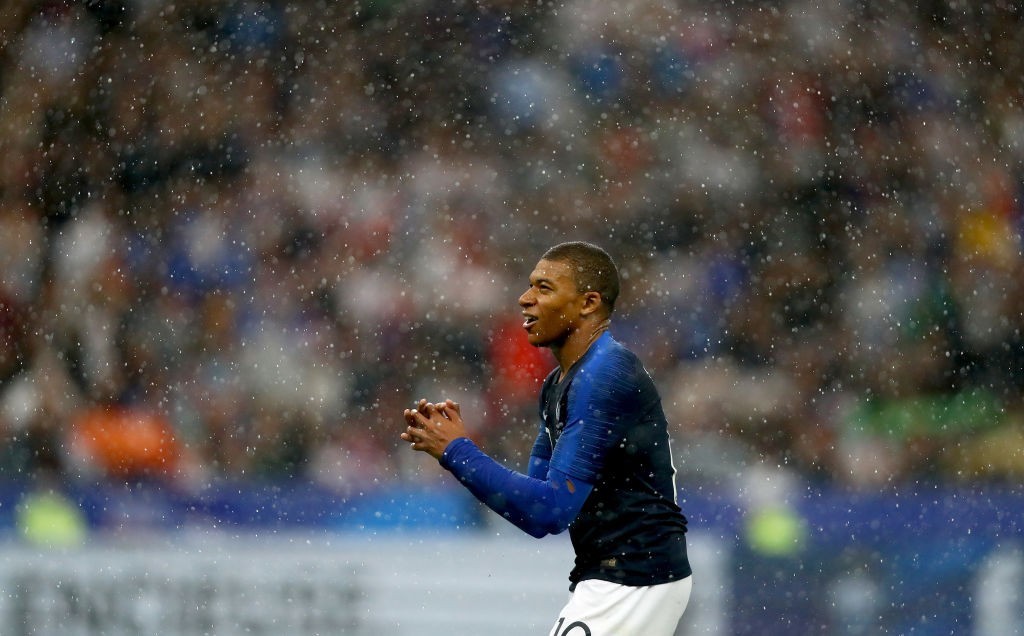
France head to the 2026 World Cup as familiar contenders, with Didier Deschamps’s tested structure, Kylian Mbappe’s firepower, and a squad built for another deep run.
France arrive at the 2026 FIFA World Cup carrying the weight of expectation that only elite teams know. They have already lifted the trophy twice, in 1998 and 2018, and they have also fallen at the final hurdle on two other occasions, in 2006 and 2022. Just as importantly, Les Bleus have turned World Cup consistency into a habit, remaining a fixed presence on the grand stage through the modern era and reaching the final in two of the last three editions.
That history matters because France no longer enter tournaments as outsiders hoping for a fairytale. They are one of the few teams that can speak with genuine authority about knockout football, tournament pressure and the art of surviving difficult moments. Their recent record also gives them a different kind of status: not merely a talented side, but a side that is expected to stay in the conversation until the last week of the competition.
The 2026 cycle adds another layer to that expectation. This is a France team that has already spent years learning how to win matches in different ways, whether by controlling games, resisting pressure or striking ruthlessly in transition. Didier Deschamps has been central to that evolution, and the World Cup will once again ask whether his blend of structure and freedom can carry France beyond the semifinal line and perhaps all the way to another final.
What makes France especially compelling is that they can drift through long stretches without ever truly losing control, the mark of a top international side. France have lived in that space for a decade, and Deschamps has built a system that suits it perfectly.
Road to the World Cup
On paper, France’s qualifying campaign was not dramatic. In practice, it was almost clinical. They finished top of their group with 16 points from six matches, taking five wins and one draw, and ending with a goal difference of +12. That was not the kind of qualification campaign that produces headlines for flair or chaos, but it did underline the same basic truth: France were simply too strong for the rest of the group.
The raw numbers are tidy, but the underlying picture is even more reassuring for Deschamps. France conceded very few chances, and among the leading European performers they ranked third-lowest for goals conceded, which says a lot about the reliability of their defensive base. A qualifying campaign can be misleading when a heavyweight side is involved, yet in France’s case the dominance was never really in doubt. They were favourites from the outset, and they played like it.
That is also why the campaign should be judged in the context of Deschamps’ longer reign. France have rarely looked reckless under him, but they have almost always looked hard to beat. Even when the performance level is not spectacular, the team tends to remain well-organised, compact and emotionally stable, which is exactly what a long international tournament demands. It was a steady campaign rather than a flashy one, but for France that steadiness is a major asset rather than a concern.
Deschamps’ Blueprint: Utilising his best talents
Deschamps has evolved France over many years, and that evolution has not been linear. Early on, his teams were often associated with caution, discipline and transition football, but he has gradually shaped a more flexible side that can defend deep, press aggressively or build through possession depending on the opponent. The key has been adaptation without losing the team’s core identity, which has remained rooted in control, athleticism and fast attacking moments.
The tactical model that emerged most clearly in the 2022 World Cup still offers the best clue to what France may do in 2026. France were willing to sit in a compact shape without the ball, but once they won it back they could attack in a flash, with Kylian Mbappe positioned to exploit space immediately. FIFA’s analysis of that “rest attack” structure made the point clearly: France organised their counter-attacking threat before they even regained possession, using Mbappe’s high, wide positioning as a permanent outlet.
That idea remains central to their identity, even if the team has become a little more possession-friendly around it. France are not a pure possession side, but they are more comfortable circulating the ball than they were earlier in Deschamps’ reign. The team can now build patiently when needed, yet the real danger still comes when the ball is won back and Mbappe, Dembele or another runner can attack space before the defence is set.
Deschamps’ elite international record strengthens the argument that France should be trusted. He has guided the team to three major tournament finals in an eight-year span — Euro 2016, World Cup 2018 and World Cup 2022 — and his tournament management has repeatedly stood up under pressure. France are not just a talented squad; they are a tournament machine, and that is usually the result of a manager who knows how to control the rhythm of a summer competition.
Squad Shape: Kylian Mbappe headlines the selection
France’s squad is built around a familiar spine, with depth in almost every area and enough attacking quality to hurt opponents in multiple ways. Mbappe remains the headline name, but Deschamps has also retained a strong supporting cast that includes Ousmane Dembele, Antoine Griezmann, Aurelien Tchouameni, William Saliba, Theo Hernandez and N’Golo Kante, giving the side both variety and balance.
The selection confirms what Deschamps has learned over a decade: France can shift between a 4-2-3-1 and a more fluid shape without losing backbone.
France’s Full 26-Man Squad:
Goalkeepers: Mike Maignan (AC Milan), Robin Risser (RC Lens), Brice Samba (Stade Rennes)
Defenders: Lucas Digne (Aston Villa), Malo Gusto (Chelsea), Lucas Hernandez (PSG), Theo Hernandez (Al-Hilal), Ibrahima Konate (Liverpool), Maxence Lacroix (Crystal Palace), Jules Kounde (Barcelona), William Saliba (Arsenal), Dayot Upamecano (Bayern Munich)
Midfielders: N’Golo Kante (Fenerbahce), Manu Kone (AS Roma), Adrien Rabiot (AC Milan), Aurelien Tchouameni (Real Madrid), Warren Zaire-Emery (PSG)
Forwards: Maghnes Akliouche (Monaco), Bradley Barcola (PSG), Rayan Cherki (Manchester City), Ousmane Dembele (PSG), Desire Doue (PSG), Michael Olise (Bayern Munich), Kylian Mbappe (Real Madrid), Jean-Philippe Mateta (Crystal Palace), Marcus Thuram (Inter Milan)
Mbappe is still the player around whom everything else revolves, even when France are not dominating the ball. The rest of the squad matters because it supports his strengths: quick transitions, direct running, and the ability to create disorder in a defence that thought it was safe. Around him, Deschamps has enough tools to build a side that is both practical and dangerous.
Key Players
Kylian Mbappe
Mbappe remains France’s most decisive player because he changes the opposition’s behaviour before the match even starts. FIFA’s tactical analysis of France at the 2022 World Cup highlighted how his high, wide positioning created a built-in counter-attacking threat and forced opponents into tactical compromises. He scored eight goals at that tournament and finished as the Golden Boot winner, which only reinforced his status as France’s most important attacking reference point.
However, the 28-year-old carries the weight of a major tournament. So, if he is not fully sharp, the entire attacking structure loses some of its menace, since France are built to maximise his explosiveness rather than to replace it.
Ousmane Dembele
Dembele offers France a different kind of threat, one that is more unpredictable but just as valuable. His ability to attack inside from the flank, carry the ball at speed and create separation in tight spaces gives Deschamps another player who can break a settled defence. In a team that sometimes relies on Mbappe for directness, Dembele provides the kind of imbalance that can make France harder to read.
The concern is consistency. Dembele has often been brilliant in bursts rather than across long stretches, and France do not always need brilliance in flashes as much as they need reliability in big moments. He can tilt a match with one good sequence, but his overall value will depend on whether he can produce that influence without drifting in and out of games.
William Saliba
Saliba is important because France need defensive authority against the best attacks in the finals. He reads danger early, handles space well and has the physical profile to survive a wide range of knockout-stage opponents. In a tournament where small errors are punished brutally, having a defender who can stay calm under pressure is a major asset.
The issue is that his starting place is not entirely secure, which makes him a fascinating but slightly vulnerable pick. France have other centre-backs who can push for minutes, and Deschamps has never hesitated to rotate when he feels a tactical match-up demands it. Saliba may be excellent, but he still has to win his place every time the lineup is chosen.
N’Golo Kante
Kante remains one of the most trusted names in French football because of what he brings beyond pure technique. He gives the midfield bite, defensive coverage and a sense of security that allows the more creative players to operate with freedom. Even after years away from the top five European leagues, his experience and reading of the game still make him relevant in tournament football.
The downside is obvious: age and rhythm. He is no longer at the peak of his physical powers, and the lack of regular exposure to elite weekly competition makes him a riskier selection than he once was. France will value what he knows, but there is always a question over whether he can still deliver it at full tournament speed.
Notable Absentees
The omissions also tell a story about the depth of French football. Eduardo Camavinga is the biggest surprise because of his quality and versatility, while Randal Kolo Muani’s absence removes another direct attacking option. Lucas Chevalier is another notable name not to make the cut, and Florian Thauvin and Esteban Lepaul add to the list of players whose exclusion underlines just how crowded France’s pool is.
Eduardo Camavinga: Camavinga’s omission is the one that will draw the most attention, because he offers France rare versatility and balance in midfield. He can help with ball progression, recovery work and tactical flexibility, which makes his absence feel more notable than most.
Randal Kolo Muani: Kolo Muani misses out despite bringing pace, direct running and the ability to stretch defences. In a squad already packed with attacking talent, that profile can still be edged out by players who are more settled in Deschamps’ plans.
Lucas Chevalier: Chevalier’s absence is a reminder of how difficult it is for young goalkeepers to force their way into a major tournament squad. He has promise and long-term potential, but France have clearly leaned toward more established options for the World Cup.
Florian Thauvin: Thauvin remains a technically neat attacking option, but his omission reflects France’s abundance of more explosive wide players. He can still contribute in the final third, yet the squad’s direction has moved toward greater pace and intensity.
Esteban Lepaul: Lepaul is the least expected name in this group, but his exclusion underlines the sheer depth France possess. Even players with good domestic form can be squeezed out when the team is selecting from such a crowded attacking pool.
Fixtures: France’s Group I Challenge
France’s group-stage schedule gives them a balanced but demanding start. Their three fixtures will be crucial not because they are expected to struggle, but because Deschamps will want to establish rhythm before the knockout rounds begin. The matches should also help France sharpen the exact habits they will need later: patience, quick transition and control without overcommitting.
France’s World Cup 2026 Schedule So Far:
- June 17, 2026: France vs Senegal at MetLife Stadium, New Jersey/New York
- June 23, 2026: France vs Iraq at Lincoln Financial Field, Philadelphia
- June 27, 2026: Norway vs France at Gillette Stadium, Massachusetts
Prediction: A semi-finals run awaits
France should be judged as semifinal material at the very least. Their squad depth, Deschamps’ tournament record and Mbappe’s match-winning ability make them one of the safest bets in the competition to reach the final four. Beyond that, much will depend on the draw and on how efficiently they manage the small tactical margins that define a World Cup knockout tie.
A third straight World Cup final is not impossible, and it may even feel natural if the draw opens up. Still, the cleaner prediction is that France should go deep and, at minimum, reach the semifinals again. In a tournament built on moments, France remain one of the teams most capable of creating their own.