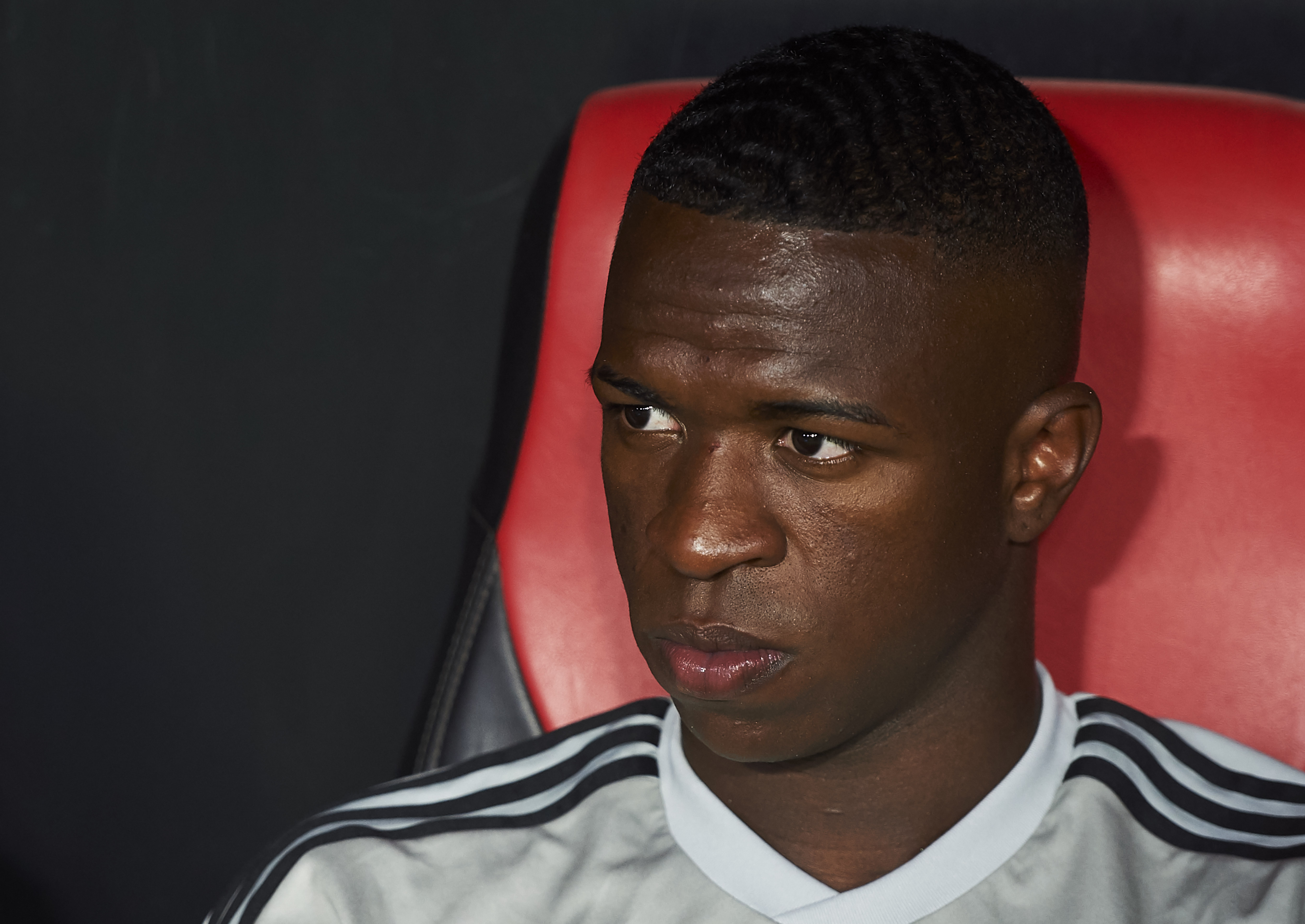
Real Madrid may have quietly stitched together a three‑game winning run, but the loudest noise around the club right now is not about results but about Vinicius Junior.
Real Madrid have responded well on the pitch after their recent wobble, winning each of their last three games across competitions to steady their ship under Xabi Alonso. Yet, instead of calm, the Bernabeu is dealing with another off‑field storm centred on its Brazilian star, Vinicius Junior.
The flashpoint came in the 2-0 win over Sevilla, when the winger was substituted and loudly booed by sections of the home crowd for what they saw as another underwhelming performance from a player who narrowly missed out on the 2024 Ballon d’Or.
His reaction? Changing his Instagram profile picture to one of him playing for Brazil and posting a cryptic caption alongside his post‑match photos, which has only fuelled the sense that this is no longer just a bad mood, but a deeper fracture.
The Espanyol flashpoint: first warning
This was not an isolated outburst. The first major incident came back in September, during Real Madrid’s 2-0 La Liga win over Espanyol at the Bernabeu. Vinicius Junior, taken off in the 77th minute with Real Madrid cruising, reacted by throwing a water bottle to the ground, raising his arms in frustration and then engaging in a tense touchline discussion with Alonso.
Xabi Alonso tried to lower the temperature in his post‑match comments, calling the reaction “normal” for a player desperate to stay on and pointing out that young midfielder Franco Mastantuono had also gone off angry at the same time.
The Real MAdrid insisted he was happy with Vinicius’s performance and framed the decision as a simple rotation in a demanding calendar, an attempt to move on quickly from what looked then like a one‑off flash of temper.
Vinicius Junior at El Clasico: “I’m leaving the team”
If Espanyol felt like a warning shot, the second big incident – in El Clasico at the end of October – was the moment the alarm bells truly started ringing. In a high‑stakes game that Real Madrid eventually won 2-1 against Barcelona, Xabi Alonso decided to substitute Vinicius Junior in the 72nd minute.
Television cameras caught the Brazilian’s reaction: “Coach! Me? Coach! Me? Always me, always me,” he shouted towards the bench, clearly stunned to see his number on the board. Alonso tried to push him through the moment – “Come on, Vini, damn it” – but the damage was done.
As he walked off, Vinicius Junior shook hands with Rodrygo and muttered the line that really shook Real Madrid’s dressing room and fanbase: “I’m leaving the team, better, I’m leaving.” He then went straight to the dressing room before later returning to the bench, but by then the clip was all over social media and discussion shows.
Reports quickly emerged that contract talks, already paused, had made no progress and that he had no intention of recommitting as things stood. With his current deal running to 2027, that timeline immediately sharpened the picture – 2026 became the natural “sell or risk losing him for free later” crossroads.
The Sevilla boos and social media message
Just as the noise seemed to be fading, the game against Sevilla brought a fresh explosion. In many ways, the context matters here. This is a player who has been one of Real Madrid’s offensive leaders over the last few seasons, posting double‑figure goals and assists across competitions and helping deliver both domestic and European titles.
In 2023/24, he was prolific enough to finish among the Ballon d’Or frontrunners; missing out on the prestigious award by a tiny margin only raised expectations further. This season, though, his numbers have taken a dip, and his performances have lacked the sharpness and end product that made him so terrifying in transition at his peak.
At a club where even Cristiano Ronaldo was booed at times for perceived dips in form, the Bernabeu turning on Vinicius Junior after another flat outing against Sevilla should not have shocked him. But instead of shrugging it off, he headed for Instagram.
Changing his profile picture to one with the Brazilian jersey and posting a caption that many fans read as a dig at the club and its supporters felt less like frustration in the heat of battle and more like a calculated message. In modern football, social media gestures from stars carry as much weight as any interview; this one was interpreted as Vinicius reminding everyone where he feels most loved, and perhaps hinting that he is already looking beyond Madrid.
Performance, behaviour and the 2026 question
At a club like Real Madrid, the equation is brutally simple: exceptional performances buy patience with difficult behaviour; average performances do not. When a forward is winning games every week, tantrums are filed under “competitive edge”. When the output dries up, the same reactions suddenly look like self‑absorbed drama.
The numbers emphasise this shift. In his peak seasons, Vinicius Junior regularly cleared 20 goals in all competitions and pushed towards double figures in assists, ranking among Real Madrid’s top contributors.
In the current campaign, he is trending notably below those standards, both in raw goals and in key attacking metrics such as shots on target and successful dribbles per 90 minutes. For a club that now also has Kylian Mbappe and Jude Bellingham as attacking reference points, patience for a misfiring, agitated winger is always going to be limited.
His behaviour also has a ripple effect beyond his own role. Every substitution debate, every angry gesture, every cryptic post becomes a talking point that drags the focus away from the collective. For a relatively young dressing room trying to adjust to a new cycle under Xabi Alonso, the presence of a senior star who feels persecuted or underappreciated can quickly turn from an asset to a problem.
With his contract running until 2027 and negotiations reportedly stalled, Real Madrid’s board will not ignore the calendar. If there is no sign of a renewal by the end of the season, a 2026 sale becomes the logical business decision. That is especially true when his market value is still high thanks to his age, profile and previous output, even if his current form is uneven.
What Vinicius Junior must learn from Ronaldo
There is also a cultural side to this story, one deeply rooted in the Bernabeu itself. This is a stadium where Cristiano Ronaldo, a club legend who produced video‑game numbers season after season, still got whistled when standards slipped, or when the crowd felt he was too individualistic.
The message has always been clear: no player, no matter how talented, is bigger than Real Madrid. Vinicius Junior has often spoken about Ronaldo as an idol, someone he has tried to study and emulate. Yet the Brazilian’s recent reactions have been the opposite of what made Ronaldo ultimately loved in Madrid.
When Ronaldo was booed, he tended to respond by tearing teams apart in the following weeks, letting goals, not gestures, do the talking. Over time, he turned those whistles into roars again. For Vinicius, the challenge is similar, but the margin for error is smaller.
In an era of instant clips, heated talk shows and impatient boards, three high‑profile public flare‑ups in a few months create a narrative that is hard to shake. If he wants to stay, his path is straightforward but demanding: accept that criticism, even harsh criticism, comes with the territory at this club, cut out the public outbursts and reconnect his talent with consistent, match‑winning performances.
If that does not happen quickly, Real Madrid will be forced to ask a painful question: is it better to cash in on a volatile star in 2026 and fully hand the keys to the attack to Kylian Mbappe and Jude Bellingham, or to gamble on a renewal and hope that this is just a turbulent phase in an otherwise elite career?
Right now, with tensions rising and the clock ticking on his contract, the idea of Vinicius Junior’s time in white ending sooner rather than later no longer feels like a wild headline, it feels like a very real possibility.