
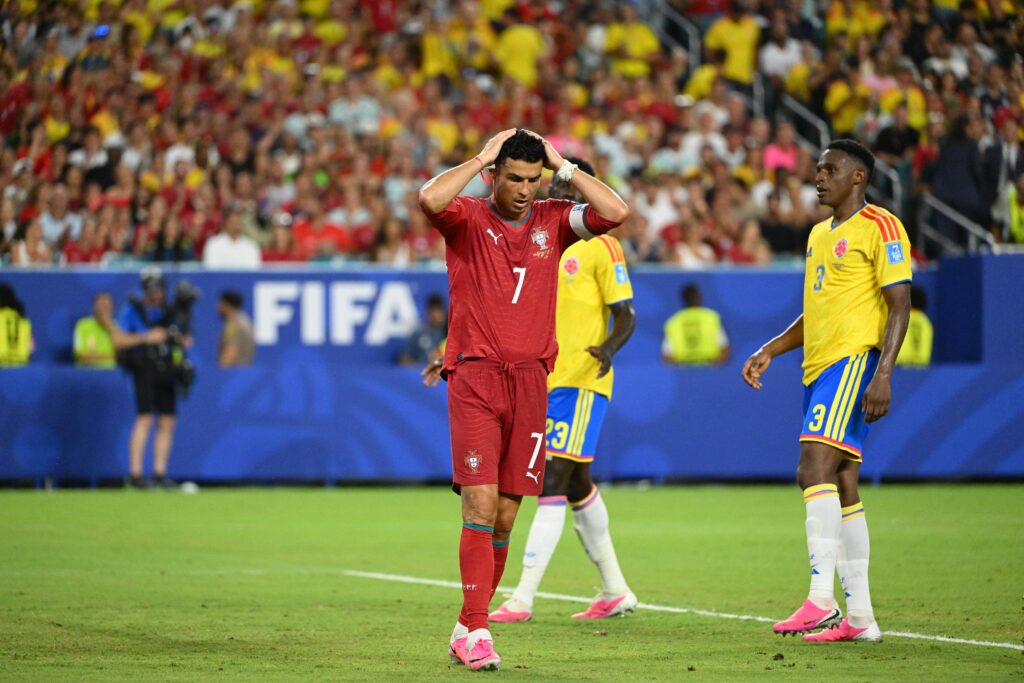
Cristiano Ronaldo has spent two decades bending football to his will, yet the World Cup, the stage he craved most, has stubbornly refused to fall in line.
Cristiano Ronaldo has spent two decades bullying scoreboards and bending elite competitions to his will, yet the World Cup, the one trophy he craved above all, has slipped through his fingers for the final time.
A legend with one missing piece
By almost any measure, Ronaldo’s international career is as complete as a footballer can dream of. He is men’s football’s most-capped player, with 233 appearances for Portugal, and the leading international goalscorer, sitting north of 140 goals.
He delivered his country’s first major trophy at Euro 2016 and followed it up with two UEFA Nations League titles, proving that he could carry Portugal to silverware and not merely star in glamorous club sides.
Yet for all that, the World Cup has remained stubbornly out of reach. Across six tournaments from 2006 to 2026, a joint record for a male player, Ronaldo has never gone beyond the semi-finals and will now retire from the competition without so much as a final appearance.
In a career defined by relentless winning, it is a curious blind spot that will forever colour discussions about his legacy on the international stage.
Numbers that flatter and underwhelm
On paper, Ronaldo’s World Cup statistics are hardly poor. He finishes with 27 appearances, 11 goals and two assists, becoming the first man to score at six different World Cups and averaging a goal roughly every two full matches.
He is also Portugal’s leading scorer at the tournament, having moved past Eusebio’s long-standing mark, and trails only Lionel Messi for World Cup games played.
Scratch beneath the headline numbers, though, and it is easy to see why his World Cup record feels underwhelming for a player of his standing. Ronaldo scored in every group stage from 2006 to 2022 and then twice more in 2026, but the goals dried up once the stakes rose; until his late-career penalty in 2026, every one of his World Cup strikes had come before the knockouts.
For a forward known for decisive moments in Champions League finals and title run-ins, that lack of impact in the sharp end of World Cups is difficult to ignore. Even his peaks came in short, explosive bursts rather than sustained dominance.
The standout performance remains his hat-trick against Spain in the group stage of Russia 2018, a complete showcase of his skillset that dragged Portugal to a 3–3 draw. Beyond that night in Sochi, however, there are few World Cup matches where Ronaldo truly felt like the tournament’s main character in the way he so often did for his clubs.
Six tournaments, one repeating story
Ronaldo’s World Cup story began in Germany in 2006, when he was still a wiry winger learning his trade under Luiz Felipe Scolari. He scored his first World Cup goal from the penalty spot against Iran and helped Portugal reach the semi-finals, only to fall short against France and then miss out on the bronze medal against Germany.
It felt, at the time, like the start of multiple deep runs on the biggest stage. Instead, what followed across 2010, 2014 and 2018 was a pattern of group-stage goals followed by early exits. Portugal were beaten in the last 16 by Spain in South Africa and by Uruguay in Russia, and they bowed out in the group phase in Brazil, their campaign undone by a combination of fatigue, injuries and a heavy opening defeat to Germany.
In each tournament, Ronaldo found the net once in the groups, or four times in 2018, only for the team to fall short before the business end of the competition. Qatar 2022, where he made history by becoming the first player to score in five different World Cups, brought no change to the broader script.
Portugal’s campaign ended in the quarter-finals against Morocco, with Ronaldo reduced to a substitute and leaving the pitch in tears after Youssef En-Nesyri’s towering header sent the African side through. The sense of unfinished business with the tournament only deepened.
By the time 2026 came around, the narrative had hardened. Ronaldo, now in his forties and playing his club football in Saudi Arabia, had already confirmed this would definitely be his last World Cup, speaking openly about closing his international chapter on North American soil. He arrived not as the unstoppable force of a decade earlier, but as a veteran trying to squeeze one last moment of glory out of the competition that had eluded him.
The final act: Spain slam the door shut
In the end, his farewell could hardly have been crueller. Portugal’s 2026 campaign never quite caught fire, and after edging their way out of the expanded group phase and into the knockouts, they ran into Spain in the round of 16 in Dallas. It was a tight, tense affair with few chances, but one that still seemed to invite the possibility of late drama written in Ronaldo’s name.
Instead, it was Spain’s Mikel Merino who provided the decisive moment, arriving in stoppage time to smash one past Diogo Costa and send Portugal home. Ronaldo, who had twice tested Unai Simon earlier in the match and carried as much threat as anyone in green and red, finished his last World Cup game without a goal and without a trophy.
As he left the pitch in tears, the cameras followed his every step, capturing a goodbye that felt both deeply personal and strangely inevitable. In the aftermath, Ronaldo spoke of leaving with a clear conscience, pointing to Euro 2016 as a trophy of equal weight and insisting that he had given everything he could at this level.
The numbers back him up to a degree; he became the first man to score in six World Cups and, in 2026, finally broke his personal knockout duck by converting a penalty in the previous round. Yet the brutal simplicity of the World Cup’s honours list remains: Cristiano Ronaldo, six tournaments, zero titles.
Why the World Cup never fit
So why did a player so ruthless in the Champions League, in league campaigns across three countries and in other international tournaments, never quite bend the World Cup to his will? There is no single answer, but several threads intertwine.
Firstly, Portugal were rarely outright favourites. For all their talent, they entered most tournaments a step behind the likes of Spain, Germany, Brazil, Argentina or France. Unlike at club level, where Ronaldo spent his peak years in squads stacked with elite players at Manchester United, Real Madrid and Juventus, he often carried a heavier share of responsibility for Portugal, especially in the earlier tournaments.
Secondly, timing matters. By the time Portugal’s golden supporting cast truly blossomed, with the likes of Bernardo Silva, Bruno Fernandes and Joao Felix taking central roles, Ronaldo was already past his physical peak.
In Qatar and again in North America, the question hung over every line-up: were Portugal stronger with or without him starting? That debate never fully resolved, and it meant that his final World Cups were played amid tactical compromise and intense scrutiny of every touch.
Finally, the nature of the World Cup itself played a part. In club football, Ronaldo could afford off days; over 38 league games or a two-legged tie, his sheer volume of shots and chances tended to level things out. In a World Cup knockout, where one bad half can send you home, the margins are slimmer and narratives harsher. Ronaldo’s ability to rise to those moments in club football is unquestioned, but on this particular stage, the decisive moments never quite aligned for him.
Legacy: failure, flaw, or footnote?
The temptation with great players is to turn every missing medal into a defining stain, to reduce entire careers to a single “but”. For Ronaldo, the World Cup-shaped hole in his trophy cabinet will inevitably be used as a stick to beat him with in comparisons, particularly with Lionel Messi, whose 2022 triumph in Qatar provided the neat conclusion storytellers crave.
Yet it is worth remembering that football history is full of legends who never lifted this particular trophy. George Best, Alfredo Di Stefano and Johan Cruyff never did; Eusebio, whose World Cup feats Ronaldo ultimately surpassed numerically, also fell short of the title.
The World Cup is not a fair test of individual greatness so much as a short, brutal tournament that demands form, fitness, luck and the right supporting cast all at once.
What makes Ronaldo’s case feel different is not just the absence of a winner’s medal, but the sense that he never quite owned a World Cup in the way he did other competitions. Aside from that unforgettable night against Spain in 2018, there is no single tournament where he was unquestionably the main story, no golden boot, no knockout run where he seemed to drag Portugal along by sheer force of will.
Even so, his records will stand for years. First man to score in six World Cups, most appearances by a European player, Portugal’s leading scorer and appearance-maker; these are not footnotes. They ensure that, while the trophy eluded him, his name is deeply written into the competition’s history.
The curious blind spot of an all-time great
In the end, Cristiano Ronaldo’s World Cup career is best viewed not as a failure but as a flaw, a conspicuous gap in an otherwise overflowing CV. He dominated the Champions League, reshaped scoring records across Europe’s top leagues and delivered for Portugal in other major tournaments, yet never quite found the same ruthless rhythm when the World Cup anthem played.
For some, that will always be the deciding detail in any argument about where he ranks among the game’s immortals. For others, it will sit alongside his achievements as a reminder that even the most relentless winners cannot control every variable, that football’s biggest stage still has a mind of its own.
What is certain is that the image of Ronaldo walking away in Dallas, eyes wet, shoulders heavy, without a crown but with a catalogue of records, will live long in the memory. It was a farewell that summed up his World Cup journey in one shot: immense effort, undeniable presence, and just enough missing to leave you wondering what might have been.